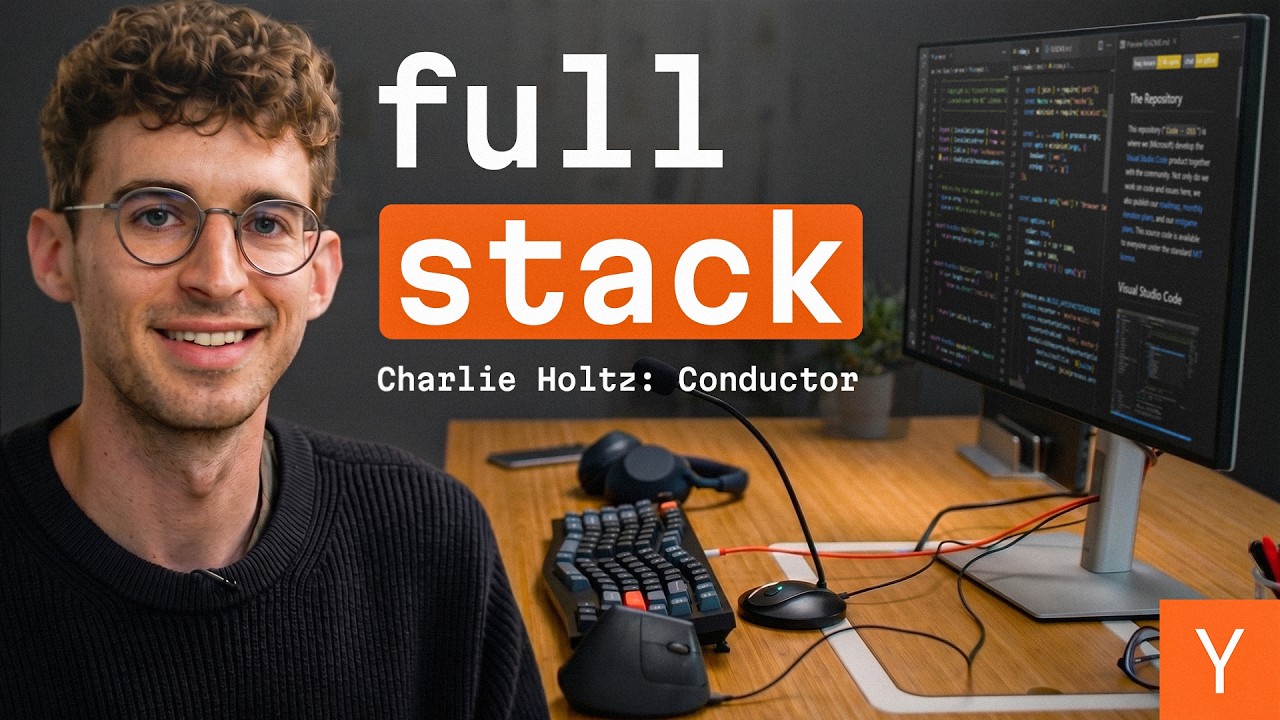
Charlie Holtz, co-founder and CEO of Conductor, shares insights into how he sets up and uses his team of AI agents to streamline software development. Conductor is an app designed to orchestrate multiple coding agents on a Mac, enabling users to manage and automate coding tasks efficiently. Charlie emphasizes his reliance on a simple $20 gooseneck microphone to communicate quietly with AI agents like Claude, especially in an open office environment, allowing him to issue commands and review code with minimal disruption. He frequently uses keyboard shortcuts to initiate new tasks, review pull requests, and provide feedback, highlighting a workflow deeply integrated with AI assistance.
A key feature Charlie demonstrates is the use of “cloud workspaces,” which allow him to start and manage multiple coding projects simultaneously. He experiments constantly by kicking off new workspaces to test ideas, many of which never make it to production but help refine the product. He also showcases the mobile capability of Conductor, where he can speak commands into his phone to trigger coding tasks remotely. While he rarely writes code manually, he occasionally uses a “caveman mode” for direct file edits, preferring to let AI handle most changes based on his verbal or written instructions.
Charlie discusses the technical stack behind Conductor, which primarily uses TypeScript for the desktop app, Elixir for the web app, and Rust for backend components. He stresses the importance of human oversight in the development process, maintaining “slot free zones” in the codebase that are strictly human-written to prevent AI from perpetuating bad code. This balance ensures quality and prevents a negative feedback loop of AI-generated errors. He also shares his philosophy on UI design, emphasizing crafted, thoughtful interfaces rather than letting AI dictate architectural or design decisions.
Regarding AI models, Charlie differentiates between Claude and Codex, using Claude for more creative, conversational tasks and Codex for focused, tool-heavy problem-solving. He explains that Conductor enforces a structured workflow where all changes go through pull requests rather than direct file edits, ensuring code quality and review. He also highlights the importance of token management, revealing that early on, he spent significant amounts on AI tokens but now focuses on efficient, high-quality output rather than sheer volume of code.
Finally, Charlie reflects on the future of AI-assisted software development, envisioning a collaborative environment where humans act as conductors of AI “orchestras,” guiding multiple agents working in unison. He believes code is becoming a byproduct of well-crafted prompts and that software will increasingly resemble modifiable platforms, similar to video games with customizable skins and features. This vision underscores the evolving role of developers from coders to prompt engineers and orchestrators, shaping how AI and humans will co-create software in the years ahead.