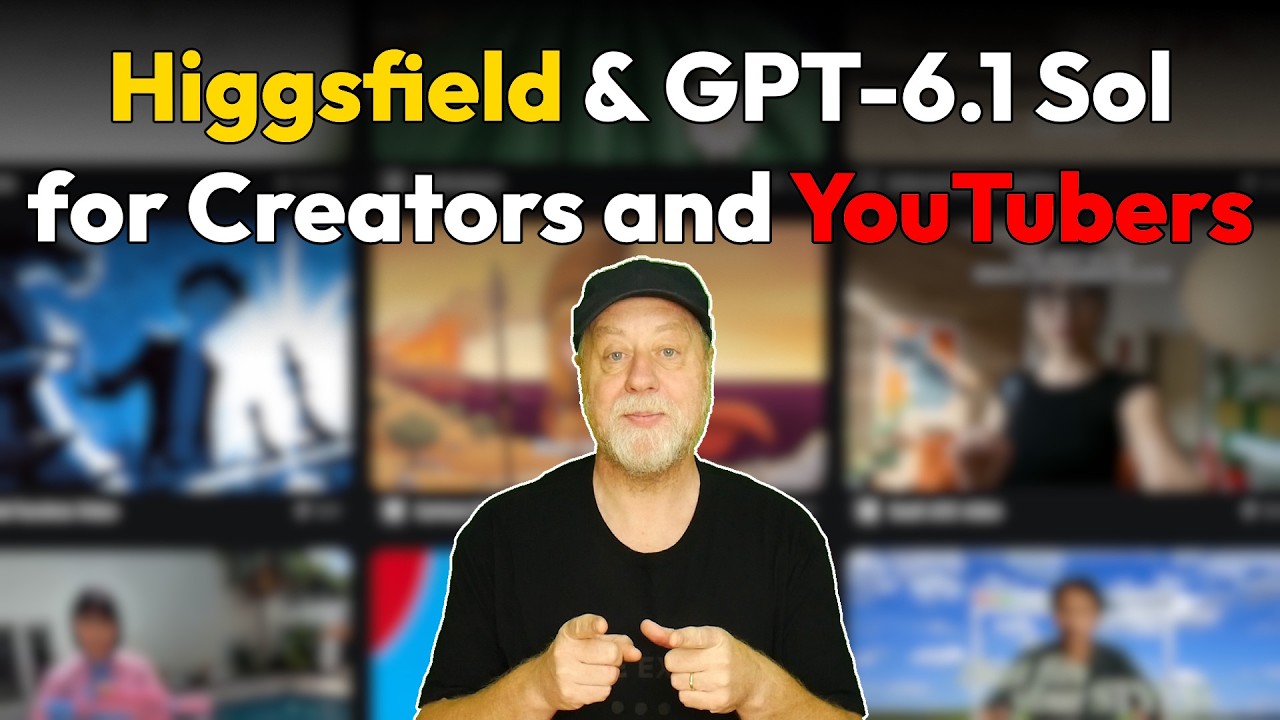
The video introduces Higgsfield, a sophisticated AI tool designed to craft visual experiences rather than merely generate images or videos. Unlike typical automated generators, Higgsfield offers a comprehensive creative toolkit capable of tasks such as inpainting, relighting, face swapping, and advanced video editing features including motion transfer, object swapping, lip syncing, and even transforming drawings into videos. This versatility makes it a powerful engine for serious creative work across various media formats.
The presenter explains how pairing Higgsfield with GPT 6.1 Sol, an upgraded version of GPT 6 Sol with enhanced research capabilities and factual accuracy, creates a robust creative tool. There are two main ways to integrate these technologies: directly within the Higgsfield supercomputer environment or through a Higgsfield plugin inside ChatGPT. This integration allows users to generate and manipulate media assets seamlessly, such as creating textures or models for game development, with GPT 6.1 Sol assisting in the creative and research process.
Demonstrating the workflow, the presenter uses the Higgsfield supercomputer to select GPT 6.1 Sol and inputs a simple prompt to create an editorial motion graphics video explaining how large language models work. The system interacts by asking clarifying questions, such as the desired video length, and then generates a script for approval. Once approved, Higgsfield produces all video elements, including voiceover and background visuals, showcasing the ease and editorial control users have over the creative output.
The resulting video effectively explains the inner workings of large language models using clear, minimalistic motion graphics that complement the narration without distraction. Visual elements like shuffling cards represent token prediction, illustrating concepts such as tokenization, embeddings, transformer attention, and the probabilistic nature of language generation. The presenter appreciates the balance between simplicity and informativeness, highlighting how the video visually supports the explanation without overwhelming the viewer.
In conclusion, the video emphasizes Higgsfield’s capability to handle diverse media generation tasks and how its combination with GPT 6.1 Sol forms a powerful tool for businesses, creative professionals, and hobbyists alike. The integration enables sophisticated, customizable content creation that goes beyond basic automation, fostering creativity and precision. Viewers are encouraged to try Higgsfield and GPT 6.1 Sol together via a provided link, underscoring the potential of this AI partnership for innovative media production.