Stephen Wolfram explains that our understanding of reality is fundamentally shaped by the nature and limitations of observers, meaning that concepts like space, time, and physical laws depend on how we process information and the scale at which we observe the universe. He suggests that different kinds of observers—whether biological, computational, or operating at different scales—would perceive order, randomness, and even the laws of physics differently, highlighting the profound impact of perspective on science and cognition.
Stephen Wolfram discusses how the nature of observation and the characteristics of observers fundamentally shape our understanding of reality. He explores the idea that our perception of space, time, and physical laws is deeply influenced by our scale and the way our minds process information. For example, our ability to think about an “instantaneous state of space” is tied to the speed at which we process information relative to the distances we observe. If we operated at vastly different scales or speeds—like much larger brains or faster computers—our scientific frameworks and intuitions might be radically different.
Wolfram introduces the concept of the “heat death” of the universe as an example of how observer perspective matters. From our current viewpoint, the eventual random motion of molecules appears as a loss of order—entropy increasing until only heat remains. However, he points out that this randomness is only apparent because of the limitations of our observational techniques. The information about the universe’s past is still encoded in the molecular motions, just in a way that seems random to us. A different kind of observer, perhaps with the ability to track individual molecules, might see intricate patterns and correlations where we see only chaos.
He extends this idea to biology, contrasting the traditional chemical view—where molecules randomly collide—with the more orchestrated reality of biological systems. In biology, molecules are often carefully guided and interact in highly specific ways, which is not captured by the simplistic view of random molecular motion. Wolfram suggests that what we notice or ignore as observers is crucial for understanding the foundations of biology. The “biological observer” is attuned to detailed molecular configurations, unlike the typical human observer.
Wolfram also reflects on the vastness of the universe and our relative scale within it. He notes that while we are already tiny compared to the universe, we are even more minuscule relative to the “rulial space”—a conceptual space of all possible rules or computations. Our position in both physical and rule-based spaces limits what we can perceive and understand. He argues that at different scales, the laws of physics and what we consider important would change, and that it’s easier to imagine these differences when thinking about physical scale than about more abstract computational scales.
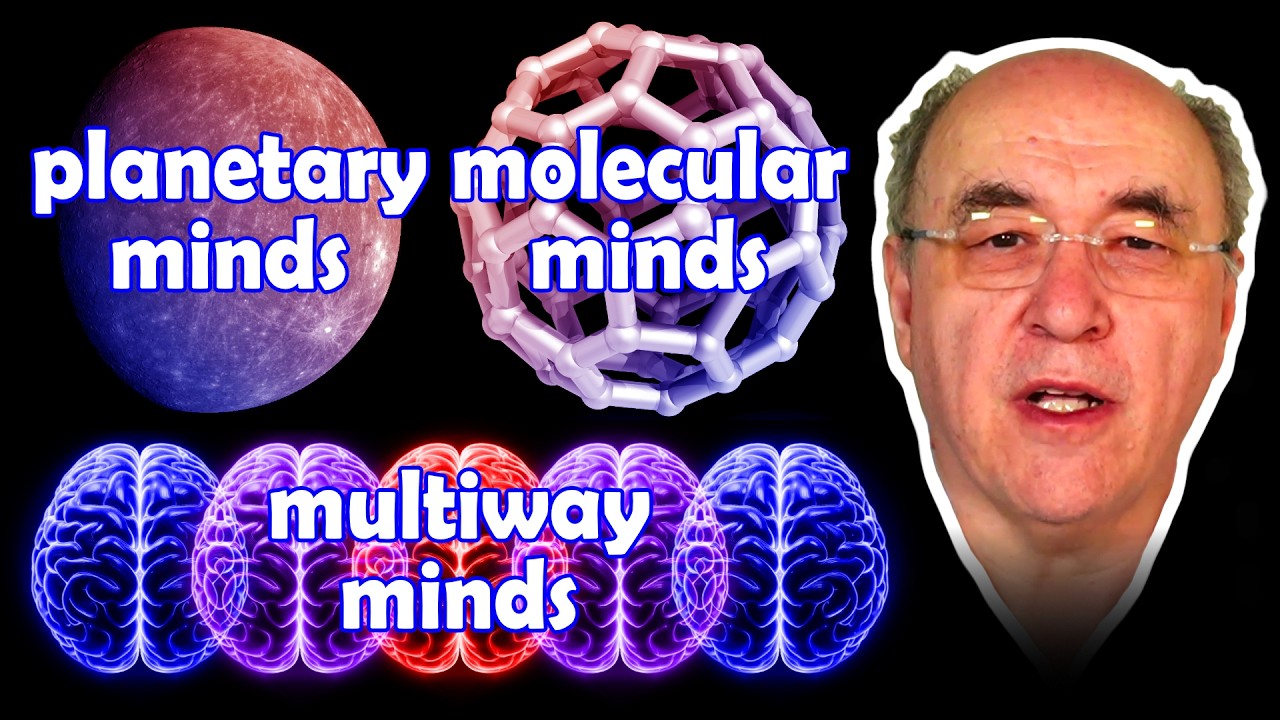
Finally, Wolfram considers the challenge of holding multiple threads of experience or history in our minds simultaneously—a “multi-way trance.” Our normal experience is linear, following a single thread of thought, but he speculates about the possibility of minds (or computers) that could operate in parallel, experiencing multiple histories at once. This is analogous to the difficulties faced in distributed computing, where managing many parallel processes is complex. Wolfram suggests that insights from his physics project may help develop new ways of thinking and technology that make parallel thought more accessible, but acknowledges that this remains a significant challenge for human cognition.