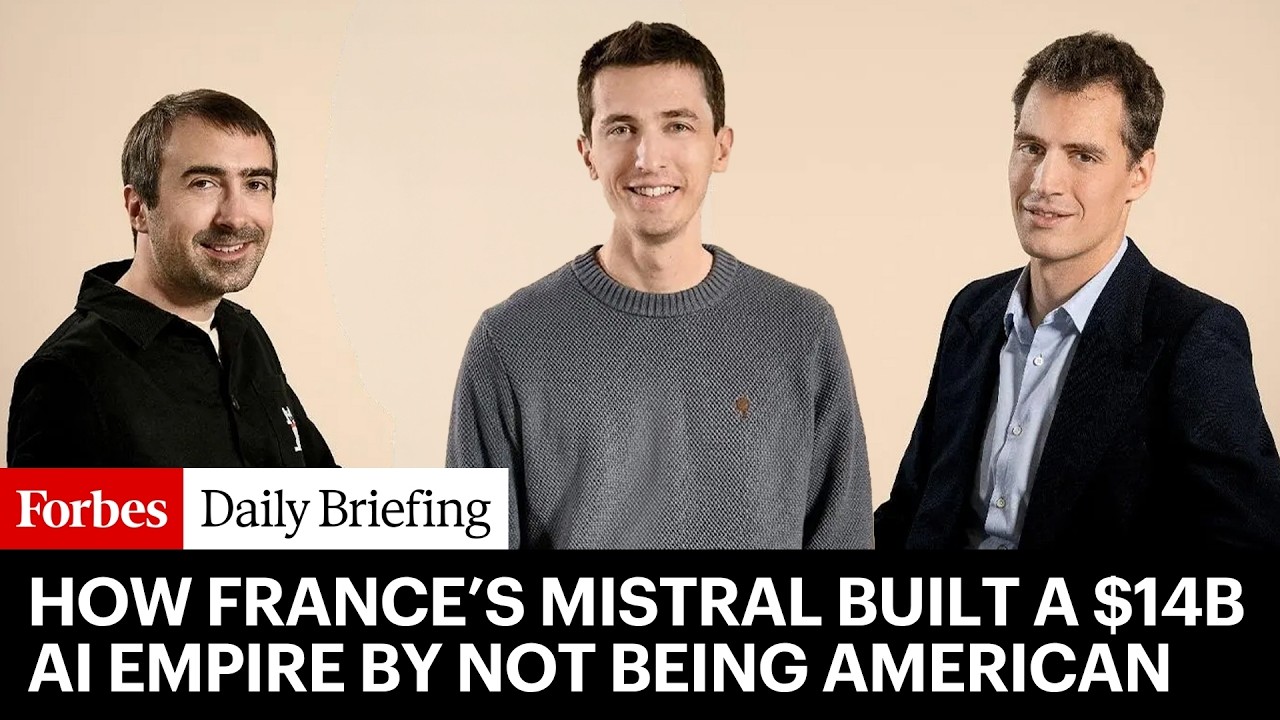
France’s AI company Mistral, led by co-founder and CEO Arthur Mensch, has built a $14 billion empire by emphasizing independence from American tech giants. At the AI Action Summit in New Delhi, Mensch presented a vision of AI as a tool for empowerment rather than dominance, advocating for global control over AI technology rather than reliance on Silicon Valley. Mistral distinguishes itself by offering open-weight AI models, which allow customers to customize, run offline, and maintain control over their data, a stark contrast to the closed-source models of American competitors like OpenAI and Anthropic.
Mistral’s approach resonates particularly well with European firms and governments, who are increasingly wary of dependence on American technology amid geopolitical tensions and trade conflicts. For example, Germany is moving away from Microsoft Office for official use, and France is developing its own alternatives to popular American software. Mensch highlights that Mistral’s open stack enables businesses to build core automation and products securely, with data remaining within their own offices or countries, addressing concerns about sovereignty and data privacy.
Despite its promising vision, Mistral faces significant challenges in AI performance. Its models lag behind those of American and Chinese competitors, including Anthropic’s Claude and Chinese companies like DeepSeek and Alibaba. These rivals benefit from larger funding pools and, in the case of Chinese firms, alleged methods of training models by leveraging American AI outputs. Mistral has raised $3.1 billion, including investments from French institutions, but still trails in benchmark rankings, making it an underdog in the fiercely competitive AI landscape.
Nevertheless, Mensch and his team believe that a smaller, more affordable European AI model is better suited for governments and global companies that prioritize security and independence over sheer computational power. Investors like Jeannette zu Fürstenberg of General Catalyst emphasize the risks Western companies face when relying on Chinese AI models, reinforcing Mistral’s strategic positioning. This approach has yielded $200 million in revenue in 2025, with projections of reaching $80 million in monthly revenue by the end of the year, although the company has yet to turn a profit due to high operational costs.
Mistral’s story highlights a broader trend in the AI industry: the desire for technological sovereignty and control beyond the dominant American and Chinese players. As Mensch puts it, Mistral aims to be at the top of the “independence leaderboard,” offering a compelling alternative for those seeking secure, customizable AI solutions. For more detailed coverage and the latest rankings of AI companies, Forbes’ Ian Martin provides further insights in his recent article.