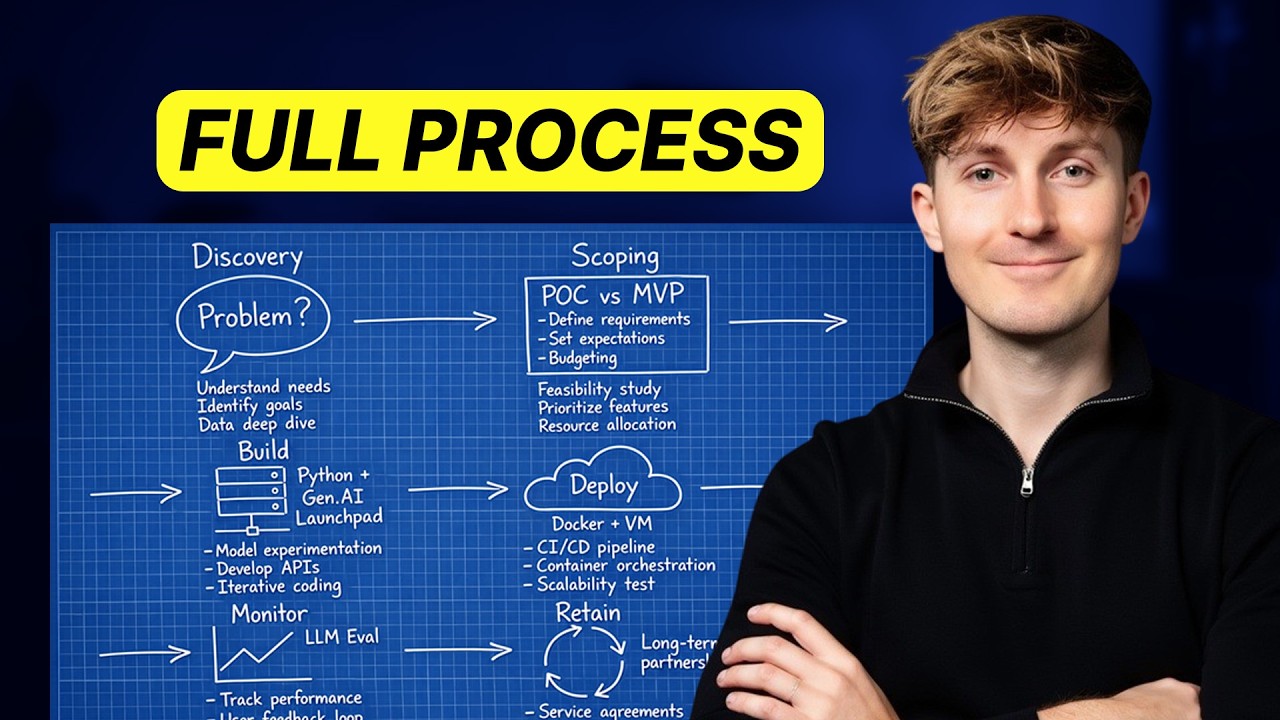
In this video, Dave Ablar, an experienced AI engineer and founder of Data Luminina, shares a comprehensive overview of how his company builds and deploys custom AI solutions for clients. He begins by outlining the importance of the discovery phase, emphasizing the need to deeply understand the client’s real problems and focus on high-impact, simple use cases with clear ROI. Dave stresses that many organizations overlook low-hanging fruit that can be automated, and he highlights the necessity of honest conversations about project scope, success criteria, and the realistic impact of AI solutions.
The process starts with a discovery call, where Dave and his team evaluate potential projects by assessing their simplicity, repeatability, and the clarity of success and failure rules. He discusses the importance of managing client expectations, especially regarding the accuracy of AI models. Typically, initial builds achieve 70-80% accuracy, improving to 90% with iteration, but rarely reach 99% immediately. Dave advises framing development as an iterative process and ensuring clients are prepared to be involved, particularly when domain expertise is required for evaluation and feedback.
Scoping and prioritization are critical steps, where the team creates detailed proposals that define what the solution will and will not do. Projects are categorized as either proof of concept (to demonstrate feasibility) or minimum viable product (to deliver tangible value). Dave explains their sprint-based approach, usually working in two-week cycles priced between €10,000 and €20,000, and highlights the importance of planning for gaps between sprints due to client delays. He also notes the significance of including ongoing costs and maintenance in proposals, as these are often overlooked by beginners.
On the technical side, Dave’s team uses a standardized stack centered on Python, FastAPI, Celery, PostgreSQL, and self-hosted Supabase, with Azure OpenAI for LLM integration. Their GenAI Launchpad framework allows for rapid, consistent project setup and deployment. For frontend needs, they use Next.js and Supabase authentication. Testing and evaluation are rigorous, with unit tests, integration tests, and LLM evaluations built into the workflow. Monitoring and observability are handled with Langfuse for LLM traces and Sentry for error tracking, ensuring robust oversight of deployed solutions.
Finally, Dave discusses the changing economics of AI-assisted development, noting that while traditional time-based pricing models are still prevalent, the speed and efficiency gains from AI tools allow his company to deliver much more value in less time. He advocates for building long-term client relationships, focusing on recurring sprints and maintenance contracts for predictable revenue. Dave concludes by encouraging aspiring freelancers and developers to standardize their processes and tech stacks, adapt to evolving AI technologies, and focus on delivering consistent, high-quality solutions. He also briefly promotes his paid programs for those seeking more structured guidance.