The video discusses how the creator built a personal AI assistant to help manage and streamline their content creation process. Having previously developed AI agents for startups, the creator decided to build a tool for themselves to organize and utilize their scattered marketing materials, YouTube videos, articles, and analytics. The motivation was to have an assistant that could provide targeted feedback, generate content ideas, and maintain a consistent personal voice across different platforms, something that generic tools like ChatGPT struggle to achieve without extensive prompting and context management.
The core of the assistant is a Next.js application using TypeScript, integrated with Vercel’s AI SDK and Quadrant as the vector database. The assistant leverages retrieval-augmented generation (RAG) to search through thousands of the creator’s articles, posts, and business documents. By chunking and encoding these materials into a vector database, the AI can semantically search and retrieve relevant content, ensuring that generated outputs reflect the creator’s unique style and experiences rather than sounding generic.
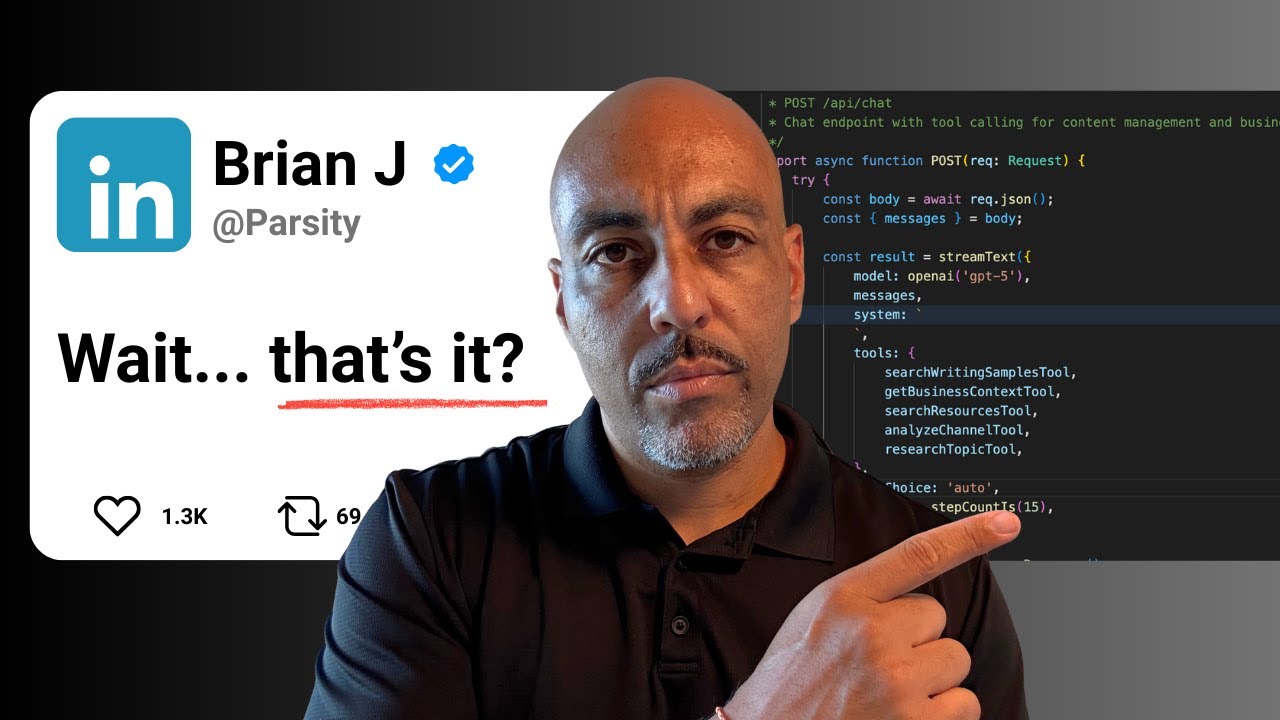
Several specialized tools or functions are built into the assistant, each accessible by the large language model. For example, the “search writing samples” tool retrieves relevant past writings to inform new content, while the “analyze channel” tool reviews recent YouTube analytics to suggest topics based on performance trends. There’s also a “research topic” tool that scans YouTube for trending subjects related to the creator’s interests, helping to identify new content opportunities. These tools are defined with schemas that guide the AI on when and how to use them.
The video emphasizes that much of the complexity is abstracted away by modern SDKs, making the process of building such an agent more about defining useful tools and providing the right context, rather than constructing the agent itself. The creator notes that most of the development effort goes into building these tools and integrating them with the AI, which then autonomously decides which tools to use based on the user’s queries. The assistant is designed to be practical and easy to interact with via a chat interface, providing actionable insights and content suggestions tailored to the creator’s needs.
Finally, the creator mentions experimenting with different frameworks and patterns, such as LangGraph for more deterministic function calling and the router pattern for simplicity. They have open-sourced the project, encouraging viewers to clone, adapt, or reverse-engineer it for their own use. The video concludes with advice to start with simpler patterns before exploring more advanced agent architectures and invites viewers to share their own experiences building AI agents.