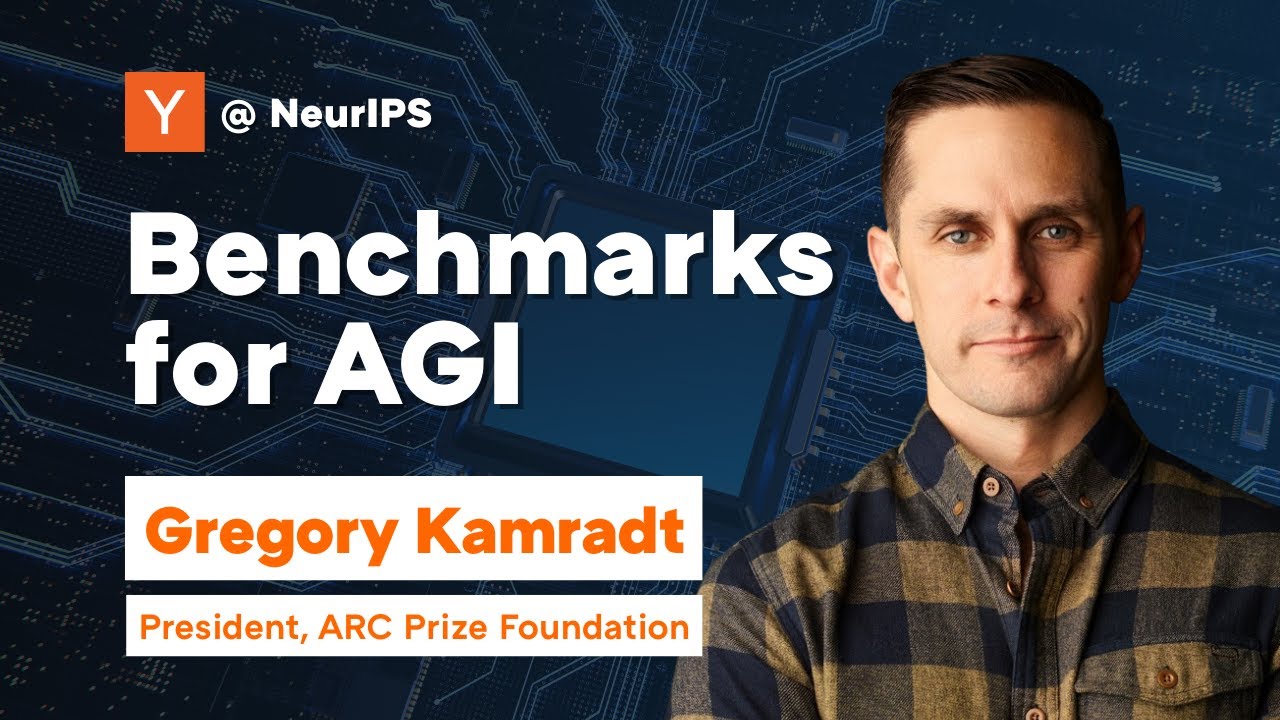
In this insightful discussion, Greg Camrad, president of the Ark Prize Foundation, explains the foundation’s mission to advance open progress toward systems capable of generalizing like humans. The Ark Prize focuses on a unique and opinionated definition of intelligence, inspired by Francois Chollet’s 2019 paper, which defines intelligence as the ability to learn new things efficiently. Unlike traditional benchmarks that measure performance on increasingly difficult tasks, the Ark Prize emphasizes the capacity to learn novel skills, reflecting a more human-like understanding of intelligence.
The conversation highlights the ARC benchmark, developed by Chollet, which tests both humans and machines on their ability to learn new tasks. While AI models have achieved superhuman performance in specific domains like chess and Go, they struggle with generalizing to new, unseen problems. Early large language models performed poorly on the ARC benchmark, scoring around 4-5%, but recent advances, such as OpenAI’s GPT-4 and other frontier models, have significantly improved performance, reaching over 20%. This progress underscores the importance of reasoning paradigms in advancing AI capabilities.
Greg also discusses the limitations of current AI evaluation methods, cautioning against overreliance on reinforcement learning environments and vanity metrics that may not reflect true generalization. He stresses the importance of developing systems that can generalize without needing tailored environments for every task, much like humans do. This perspective aligns with the Ark Prize’s goal of fostering genuine progress toward artificial general intelligence (AGI) rather than incremental improvements on narrow benchmarks.
The evolution of the ARC benchmark is another key topic. Starting with ARC 1 in 2019, followed by ARC 2 in 2025, the foundation is now preparing ARC 3, which introduces interactive, game-like environments. Unlike previous static tests, ARC 3 requires AI systems to interact with environments without explicit instructions, mimicking real-world learning through trial and error. This new benchmark will measure not only accuracy but also efficiency, comparing the number of actions AI takes to solve tasks against human performance, thereby providing a more holistic assessment of intelligence.
Finally, Greg reflects on the implications of a hypothetical AI model achieving a perfect score on the ARC AGI benchmark. While such an achievement would be groundbreaking and provide strong evidence of advanced generalization, it would not alone confirm the arrival of true AGI. The Ark Prize views solving ARC as a necessary but not sufficient condition for AGI. The foundation aims to continue guiding research and understanding to be prepared to recognize and declare AGI when it truly emerges, emphasizing ongoing analysis and collaboration with leading AI teams.