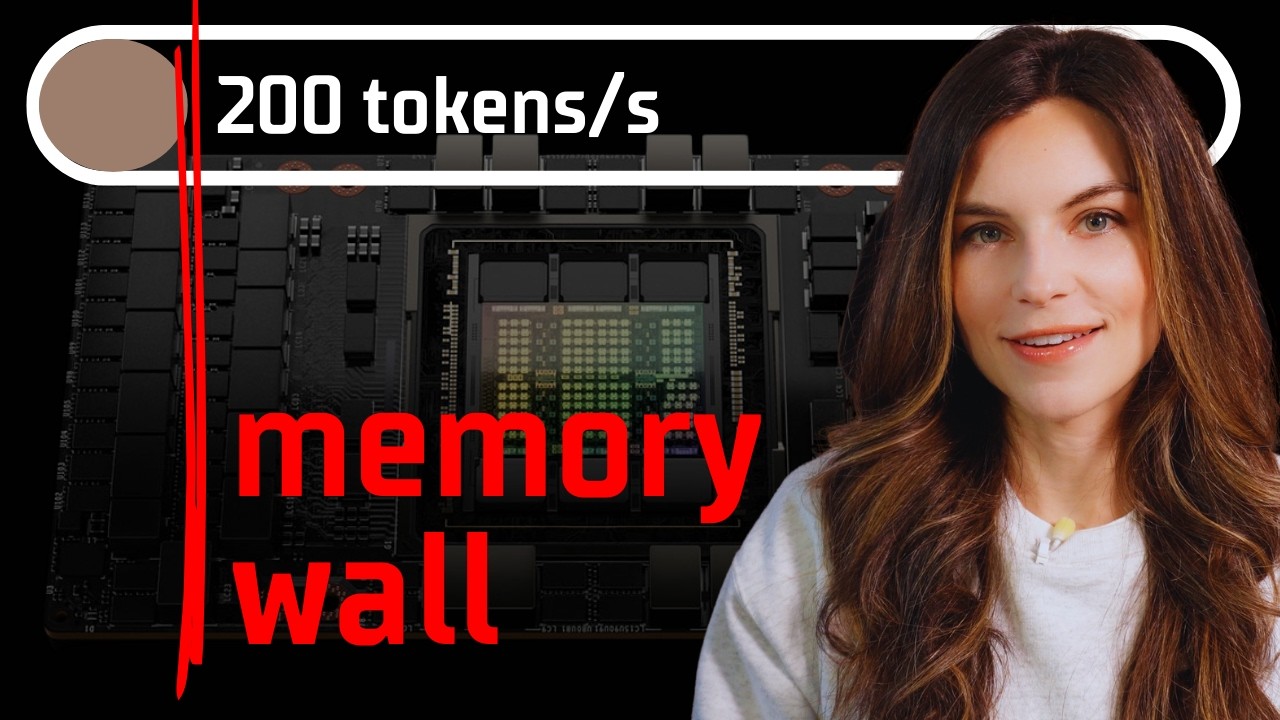
The video explores how hardware limitations, particularly memory bandwidth, are shaping the design and optimization of large language models (LLMs). While modern GPUs like the NVIDIA H100 boast immense computational power—up to one quadrillion floating point operations per second—the actual throughput for LLM inference is much lower than theoretically possible. This discrepancy is primarily due to the “memory wall,” where improvements in memory speed and capacity have lagged behind advances in compute power. As a result, transferring model weights from high-bandwidth memory (HBM) to the processor becomes the main bottleneck, especially for auto-regressive LLMs that require a full model pass for each generated token.
To address this bottleneck, the industry has implemented various engineering optimizations. One key technique is batching, where multiple user queries are processed in parallel, allowing the expensive transfer of model weights to be amortized across several outputs. Continuous batching, or iteration-level scheduling, further improves efficiency by dynamically reconfiguring batches as responses are completed. However, the size of the key-value (KV) cache, which stores activations for each token, limits how large batches can be, as it consumes significant memory bandwidth and capacity.
Beyond system-level optimizations, algorithmic innovations are being explored to further improve inference speed. Speculative decoding is one such approach, where a smaller, faster draft model generates candidate tokens, and the larger model acts as a verifier, processing multiple tokens in parallel when possible. This reduces the number of heavy forward passes required by the large model, but requires careful balancing to avoid wasted computation if the draft model’s predictions are frequently incorrect.
A more radical shift is the adoption of diffusion-based LLMs, which generate entire drafts of responses in parallel and iteratively refine them, rather than producing one token at a time. This paradigm increases arithmetic intensity and better utilizes GPU compute resources, moving inference from being memory-bound to compute-bound. However, early diffusion models suffered from inefficiencies, such as wasted computation on low-confidence tokens and unnecessarily large context windows, prompting further research into selective decoding and dynamic window sizing.
The industry is now converging on hybrid approaches like block diffusion, which combines the strengths of both diffusion and auto-regressive models. In block diffusion, tokens are grouped and refined in blocks using diffusion, while blocks themselves are processed sequentially, enabling early stopping and compatibility with existing optimizations like KV caching. These advances, along with other techniques such as distillation, mixture of experts, and quantization, are collectively pushing LLM inference closer to the theoretical limits of modern hardware, overcoming the memory bottleneck and enabling faster, more efficient AI systems.