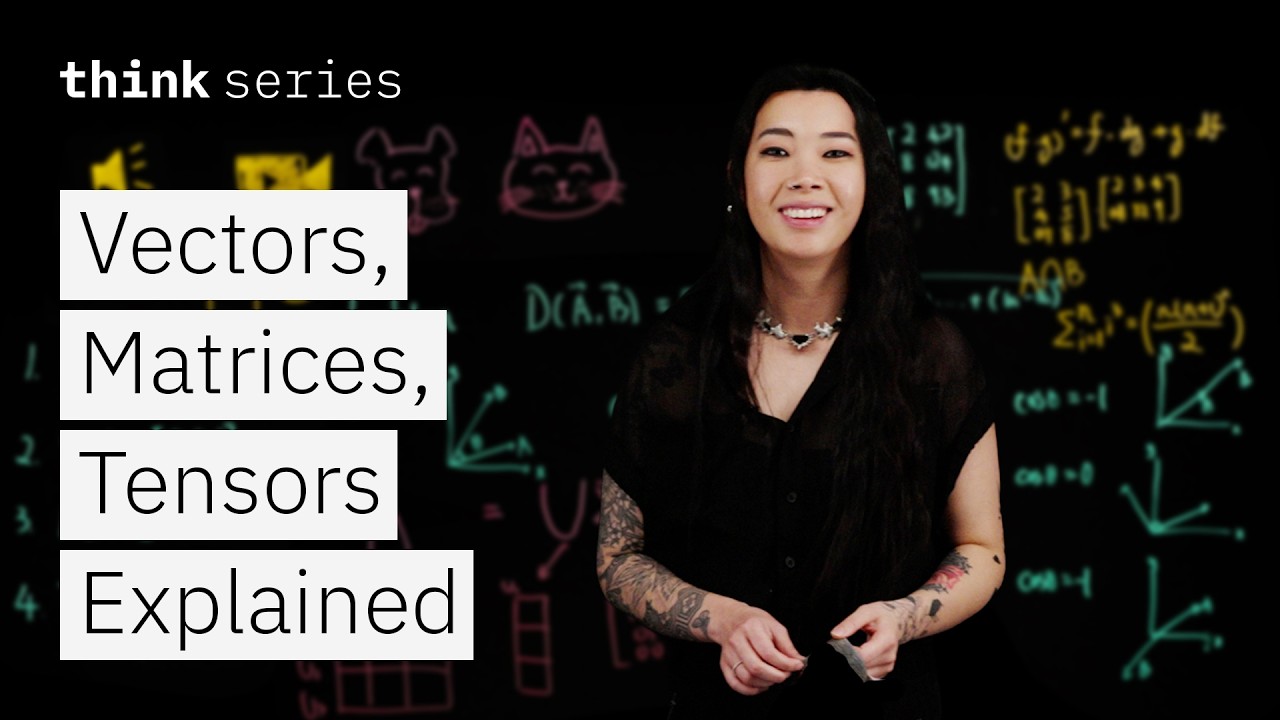
Certainly! Here’s a five-paragraph summary of the video transcript:
Machine learning models, such as those used to distinguish between images of dogs and cats, rely on translating raw data—like images, text, audio, or video—into mathematical representations that computers can process. This translation is made possible by linear algebra, which provides the tools to represent, manipulate, and transform data into a form suitable for computation. For example, an image is converted into a numerical matrix in high-dimensional space, allowing the model to analyze and learn patterns and relationships within the data.
Linear algebra organizes data into four fundamental types: scalars, vectors, matrices, and tensors. Scalars are single numbers, vectors are one-dimensional lists of numbers, matrices are two-dimensional arrays, and tensors generalize these concepts to higher dimensions. These mathematical objects enable computers to process and reason about complex data efficiently, regardless of whether the data is structured, unstructured, or multi-dimensional.
Once data is transformed into these linear algebraic objects, various mathematical operations can be performed to prepare it for machine learning. For instance, text can be tokenized and represented as vectors, capturing semantic meaning. The similarity between two pieces of data can be measured using metrics like Euclidean distance (which calculates the straight-line distance between two vectors) or cosine similarity (which measures the angle between vectors). These metrics help models compare and understand relationships between data points.
Matrix operations, especially the dot product, are central to machine learning and are used extensively in neural networks and advanced models like transformers. However, working with high-dimensional data can be computationally expensive. To address this, dimensionality reduction techniques such as Singular Value Decomposition (SVD) are used. SVD breaks down large matrices into smaller, more manageable components, retaining only the most informative features and discarding less useful information, thus making computations more efficient.
In summary, linear algebra is foundational to machine learning because it transforms raw data into structured numerical forms, enables efficient computation through matrix operations, and supports large-scale optimization. Techniques like SVD further enhance the process by reducing dimensionality and highlighting the most important structures within the data. This mathematical framework is what allows machine learning systems to convert data into actionable intelligence, powering modern AI applications.