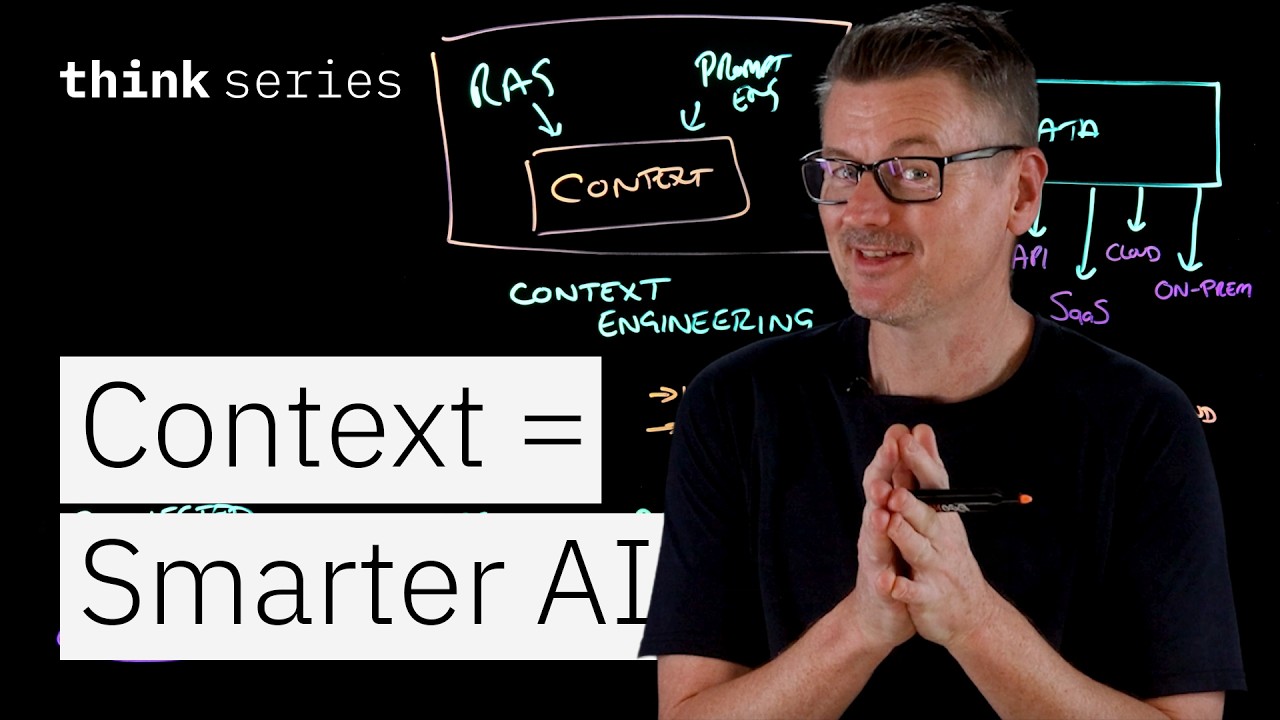
The video discusses one of the biggest challenges in getting AI models to perform effectively: context. While modern AI models demonstrate impressive reasoning and intelligence, they often falter not due to lack of capability but because they lack relevant context. Context engineering is introduced as the practice of providing AI systems with the right data, understanding its meaning, and applying it appropriately within operational and governance constraints. For example, an AI assistant preparing for a client meeting can deliver generic information without context, but with proper context engineering, it can pull in relevant client data, recent issues, and deal history while respecting access permissions, resulting in a much more useful output.
Context engineering involves more than just prompt design or retrieval-augmented generation (RAG); it requires addressing where and how contextual data is sourced. Data relevant to AI models is often scattered across multiple locations—databases, document stores, APIs, cloud platforms, and on-premise systems—with varying structures, update frequencies, and access controls. This makes delivering the right context at the right time a complex infrastructure challenge. The video outlines four essential pillars for effective context engineering: connected access, knowledge layer, precision retrieval, and runtime governance.
Connected access ensures AI can query data where it resides without copying it, preserving freshness and access controls. The knowledge layer adds meaning to raw data by resolving entities, mapping relationships, and incorporating institutional knowledge. Precision retrieval focuses on delivering only the most relevant information filtered by intent, role, time, and policy, avoiding overwhelming the AI with unnecessary data. Runtime governance enforces access permissions and policies live during data retrieval and response generation, ensuring compliance and security.
The video then delves deeper into precision retrieval, highlighting RAG as a popular method for providing external context to AI models. Traditional RAG involves chunking documents, embedding them into vectors, and performing similarity searches to find relevant information. However, more advanced forms exist, such as agentic RAG, where the AI iteratively requests additional data as needed, and graph RAG, which uses graph structures to navigate relationships between entities and documents for more precise context. Additionally, context compression techniques summarize or prioritize information to fit within model context windows, reducing noise and improving relevance.
In conclusion, the video emphasizes that AI model reasoning is no longer the primary bottleneck; rather, the challenge lies in delivering high-quality, relevant context. Systems that combine connected access, knowledge layers, precision retrieval, and runtime governance create contextually intelligent AI capable of making better decisions and producing superior outcomes. Techniques like agentic RAG, graph RAG, and context compression are key tools in building these systems, enabling AI to leverage contextual intelligence effectively and operate with greater precision and reliability.