The video discusses the evolving capabilities of artificial intelligence (AI) and whether humans can keep pace with its rapid advancement. The central thesis is straightforward: AI can become extremely intelligent, surpassing human abilities in many economically valuable tasks, and humans, with their current biological hardware, cannot keep up. The speaker references the concept of the “jagged frontier,” where AI excels in some domains while lagging in others, but this frontier is shifting rapidly. The definition of Artificial General Intelligence (AGI) used here is practical—AI that can perform all economically valuable tasks that humans can do. The video emphasizes that AI is transitioning from a subset of human capabilities to a superset, meaning machines will eventually outperform humans in nearly all tasks.
The speaker introduces six axioms to frame the discussion about the limits and potential of AI intelligence. The first axiom asserts that physics bounds what is computationally possible, and since machines operate within physical laws, their capabilities are ultimately limited by these laws but can still surpass human cognitive abilities. The second axiom highlights the limited time horizon for prediction due to chaos and complexity in systems, meaning no intelligence—human or machine—can predict the future indefinitely. Other axioms address computational complexity, the impossibility of extracting more signal than exists in data, the bandwidth gap between human and machine information processing, and the cognitive horizon, which defines the maximum understanding an agent can possess based on its mental primitives and operations.
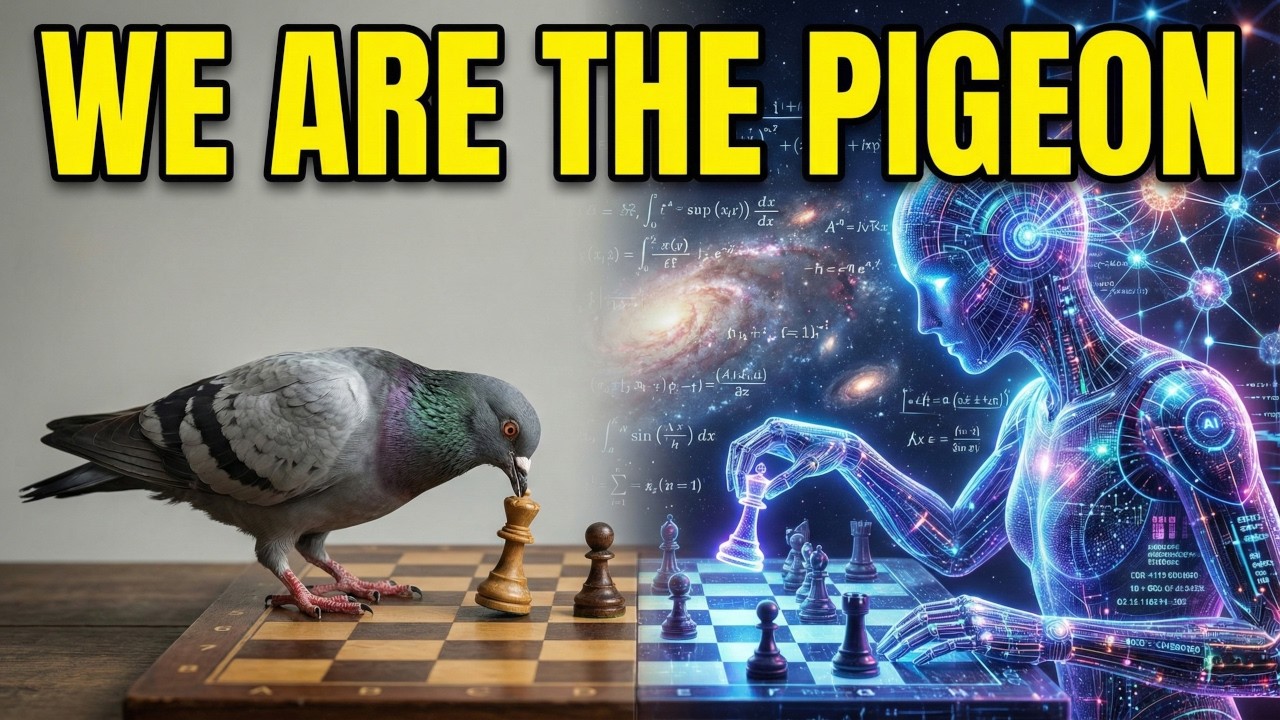
A key insight is that machines will develop cognitive primitives and horizons far beyond human capacity, enabling them to intuitively grasp complex concepts that humans cannot. This leads to what the speaker calls the “pigeon paradox” or the ineffability of machines—just as pigeons cannot understand chess, humans may find many machine insights incomprehensible. Despite this, both humans and machines share the same physical reality, which acts as a grounding factor. Reality provides measurable outcomes that serve as the ultimate test of any intelligence’s claims, such as whether a proposed warp drive actually works or a medical treatment cures disease.
The video also discusses the practical implications of these ideas. While machines may become vastly more intelligent, there are fundamental mathematical and physical limits—such as computational irreducibility and entropy—that impose a ceiling on useful intelligence. Beyond a certain point, increasing intelligence yields diminishing returns, and the focus may shift toward making AI more energy-efficient rather than infinitely smarter. The speaker stresses that this trajectory does not inherently imply that AI will be dangerous or safe; rather, it is a neutral characterization of where technology is headed based on current understanding.
In conclusion, the speaker calls for a broad and open conversation about the implications of AI surpassing human capabilities, noting that the Overton window—the range of acceptable public discourse—has shifted enough to allow this discussion. Recognizing that machines will likely become a superset of human intelligence (M superset H) is crucial for addressing future economic, existential, and societal questions. The video encourages moving beyond skepticism and fear to thoughtfully consider what this new reality means for humanity, emphasizing that while AI’s intelligence may become ineffable to us, the shared reality we inhabit will remain the ultimate arbiter of truth and utility.