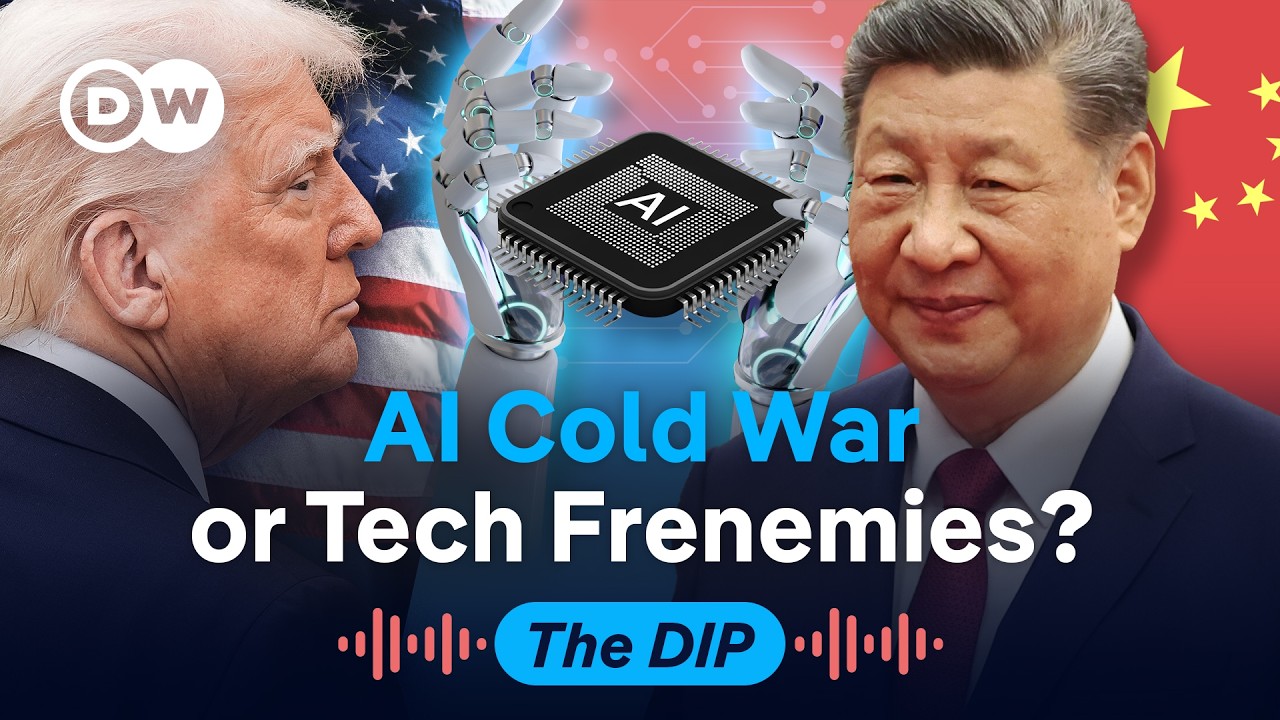
The podcast episode explores the escalating AI competition between the US and China, highlighting the differing approaches, challenges, and global implications of this technological race. While US big tech companies often dominate headlines with concerns about AI risks and calls for regulation, the discussion shifts to how China fits into this landscape. Chinese AI models are noted for their efficiency and widespread integration into daily life, with the government actively promoting AI adoption across sectors. Unlike the US, where skepticism and pushback against AI and data centers are common, China exhibits broader societal acceptance, partly due to government control and strategic emphasis on AI as a productivity tool.
China’s strategy involves leveraging its industrial and technological strengths to scale AI development effectively. This includes powering data centers with renewable energy in resource-rich, less populated regions like Inner Mongolia and Xinjiang, enabling cost-effective and sustainable AI infrastructure growth. Additionally, China is investing in global markets, particularly in developing countries across Africa and Southeast Asia, by offering affordable, adaptable AI models and partnering with local institutions to foster digital ecosystems. This global outreach contrasts with the US approach and reflects China’s ambition to embed its AI standards and technologies worldwide.
Financially, the competition is not just about technology but also about sustainable investment. China is restructuring its financial system to support tech self-reliance amid strategic competition with the US. Despite export controls and chip supply restrictions imposed by the US, China is innovating by redesigning chip technology and building an independent industrial ecosystem to reduce reliance on American technology. This dual approach of acquiring advanced components while fostering domestic innovation underscores China’s long-term commitment to AI leadership without overinvesting prematurely.
The podcast also touches on the geopolitical dimension of AI governance and cooperation. While there have been high-profile meetings between US and Chinese leaders discussing AI safety and regulation, the reality is an ongoing struggle for influence over the global digital economy. Many countries, especially middle powers and those in the Global South, seek strategic autonomy and resist being locked into either US or Chinese technological spheres. Both powers are actively engaging these countries through investments, partnerships, and training programs, making the AI competition a complex, multifaceted global contest rather than a zero-sum race.
Looking ahead, the future of AI usage will likely be regionally divided, with US AI dominating in some areas and Chinese AI in others, depending on local infrastructure, economic ties, and political alignments. The interconnectedness of digital ecosystems complicates clear-cut outcomes, as many countries and industries will interact with both US and Chinese technologies. Ultimately, the AI arms race is less about a definitive winner and more about ongoing competition, cooperation, and adaptation in a rapidly evolving technological landscape.
Useful Links