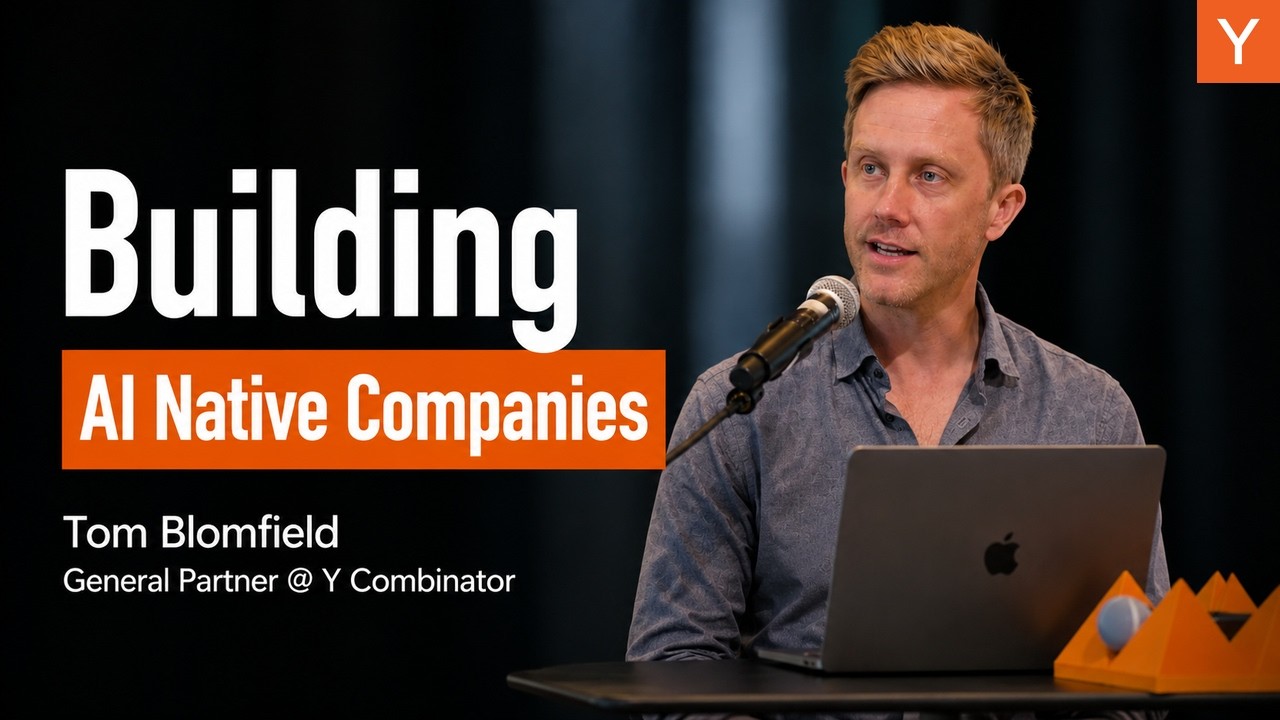
The talk challenges the traditional hierarchical structure of companies, likening them to Roman legions where information flows up and down through human intermediaries. It argues that AI disrupts this model by enabling companies to be reimagined as self-improving, intelligent organizations powered by recursive AI loops rather than relying on human hierarchies. Instead of merely using AI as a productivity tool to enhance existing workflows, the speaker envisions AI extracting and codifying domain knowledge from all company data—emails, messages, documents—making the entire organization legible to AI systems that can then operate autonomously and improve continuously.
A key concept introduced is the AI loop consisting of several layers: sensors that gather data from customer interactions and product telemetry; a policy layer that governs AI decisions; a tool layer comprising deterministic APIs and code; quality gates for safety and review; and a learning mechanism that enables the system to self-correct and evolve. The speaker shares a real-world example where an AI agent monitors queries, identifies failures, writes code fixes, and deploys improvements overnight without human intervention, illustrating a company that literally self-improves while its employees sleep.
The implications for company structure are profound. The speaker predicts a shift from headcount-driven growth to token (AI compute) usage as the main constraint, rendering middle management obsolete. Instead, companies will rely on individual contributors who are directly responsible for outcomes, supported by AI systems that handle coordination and optimization. This new model demands that companies record and store all interactions and data to feed the AI, making the entire organization transparent and accessible to machine intelligence.
To operationalize this vision, the speaker emphasizes the importance of making all company knowledge and processes legible to AI by recording everything—emails, meetings, Slack messages—and synthesizing this data into usable formats. They describe how YC regenerated its user manual by aggregating thousands of hours of recorded office hours, creating a living document that continuously updates itself with new insights. Internal software and dashboards should be treated as disposable artifacts that can be regenerated on demand by AI, with the true value residing in the underlying business context and skills encoded in the data.
Finally, the speaker reflects on the evolving role of humans in this AI-native company. Humans will operate at the edges, handling novel, high-stakes, or ethical situations where AI still falls short, such as sensitive conversations or complex negotiations. The core intelligence of the company will be AI-driven, continuously learning and improving, while humans provide the nuanced judgment and interpersonal connection necessary for certain tasks. The talk concludes by urging founders to consider building their companies from the ground up with this AI-first, self-improving architecture in mind.