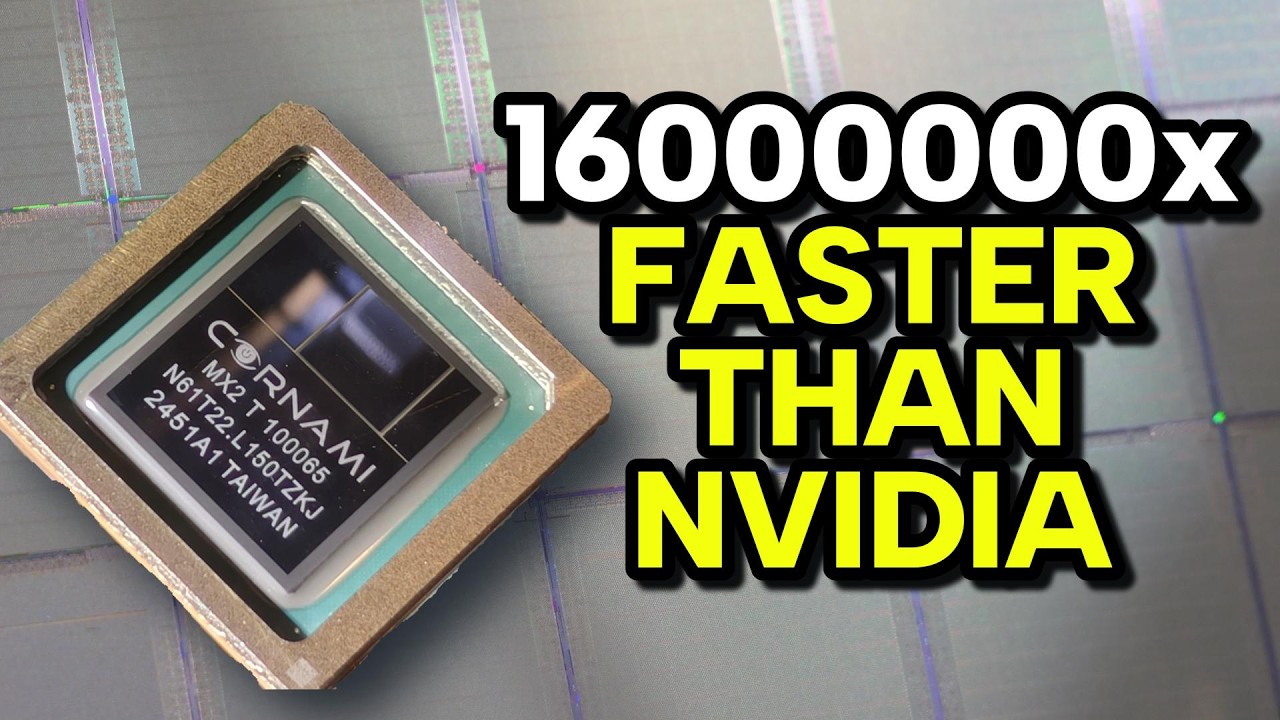
The video highlights Cornami’s breakthrough in fully homomorphic encryption through their innovative Fractal Core architecture, enabling efficient and scalable computation on encrypted data with performance vastly surpassing traditional GPUs. This technology promises to revolutionize secure data processing across industries by allowing existing AI frameworks to run on encrypted data without modification, significantly enhancing data privacy and computational efficiency.
The video recounts the speaker’s experience attending an AI conference in Paris, where they unexpectedly attended a talk by Dr. Wally Ry from Cornami, a company focused on fully homomorphic encryption (FHE). Cornami, a 14-year-old startup with over $100 million in funding, is developing specialized silicon chips that enable computation on encrypted data without needing to decrypt it first. This breakthrough allows secure data processing, which has traditionally been computationally prohibitive, to be done efficiently and at scale.
Cornami’s core innovation lies in their Fractal Core architecture, which features a reconfigurable compute fabric composed of thousands of small, configurable cores capable of deep pipelining and exploiting multiple types of parallelism. Unlike GPUs that exploit limited parallelism types, Cornami’s design can handle hundreds of concurrent streams and pipelines up to 100,000 stages deep. This architecture drastically reduces the computational overhead of FHE, achieving performance improvements of up to 16 million times compared to traditional GPU processing for encrypted data.
The company’s chips are designed to be power-efficient, consuming significantly less energy per core than comparable GPU cores, with projections for further improvements as they move to smaller process nodes like 4nm and 2nm in the coming years. Cornami aims to run existing software stacks, including AI frameworks like PyTorch and TensorFlow, without modification by using a translation layer, making their technology accessible for a wide range of applications. Their software stack integrates FHE libraries to enable encrypted data processing at speeds comparable to plaintext computation when scaled across multiple servers.
Cornami demonstrated impressive real-world applications, including running large language models with encrypted data and algorithmic trading workloads, showing substantial speed and cost advantages over traditional GPU-based systems. Their MX2 and MX128 server designs highlight flexible precision computing and scalability, enabling efficient inference on encrypted data. The company envisions their technology as a critical enabler for secure data processing in industries where data privacy is paramount, potentially transforming how sensitive information is handled in AI and beyond.
The speaker concludes by expressing intrigue and optimism about Cornami’s progress, noting that while FHE has not yet become mainstream like machine learning, it represents a fundamental advancement in secure computing. They plan to engage further with Cornami to explore the technology in action and understand its roadmap and commercial viability. The video invites viewers to ask questions for the Cornami team, emphasizing the significance of this milestone in encrypted data computation and the potential impact on future secure computing paradigms.