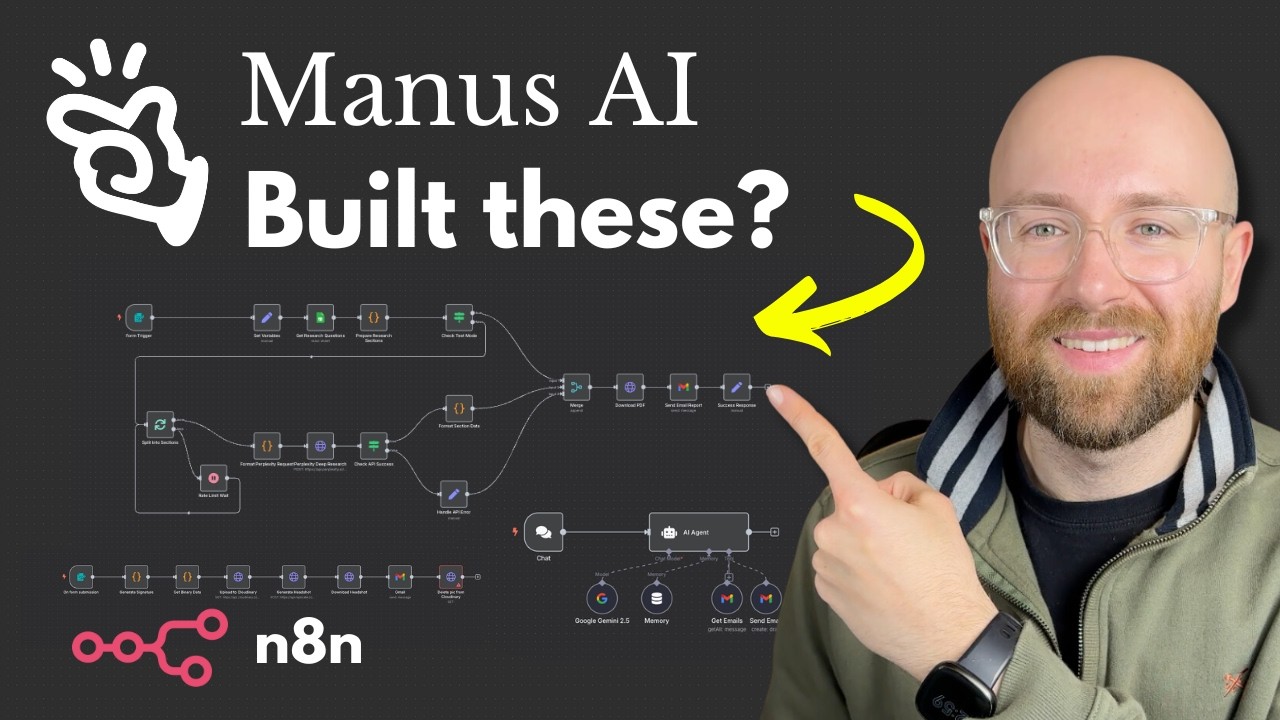
The video explores the claim that ready-to-use n8n agents can be generated instantly using Manus AI, ChatGPT, or Claude, which is a popular topic on YouTube. The presenter has experience using n8n and various AI tools and decides to test whether these AI platforms can actually build functional automation workflows. Manus AI is introduced as a tool similar to Claude, essentially a large language model wrapped with additional features and super prompts to enhance its capabilities. The presenter demonstrates Manus AI’s ability to autonomously assign tasks, create content like slides, images, videos, and even websites, showing promise in generating strategic analysis and automation ideas.
The core experiment involves instructing Manus AI to act as an n8n consultant to create three specific automation workflows: a Gmail autoresponder agent, a market research report generator, and a consulting tip Twitter scheduler. The presenter provides Manus AI with a detailed prompt to generate the JSON workflow files and accompanying markdown documentation for these automations. Manus AI successfully produces detailed documentation outlining the business use case, workflow overview, steps, required API keys, and configuration instructions, which the presenter finds impressive and valuable for understanding workflow logic.
However, when testing the generated JSON workflows by importing them into n8n, the presenter encounters errors indicating that the workflows are not functional. Despite multiple attempts to have Manus AI fix the JSON errors, the workflows remain broken and unusable. This highlights a significant limitation of Manus AI in reliably producing working n8n workflows, especially for multi-layered automations. The presenter notes that while Manus AI can generate documentation and conceptual overviews well, it currently falls short in delivering fully operational automation workflows.
The video also touches on the potential of paid versions of Manus AI, which might offer enhanced reasoning and better workflow generation, but at the time of testing, the free version does not meet expectations. The presenter suggests that creating simple n8n agents manually is straightforward and more reliable than relying on AI-generated workflows. The value of AI-generated documentation is emphasized, as it helps users understand complex automation logic and break down problems, which is particularly useful for more complicated workflows like a headshot generator.
In conclusion, the presenter recommends that viewers build their own n8n workflows for now and consider joining the AI Automation Pro community for support, consultation, and collaborative problem-solving. The community offers personalized blueprint creation, technical assistance, and even monetary rewards for active participation. While Manus AI and similar tools show promise in automating parts of the workflow creation process, they are not yet capable of fully replacing human expertise in building functional n8n automations. The video encourages viewers to engage with the community for practical help and ongoing learning in AI-driven automation.