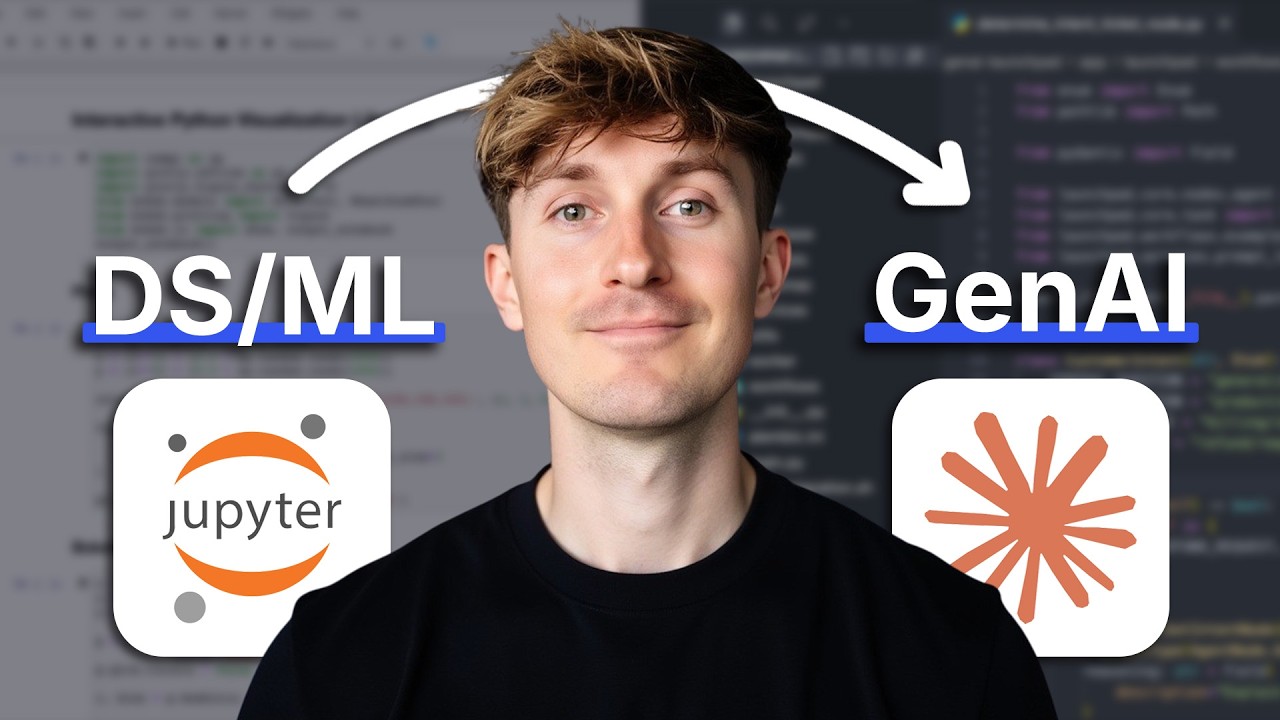
The video discusses the transition from a data scientist or machine learning background into AI engineering, a path the speaker personally followed. Starting as a data scientist in 2013 and working in the field until 2019, the speaker shifted focus entirely to generative AI over the past three years. The video aims to provide a roadmap tailored for those with data science or ML experience, emphasizing not only technical skills but also mindset and the order in which to acquire new competencies. The speaker also offers a curated markdown resource with free learning materials to support self-study.
AI engineering is currently one of the fastest-growing and most lucrative roles in tech, driven by increasing enterprise investment and the integration of AI into core operations. Unlike traditional data science roles that focus on model development and research, AI engineering involves working with pre-trained models and requires a stronger software engineering skill set. The speaker highlights that data scientists are well-positioned to become AI engineers because of their statistical thinking, experience with non-deterministic models, and familiarity with Python, which remains the dominant language in AI engineering.
The roadmap to becoming an AI engineer consists of six key steps. The first step is closing the software engineering gap by moving beyond Jupyter notebooks to structured Python projects, mastering dependency management, version control with Git, and production basics like testing and debugging. The second step focuses on learning to work with large language models (LLMs) through official SDKs, prompt engineering, building AI agents from scratch, and mastering context engineering to optimize model inputs and outputs.
The third and fourth steps involve building production-ready backends using tools like FastAPI, Docker, and databases, and developing retrieval-augmented generation (RAG) pipelines that connect AI systems to custom data sources. These stages require deeper software engineering skills, including containerization and database management, as well as experimentation with embedding and retrieval techniques. The fifth step emphasizes observability and evaluation (EVALS), where AI engineers monitor model performance, detect regressions, implement guardrails against prompt injection, and continuously improve AI applications using applied data science principles.
Finally, the speaker encourages hands-on project building as the best way to solidify skills, recommending two end-to-end projects available on their channel that cover everything from data ingestion to deployment. They also suggest seeking AI engineering opportunities within current roles or freelancing on AI projects to gain practical experience. The video concludes by offering a comprehensive, free roadmap resource and curated tutorials to help viewers self-study and successfully transition into AI engineering.