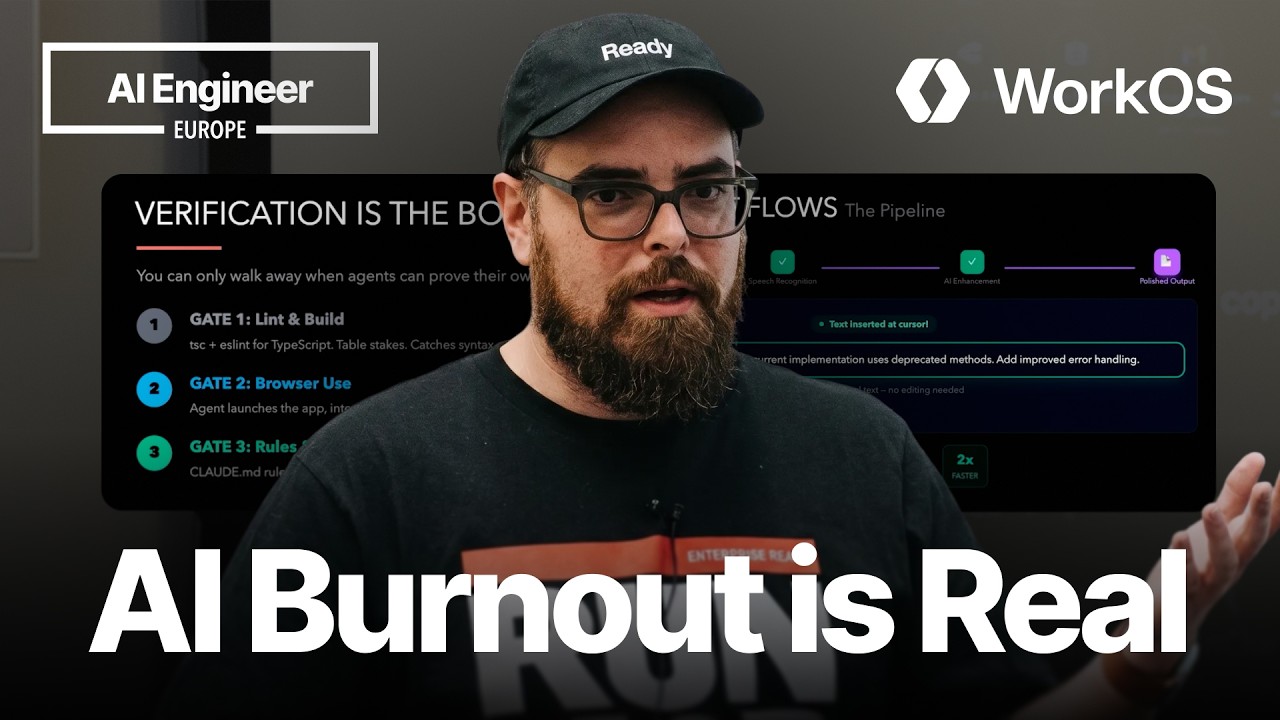
Zack Proser from WorkOS discusses how developers can maintain productivity and balance while leveraging powerful AI tools like coding agents. He begins by acknowledging the overwhelming influx of new tools and the exhaustion caused by constant context switching, despite increased output. Zack shares a personal story about using an AI agent, Claude Code, to autonomously fix a bug in a Slack bot he was developing. By granting the agent access to Slack and his task management system, he was able to delegate the bug fix and verification process, allowing him to return to a completed task without manual follow-up. This experience highlighted both the potential and the risks of relying heavily on AI agents, emphasizing the need for human judgment and balance.
Zack outlines the challenge that while AI agents can scale infinitely and handle numerous tasks simultaneously, human attention remains a limited resource. He stresses that developers must find their own balance to avoid burnout, as the agents are no longer the bottleneck—humans are. To address this, he introduces several strategies: creating signal layers to manage information flow, adopting voice-first coding to increase speed and multitasking, utilizing remote control to work away from the desk, and enabling systems to improve themselves by analyzing past interactions and workflows. These approaches help developers harness AI effectively while preserving their well-being.
Voice-first workflows have been transformative for Zack, allowing him to code at speeds far exceeding traditional typing by speaking commands and interacting with multiple AI tools in parallel. This method not only accelerates development but also facilitates working remotely through remote control features. He explains how remote control enables developers to maintain active coding sessions on their primary machines while interacting with them via mobile devices from anywhere. This supports the “shower principle,” where stepping away from focused work allows the subconscious to solve problems, now without sacrificing productivity or progress.
Zack emphasizes the importance of verification and safety when delegating work to AI agents. He describes multi-level verification processes, from basic linting and testing to advanced browser-based checks and constitutional AI frameworks where agents monitor and correct each other. This layered approach ensures quality and reliability, enabling developers to confidently delegate routine tasks and focus on higher-level problem-solving. He also highlights the value of reviewing AI interactions regularly to identify inefficiencies and improve workflows, turning the developer-agent relationship into a continuously evolving system.
In the Q&A, Zack addresses concerns about skill development for early-career developers, advising them to build foundational knowledge before relying heavily on AI. He encourages deep work and learning through challenges, using AI as a tool to accelerate understanding rather than replace it. He also discusses practical aspects like managing large chat histories for AI review, using night-time agent workflows, and balancing small tasks with complex feature development through parallel work trees and agent teams. Overall, Zack advocates for intentional, balanced use of AI to enhance productivity while safeguarding mental and physical health.