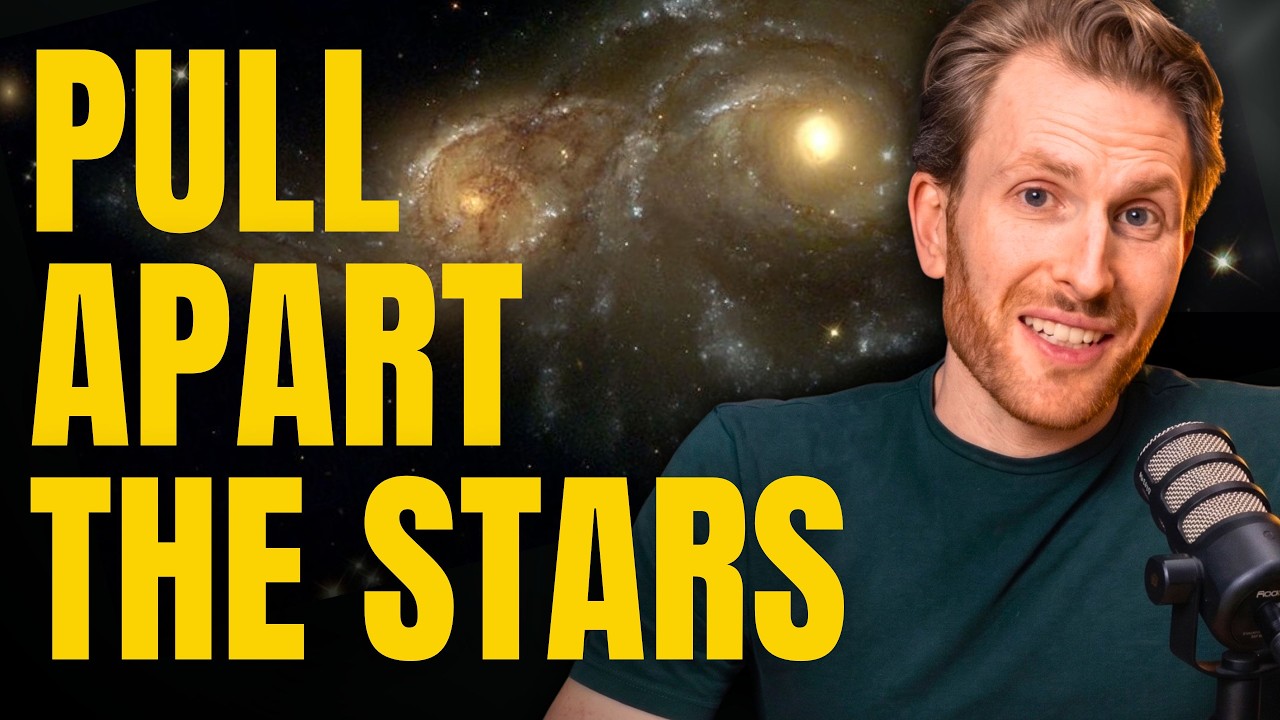
The video explores the concept of intergalactic war billions of years in the future, focusing on whether such conflicts would favor attackers or defenders. It imagines two Kardashev III (K3) civilizations, each harnessing the energy of an entire galaxy, positioned next to each other without faster-than-light travel or wormholes. The key question is whether attackers or defenders have the advantage in such a scenario, as this would determine if the universe ends up peaceful or violent.
Three main classes of weapons are considered: beam weapons (powerful lasers), relativistic kill vehicles (RKVs), and invasion fleets. Beam weapons can deliver enormous energy instantly but suffer from a massive time lag due to the vast distances, making them effective only against fixed targets. RKVs are physical projectiles traveling near light speed that can adjust their course, but they give defenders long warning times, allowing them to deflect or neutralize the threat cheaply. Invasion fleets face severe challenges due to the need to decelerate visibly and the logistical nightmare of maintaining supply lines across millions of light years.
To defend against these threats, a civilization should avoid clustering around predictable points like stars and planets. Instead, they should distribute mobile habitats randomly across the galaxy, making them hard to target. They should also build extensive sensor networks to detect incoming threats early, deploy minefields to slow attackers, maintain a powerful second-strike capability to deter attacks, and be vigilant against self-replicating enemy probes. These strategies leverage the vast emptiness of space and the defender’s proximity advantage to create a strong defensive posture.
The analysis concludes that defense strongly dominates offense in intergalactic warfare, making large-scale attacks irrational and unlikely except for ideologically driven aggressors. Mature civilizations that prepare well are almost impossible to destroy, leading to a stable cosmic patchwork where each galaxy remains under the control of its first colonizers. This scenario contrasts with the “Dark Forest” hypothesis of constant mutual fear and conflict, suggesting a more peaceful long-term cosmic order.
For humanity, the implications are mixed. Currently, we are vulnerable as a single-planet species clustered predictably in space, making us easy targets for advanced civilizations. However, the absence of attacks so far suggests no hostile K3 civilizations nearby. In the future, spreading out and becoming a distributed, technologically mature civilization could secure our survival and influence. Ultimately, whether humans or another species dominate the galaxy depends on intelligence, wisdom, moral values, and the ability to cooperate and avoid tyranny, highlighting the importance of our choices today.