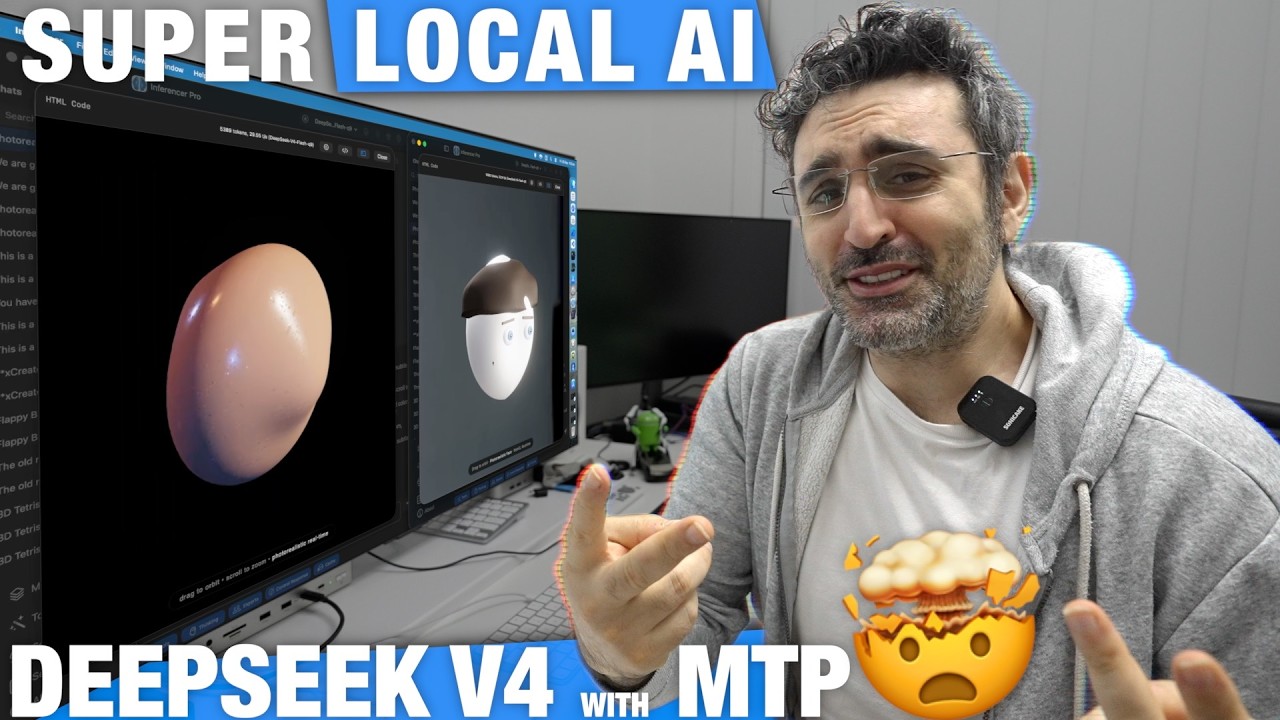
The video demonstrates how combining Deep Seek V4 Flash with the MTP speculative decoding layer can boost local AI token generation speeds by around 20%, especially in structured tasks like coding, while maintaining accuracy through model verification and rollback. It also discusses the trade-offs of increased memory usage, variable performance depending on task type, and practical setup tips for integrating MTP in inference environments.
The video explores the performance enhancements of Deep Seek V4 Flash when combined with MTP, a speculative decoding strategy that predicts multiple tokens ahead without fully running the main model. This approach allows for faster inference by batching token processing, theoretically maintaining 100% accuracy since the main model verifies the draft tokens and rewinds if necessary. The presenter demonstrates that enabling MTP can boost token generation speeds from around 31 tokens per second to peaks of over 40 tokens per second, especially noticeable in coding tasks like generating Flappy Bird HTML, where token prediction is more constrained and thus more accurate.
However, the performance gains vary depending on the task. For creative tasks such as story writing, the MTP layer’s guesses are less accurate, resulting in smaller speed improvements. The video also highlights the memory trade-offs, with MTP requiring an additional 4 GB of RAM, which might be a consideration for users with limited resources. Different quantization versions of the MTP layer were tested, with the Q4.3 version performing better than the Q3 version, which caused more rollbacks and slower speeds despite its smaller size.
The presenter further demonstrates the practical use of MTP in various scenarios, including tool calls and complex code generation like 3D Tetris and real-time WebGL rendering. Interestingly, MTP sometimes leads the model down different reasoning paths, producing slightly different but still verified outputs due to floating-point variations and random seed differences. In some cases, MTP helped avoid reasoning loops that the non-MTP version fell into, showcasing its potential to improve both speed and stability in complex tasks.
The video also covers how to set up and run Deep Seek V4 Flash with MTP in inference environments like Inferno and OpenCode, explaining that the MTP decoder runs as a separate layer alongside the main model. This modular approach allows users to switch between different speculative decoding strategies easily. The presenter notes ongoing experiments with other decoding methods like Eagle 3 and Dlash, though these have yet to perform well on their hardware.
In conclusion, while Deep Seek V4 Flash with MTP does not achieve the dramatic speedups seen in smaller models, it still delivers a solid 20% performance boost on a very large 100+ billion parameter model. The trade-offs include increased memory usage and occasional variability in output due to the speculative nature of token prediction. Overall, the video provides a comprehensive overview of how MTP enhances local AI inference speed and offers practical guidance for users interested in leveraging this technology.