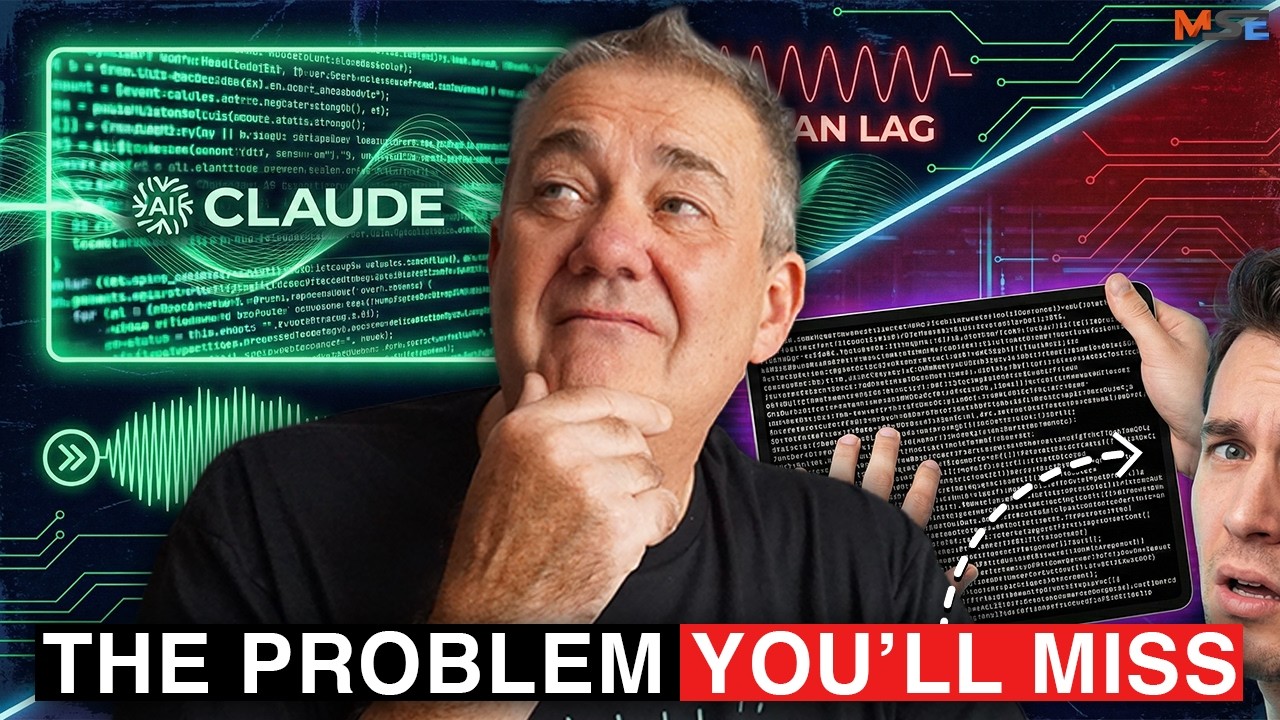
Dave Farley discusses the challenges and opportunities presented by AI programming assistants, such as Claude, which can generate code at a much faster rate than humans. He raises a critical question: how can developers ensure that this rapidly produced code is not only syntactically correct but also functionally accurate and aligned with system requirements? Farley draws an analogy from information theory, specifically the Nyquist-Shannon sampling theorem, to highlight the risk of missing errors when feedback mechanisms do not keep pace with the increased rate of code generation.
He explains that traditional development involves natural feedback loops, as developers write and test code incrementally. However, when AI generates large features or modules in seconds, the frequency of code production skyrockets, but most teams still rely on slower, manual feedback processes like code reviews and occasional testing. This mismatch, according to the sampling theorem, leads to “undersampling,” where significant errors can slip through undetected because the code is being checked too infrequently relative to how quickly it is produced.
Farley proposes continuous integration (CI) as the solution, reframing it as a critical sampling strategy rather than just a tool for running tests. By running the CI pipeline on every commit or significant change, teams can “sample” their codebase at a frequency that matches the rapid pace of AI-generated changes. This ensures that errors are caught early and reliably, maintaining the integrity and correctness of the system even as development accelerates.
He emphasizes that, especially with AI-generated code, teams must automate their feedback processes. This includes running the full test suite on every change, enforcing linting and architectural standards, and using contract tests to ensure compatibility. Manual code reviews are insufficient; automated checks are necessary to catch both syntactic and behavioral errors. Farley also advises working in small increments, maintaining fast pipelines, making tests the source of truth, integrating frequently, and investing in robust deployment pipelines to ensure that real-world feedback is quickly incorporated.
In conclusion, Farley argues that AI is fundamentally changing the dynamics of software development by removing the bottleneck of human typing speed. While this can greatly enhance productivity, it also demands a new discipline centered on rapid, automated feedback. Continuous integration becomes not just a best practice but a necessity for maintaining quality and understanding in a high-frequency development environment. Teams must adapt their processes to match the new pace set by AI, ensuring that feedback and validation keep up with code generation to prevent subtle and significant errors from reaching production.