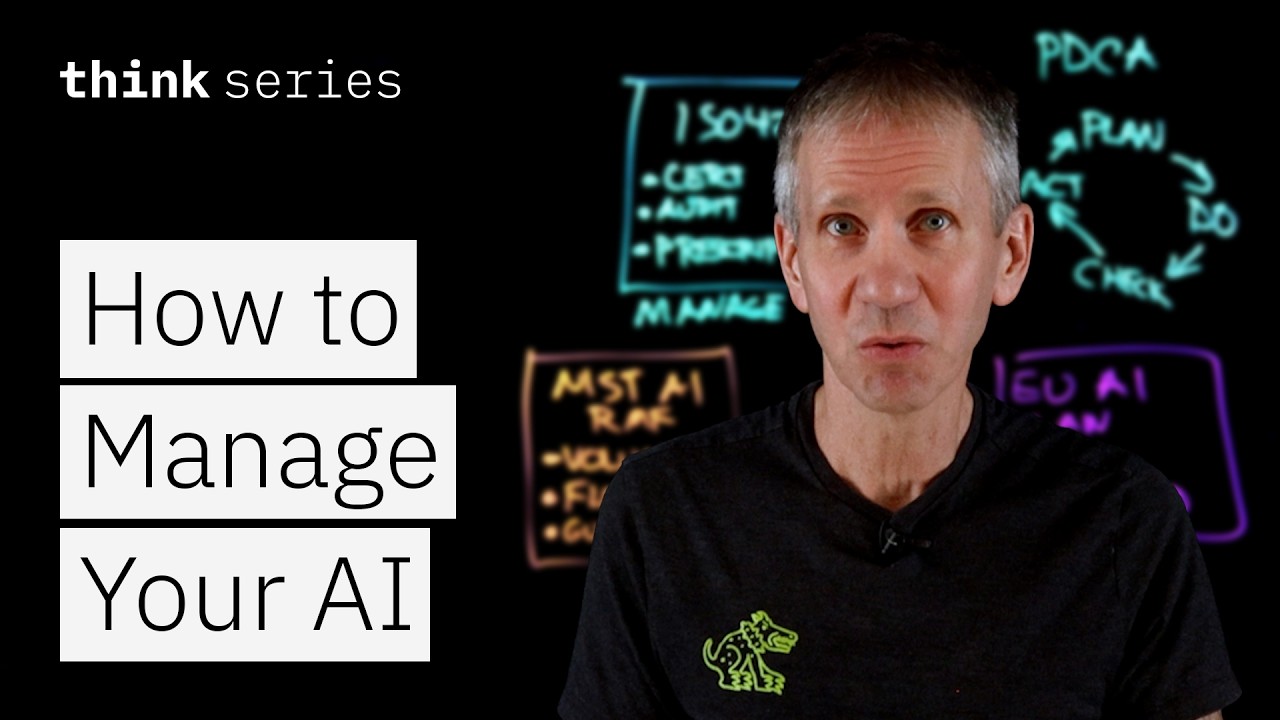
The video discusses the critical need for managing AI systems effectively to prevent wrong or harmful decisions, such as a bank denying a loan without explanation due to an AI decision. It highlights a common issue where organizations lack clarity on who validates, monitors, and takes responsibility for AI models post-deployment. To address this gap, the video introduces the ISO 42001 standard, a new international standard designed specifically for AI management systems. This standard builds on the success of ISO 27001, which governs information security, by providing a framework for continuous AI risk management, governance, and improvement throughout the AI lifecycle.
ISO 42001 is not a simple checklist but a comprehensive, auditable, and certifiable system that follows the Plan-Do-Check-Act cycle. Organizations begin by defining AI policies, scope, and risk criteria (Plan), then develop and deploy AI with appropriate controls (Do). They continuously monitor AI performance for bias, drift, and unintended consequences (Check), and act on findings to improve the system (Act). The standard emphasizes a risk-based approach, recognizing that different AI systems carry varying levels of risk, and it addresses risks across multiple layers including data quality, model accuracy, system integration, security, and potential misuse.
The standard’s structure includes several key sections: context (defining scope, stakeholders, and regulatory obligations), leadership (assigning accountability and governance), planning (risk assessments and treatment plans), support (documentation and training), operation (lifecycle governance and change management), evaluation (monitoring and audits), and improvement (incident handling and corrective actions). This holistic approach ensures that AI governance is embedded into organizational processes and continuously refined to adapt to changes and emerging risks.
The video also compares ISO 42001 with other AI governance frameworks such as the U.S. National Institute of Standards and Technology (NIST) AI Risk Management Framework and the European Union’s AI Act. NIST’s framework is voluntary and flexible, serving as guidance on best practices without certification. ISO 42001, in contrast, is prescriptive and certifiable, providing a formal governance structure. The EU AI Act is legally binding with enforceable penalties, focusing on compliance with risk-based regulations. Together, these frameworks complement each other by addressing different aspects of AI risk management, governance, and legal compliance.
In conclusion, the video stresses that treating AI governance as a mere checkbox is insufficient and risky. Organizations that integrate AI governance into their management systems using standards like ISO 42001 will be better positioned to scale AI safely and effectively. Proper governance enables organizations to harness AI’s potential for positive impact, while poor management risks loss of control and unintended consequences. ISO 42001 represents a significant step forward in formalizing AI governance on an international scale, helping organizations manage AI responsibly and transparently.