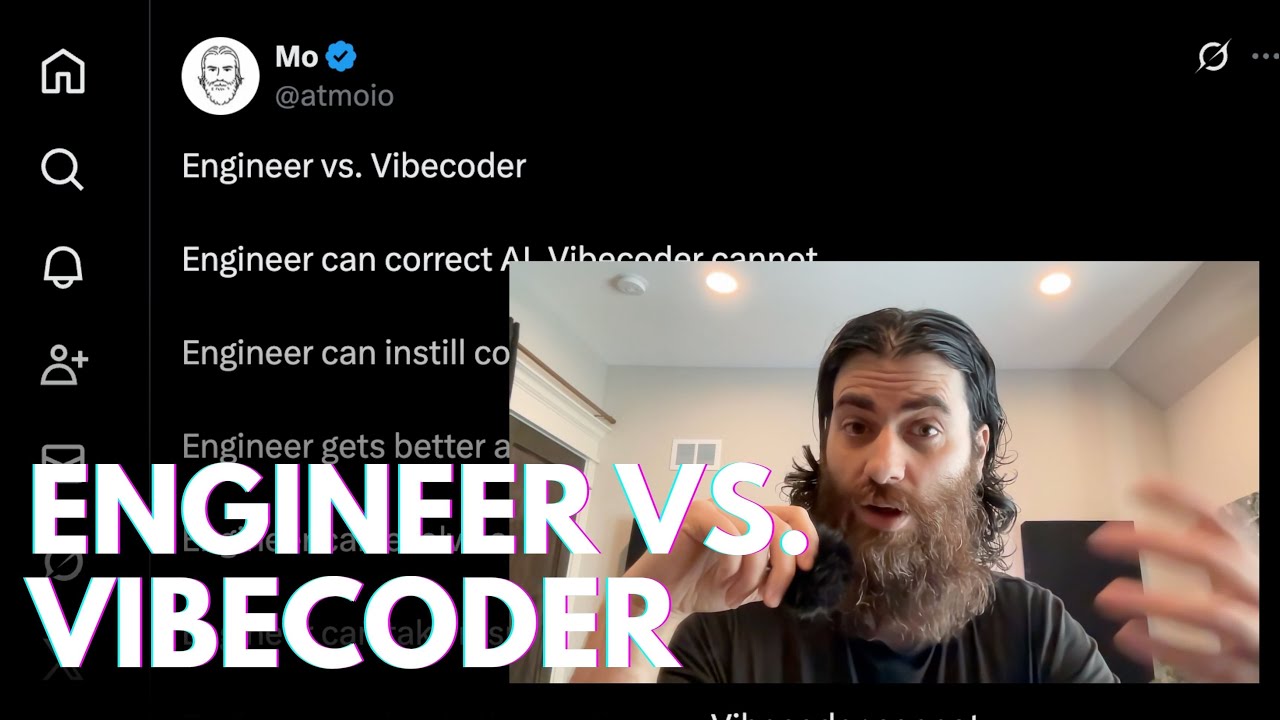
The video addresses the growing concern among software developers about job security in the age of AI, particularly with the rise of large language models (LLMs) that can generate code. The speaker distinguishes between “engineers” and “vibe coders” (or “agentic coders”), emphasizing that only those who strive for excellence and can add unique value will remain indispensable. Mediocre or passive developers—those who simply prompt AI tools without understanding or correcting their output—are at the highest risk of being replaced, as companies no longer need to overhire for redundancy.
A key point is that true engineers possess the ability to critically evaluate and correct AI-generated code, whereas vibe coders cannot. LLMs are inherently prone to hallucinations and overconfidence, often producing plausible but incorrect results. The real value lies in being able to discern good from bad output, steer AI agents effectively, and ensure that the final product meets high standards. This skill set is irreplaceable and forms the foundation of job security in a landscape increasingly shaped by AI.
Engineers also play a crucial role in instilling confidence within organizations. They are responsible for signing off on launches, ensuring robustness, and taking ownership of outcomes. Their judgment and reliability are essential, especially when compared to AI agents, which lack the ability to build trust or take responsibility. Over time, engineers become more valuable as they learn from failures, adapt, and contribute to organizational growth, whereas vibe coders do not exhibit this self-improvement.
Another important distinction is that engineers are proactive problem solvers who drive product evolution and organizational success. They identify and address core business challenges, often inventing new products or processes that can dramatically increase a company’s value. The speaker highlights that the most impactful engineers can be “million-x” contributors, far surpassing what any number of AI agents could achieve. These individuals are highly sought after and can make or break a company’s trajectory.
Finally, engineers are capable of taking responsibility, leading teams, and saying “no” when necessary to prevent costly mistakes. They provide critical feedback, guide architectural decisions, and help organizations avoid technical debt. In contrast, AI agents are “yes-men” that lack the context and judgment to protect a company’s long-term interests. The speaker concludes by encouraging engineers to be proactive, communicative, and relentlessly focused on self-improvement and problem-solving, while advising organizations to recognize and retain their best human talent in the face of rapid technological change.