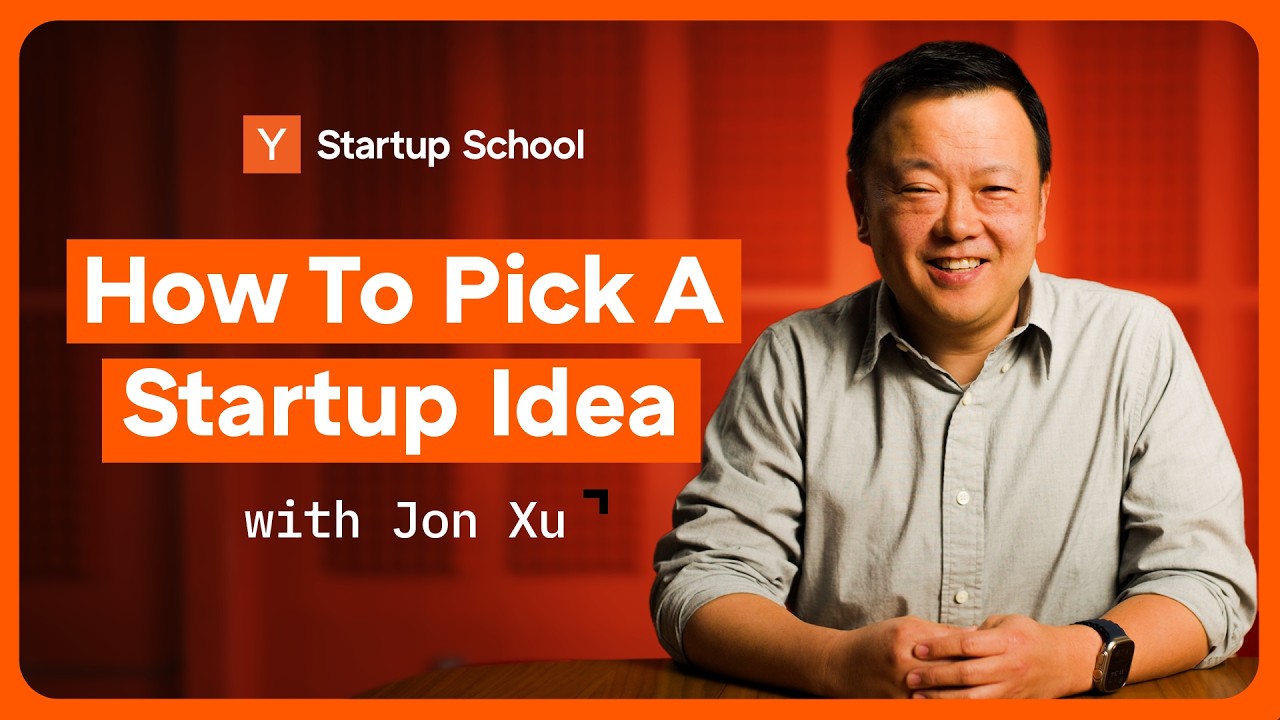
In the video, John, a partner at YC, addresses founders who struggle to choose a startup idea, emphasizing the importance of commitment over indecision. He warns against overthinking, particularly the misconception that one must find the perfect idea or be the perfect founder before starting. Instead, he encourages founders to pick an idea they are curious about, dive deep into it, and engage extensively with customers to gain real-world feedback and knowledge. John highlights that deep understanding can be developed quickly through focused effort and customer interaction, citing examples like Blake Scho of Boom Supersonic who successfully transitioned industries by immersing himself in a new domain.
John stresses the necessity of committing fully to a single idea rather than juggling multiple projects. He explains that spreading attention across several ideas leads to poor data and weak signals about what truly works, which can cause premature abandonment of good ideas or persistence with bad ones. To go deep means to “burn the boats,” cutting off other options and fully immersing oneself in the chosen idea, even changing company identity and narrative if needed. This intense focus helps founders become domain experts, as illustrated by the startup GovDash, which pivoted multiple times before finding success by deeply understanding government procurement.
To evaluate whether a founder is truly going deep, John suggests they should be able to run their customers’ business or teach a class on the problem they are solving. This level of expertise requires intimate knowledge of customer pain points and the business context, gained through continuous customer conversations and iterative product development. He advises against waiting to talk to hundreds of customers before building; instead, founders should engage in a tight feedback loop of learning and product delivery to validate their ideas with real data.
John also outlines key qualities of good startup ideas in the AI era. First, ideas should leverage the cutting edge of current AI capabilities, improving as models advance. Second, they should verticalize by owning entire outcomes rather than just providing software, exemplified by Corgi Insurance, which became a full-stack insurer rather than a tech-enabled broker. Third, ideas should be ambitious, aiming to transform entire sectors or tackle large incumbents, as the effort required for ambitious and modest ideas is similarly high, but ambitious ideas offer stronger competitive moats and attract top talent.
Finally, John reassures founders that failure is part of the process and valuable for learning. Even if the initial idea fails, founders gain clear customer data, conviction for pivots, and a deeper understanding of structural problems that can lead to better ideas. The key takeaway is to stop searching for the perfect idea, commit fully to one, and move quickly to generate meaningful information. The worst failure is indecision and shallow exploration, so founders should pick one idea and go deep to discover the best path forward.