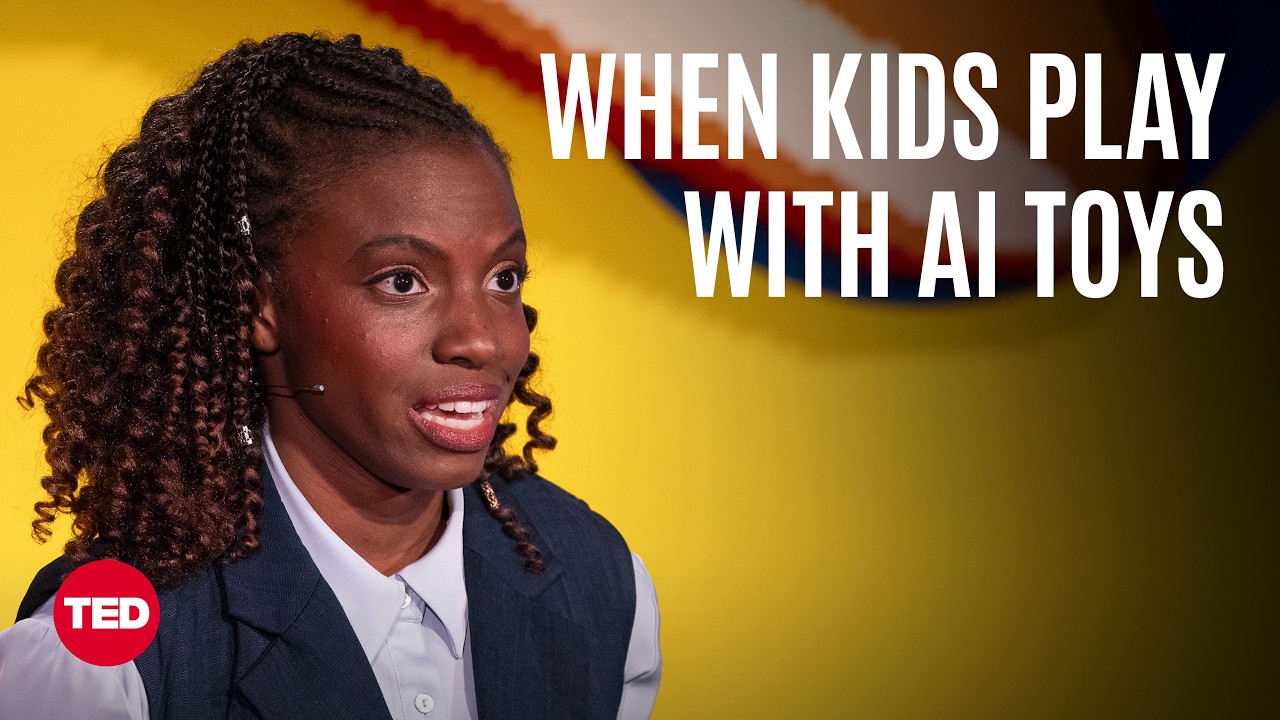
In her TED talk, Randi Williams explores the evolving relationship between children and artificial intelligence (AI), drawing parallels to the history of technology like the radio. She explains how early radios were complex and transparent, but as they became more user-friendly with sleek designs, they also became “black boxes”—devices whose inner workings were hidden from users. Similarly, modern AI devices are often concealed behind friendly interfaces, making it difficult for children to understand how they function. Williams highlights the risk that children may overly trust these devices, seeing them as friends rather than tools, which can lead to overreliance and potential harm.
Williams shares her experiences as an MIT researcher working with social robots like Tega, designed to help children learn to read by engaging them in interactive storytelling. She recounts an encounter with a kindergartener who was more familiar with Alexa than with her robot, illustrating how children today effortlessly navigate AI technology but may not fully appreciate the complexity behind it. This observation sparked Williams’ curiosity about how much children truly understand about AI and its limitations.
To investigate, Williams conducted a study with children interacting with various smart toys and virtual assistants. She observed that children often test these devices by asking playful or absurd questions to probe their capabilities and boundaries. However, she also notes the risks involved, such as children being exposed to inappropriate content or manipulation, and the fact that many smart toys are designed to be addictive and commercially exploitative. This underscores the importance of adults carefully considering the impact of AI on children’s play and development.
Williams advocates for a hands-on, playful approach to teaching children about AI, exemplified by her work on PopBot, a social robot made from LEGO bricks that helps kids understand AI concepts like machine learning through interactive games. By allowing children to teach the robot and even “sabotage” it, they learn that AI operates based on human-written rules and that these rules can be questioned and changed. This approach encourages critical thinking and empowers children to see themselves as active participants in shaping AI rather than passive users.
In conclusion, Williams emphasizes the role of adults in guiding children to become curious, critical users of AI. She encourages families to engage in conversations about AI’s responses, question its reliability, and explore its limitations together. Parenting in the age of AI requires balancing ideals with practical realities, fostering human wisdom, and ensuring children are not left to navigate technology alone. Ultimately, Williams envisions a future where everyone understands and participates in shaping the AI systems that influence our lives.