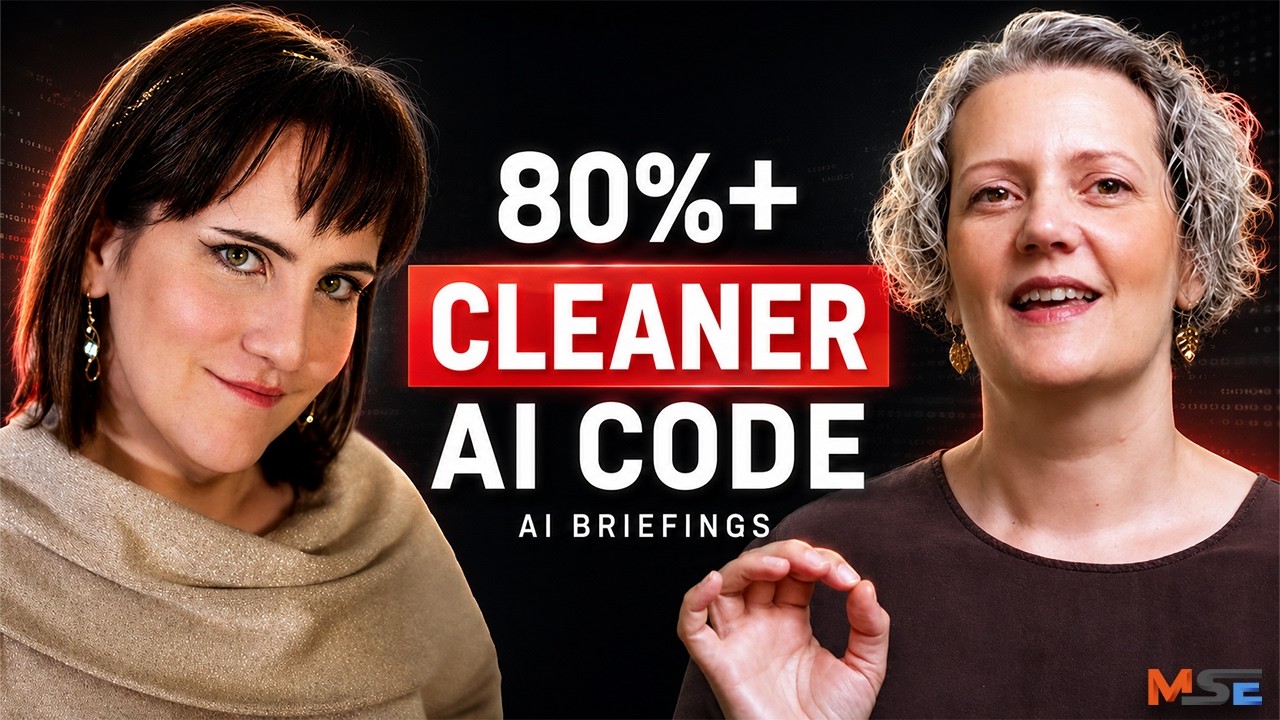
The video discusses the challenge of maintaining code quality as AI coding agents become more prevalent, highlighting the tool Habit Hooks, which integrates linters with detailed refactoring guidance to help AI produce cleaner, well-designed code. It emphasizes that embedding good coding habits into AI through such user-defined prompts significantly improves code maintainability and prevents technical debt, aligning with Kent Beck’s philosophy on the importance of good development habits.
The video begins by highlighting a quote from Kent Beck about the importance of good habits in software development, emphasizing that these habits become automatic behaviors even when attention is elsewhere. Traditionally, test-driven development (TDD) has been one such habit, but with the rise of AI coding agents, the question arises: what habits should these agents adopt to maintain code quality? The concern is to avoid a “slopocalypse,” where poorly designed code accumulates technical debt and becomes unmanageable, even for AI agents themselves.
Emily Bache interviews Yvette Eddog, an expert in TDD and early adopter of agentic AI, who created a tool called Habit Hooks. Yvette explains that Habit Hooks was developed to address the recurring problem of AI-generated code that looks messy or poorly designed, often requiring repeated refactoring requests. The tool integrates with linters to detect code smells and then provides detailed guidance to the AI agent on how to refactor the code properly, rather than just superficially fixing issues to pass linting rules.
A demo showcases how Habit Hooks works in practice. When a function is flagged by a linter for being too long or complex, the AI agent initially tries to fix it by simply splitting the function to meet line limits, resulting in awkward and unhelpful code. Habit Hooks improves this by supplying the agent with a prompt that explains the underlying design problems and suggests meaningful refactoring strategies. This leads to cleaner, more modular code that the developers would be happy to ship, demonstrating a significant improvement over naive fixes.
The video also references an independent study by Leena Suoninen, which evaluated the effectiveness of different prompting strategies on AI models fixing code smells. The study found that simply instructing the AI to “improve the code” fixed issues about 30% of the time, while providing only linter metrics led to mixed results. However, prompts enriched with specific refactoring guidance, as Habit Hooks does, resulted in over 80% of code smells being properly fixed. This evidence supports the idea that combining sensors (linters) with guides (refactoring advice) in prompts greatly enhances AI code quality.
In conclusion, the video advocates for embedding good coding habits into AI agents through user-defined harnesses like Habit Hooks. By pairing problem detection with actionable guidance, these tools help AI produce well-designed, maintainable code, aligning with Kent Beck’s philosophy of cultivating great habits. This approach is crucial to preventing the degradation of codebases in an era where AI increasingly contributes to software development, ensuring that the benefits of automation do not come at the cost of code quality.
Useful Links