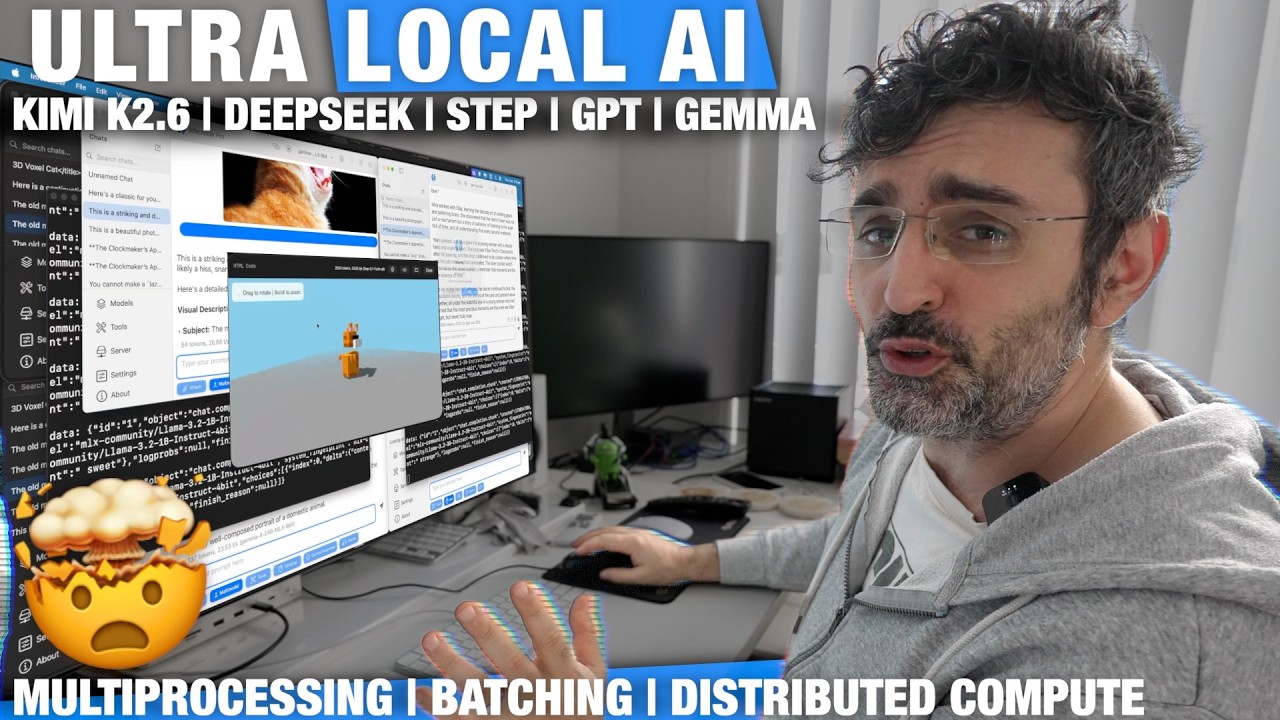
The video explains how to transform a local computer into a powerful AI supercomputer by using techniques like multiprocessing, batching, distributed computing, and multi-threaded inferences to run multiple AI models simultaneously while balancing speed and determinism. It also demonstrates managing system resources, serving models via APIs, and connecting multiple machines to handle large models efficiently, showcasing advanced methods to maximize local AI performance.
In this video, the presenter demonstrates how to transform a local computer into a powerful AI supercomputer capable of running multiple AI models simultaneously. The key techniques discussed include multiprocessing, batching, distributed computing, and multi-threaded inferences. These methods allow for maximizing system performance by efficiently managing resources and running several AI tasks concurrently. The video also touches on deterministic inference, which ensures consistent AI responses, contrasting it with batching that can introduce slight variations due to floating-point precision and random number generation.
Batching is explained as a method that combines multiple inference requests into a single batch to improve throughput, increasing token generation speed but sacrificing determinism. In contrast, multiprocessing runs separate instances or threads of models independently, maintaining deterministic outputs but at a slower speed due to less efficient GPU utilization. Multiprocessing also enables running multiple different models simultaneously by loading each into its own memory space, allowing for diverse AI tasks to be processed in parallel.
The presenter showcases running various models such as Deep Seek, Step 3.7 Flash with vision inference, and GPT OSS20B concurrently, highlighting how multiprocessing and batching can be combined to optimize performance. They also demonstrate monitoring system resources, showing how memory usage is managed when multiple models are loaded. Server mode is introduced, which allows serving AI models via APIs with multiprocessing and batching enabled, facilitating simultaneous inference requests from different clients or applications.
A significant feature covered is distributed computing, which connects multiple computers to share the workload of running large AI models that might not fit into a single machine’s memory. The video shows how a cluster of machines can be linked, with models intelligently loaded and unloaded based on available memory and demand. This system queues inference requests and manages memory dynamically, ensuring smooth operation without overloading any single device. The presenter emphasizes the seamless integration of local and server-based models working together in harmony.
Overall, the video provides a comprehensive overview of advanced techniques to maximize local AI capabilities, turning a standard computer into a multi-model AI powerhouse. It highlights the trade-offs between speed and determinism, the benefits of combining multiprocessing with batching, and the power of distributed computing for handling large models. The presenter encourages viewers to explore these features and share feedback, showcasing the evolving landscape of local AI inference technology.