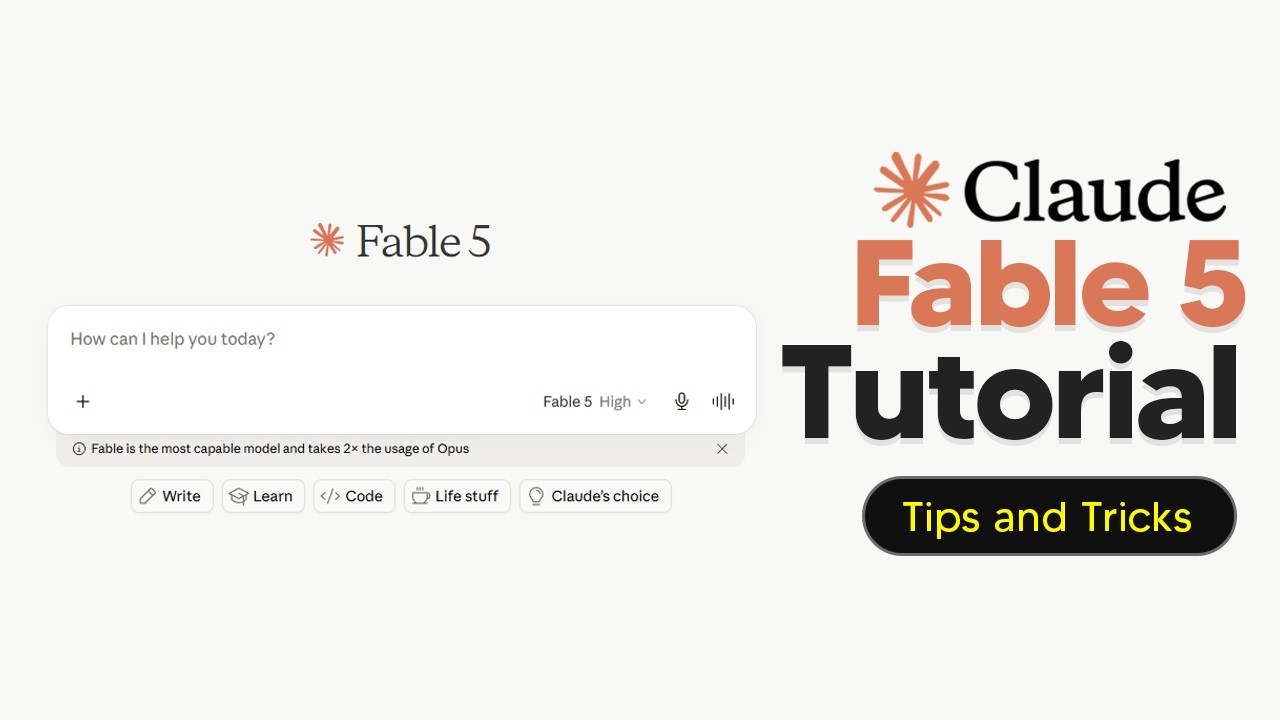
Claude Fable 5 is a powerful but specialized AI model best suited for complex, ambitious tasks and advanced multimodal vision applications, though it has strict safety safeguards that limit its effectiveness in sensitive or high-stakes areas and consumes more usage credits than other models. Users should be aware of its unique quirks, the shift to a credit-based payment system, and Anthropic’s 30-day data retention policy, making it less ideal for everyday use or sensitive information.
The video provides an in-depth overview of Claude Fable 5, emphasizing that it is a highly powerful but specialized AI model not intended for everyday use. Users are advised to enable Fable on high settings only for ambitious, complex tasks. For general purposes, the Opus 4.8 model is recommended as Fable 5 has unique quirks that can hinder its performance in common scenarios. One major issue is that Fable 5 frequently pauses chats or falls back to Opus 4.8 when handling sensitive topics such as biology, chemistry, cybersecurity, or even some mathematics, due to strict safety measures designed to filter potentially dangerous content.
A notable hidden feature of Fable 5 is the presence of secret safeguards that Anthropic has not publicly disclosed. These safeguards silently limit the model’s effectiveness in specific high-stakes areas like building or improving frontier large language models, training data pipelines, or distributed training across GPU clusters. Instead of outright refusing requests or switching models, Fable 5 subtly reduces its capabilities through prompt modifications and other internal mechanisms. This means that while the model may appear helpful, it is intentionally less capable in certain specialized tasks, which is important for paying users to understand.
The video also discusses changes in how users will access and pay for Fable 5. Instead of being included in pro plans, access will shift to a usage credit system where users must purchase credits to use the model. Fable 5 consumes roughly twice the usage credits compared to Opus 4.8 because it processes information more thoroughly, resulting in longer and more detailed outputs. Users are cautioned to monitor and set spending limits carefully to avoid unexpectedly high costs, especially since the model’s intensive processing can quickly deplete usage credits.
One of Fable 5’s standout features is its advanced multimodal vision capabilities, making it state-of-the-art in interpreting charts, tables, and diagrams within PDFs. This strength is highlighted through benchmarks like GDP PDP PDF and the blueprint benchmark, where Fable 5 excels. Users interested in vision tasks are encouraged to use Fable 5 over other models like the Gemini series, as it offers superior accuracy in analyzing visual data embedded in documents. This capability is somewhat buried in official documentation but is a key advantage of the model.
Lastly, the video addresses privacy and data retention concerns. Anthropic retains prompts and outputs generated by Fable 5 for 30 days to support trust and safety efforts. This policy applies across all platforms where the model is available, meaning users in sensitive or confidential environments should avoid submitting private or sensitive information. The data retention policy may evolve, but for now, it is a critical consideration for organizations with strict data privacy requirements when deciding whether to use Claude Fable 5.