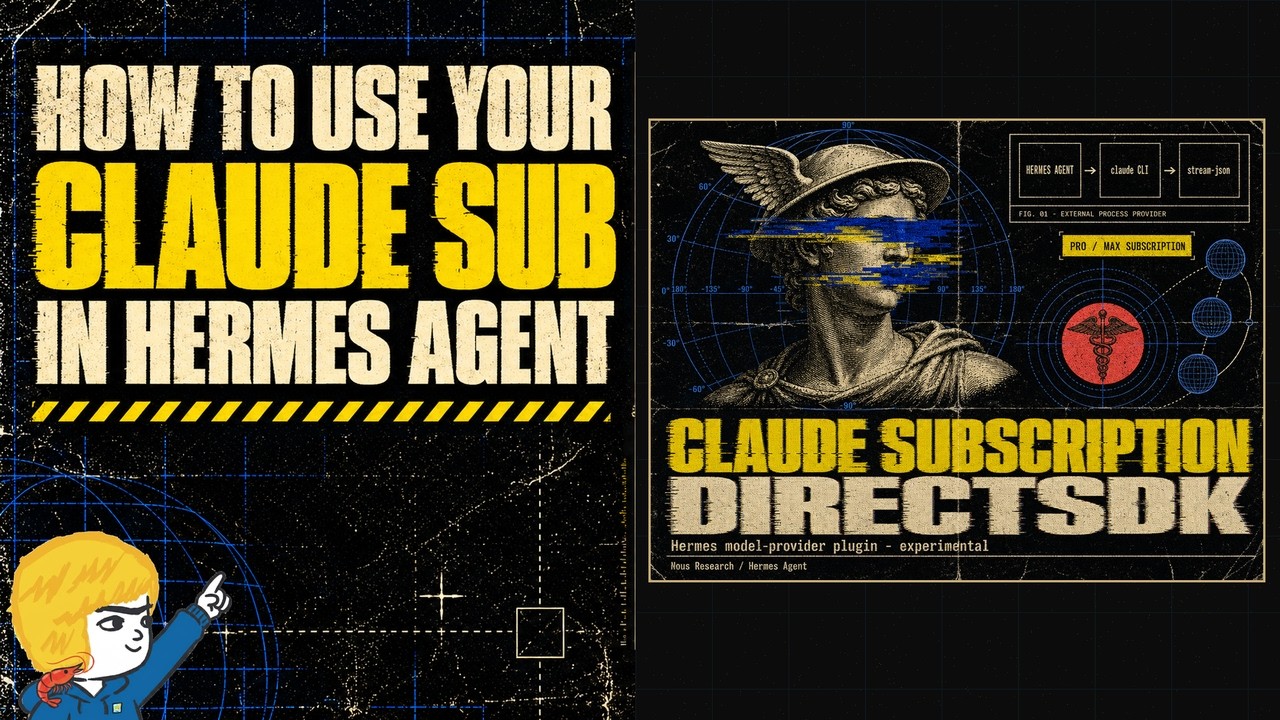
The video explains how to integrate the official Claude subscription direct SDK from News Research into the Hermes agent, enabling users to access Claude models like Opus 5.5 without OAuth or token hassles by leveraging the Claude CLI for model backend while Hermes manages agent functions. It highlights the installation process, benefits of this setup compared to other platforms, and demonstrates improved response speed and efficiency within Hermes using the Claude subscription.
The video discusses how users who initially started with agents using OpenClaw subscriptions faced challenges when Anthropic discontinued token-based access for these models in agents. Since then, the presenter has experimented with other models like GPT, Grock, and local models but missed the Claude models, especially the new Opus 5.5, which is considered superior. Fortunately, News Research recently released an official Claude subscription direct SDK that allows users to integrate their Claude subscription directly with the Hermes agent without violating terms of service. The video aims to demonstrate how to install and use this SDK within Hermes agent.
The Claude subscription direct SDK is an official plugin from News Research that leverages the Claude CLI for model access. It is still experimental but has been working well for the presenter over the past few weeks. There are multiple ways to install the plugin: either through the Hermes desktop app’s plugin catalog or via terminal commands. The installation process involves adding the plugin to a specific Hermes profile, installing necessary Python dependencies, and enabling the plugin. Once installed, users can select from all available Claude models, including the latest Opus 5.5, directly within Hermes.
One notable feature of this integration is that it does not require any OAuth setup or token pasting because the CLI session is already logged into the user’s Claude account. The plugin uses the official Claude CLI as a transport layer, with Hermes managing the agent loop, tool execution, memory, skills, and session context. This means Claude acts purely as the model backend, while Hermes handles all agent-related functions, ensuring no compromise in agent capabilities. Each model call starts a fresh CLI process that replays the relevant conversation to maintain context.
The video also compares this approach to other agent interfaces like T3 code and Buzz. Unlike those platforms where Claude itself runs the agent and executes tools, in the Hermes setup, Claude only supplies model responses while Hermes runs the agent logic and tools. The direct SDK plugin communicates natively with the unmodified Claude CLI executable without requiring additional Python SDK packages. This architecture allows for efficient and flexible use of Claude models within Hermes while maintaining full agent functionality.
Finally, the presenter demonstrates a side-by-side speed and response comparison between the Claude CLI and Hermes agent using the direct SDK with Opus 5.5. Hermes returned a more concise answer faster, likely due to custom skills and preferences set in the agent’s configuration. The video concludes by inviting viewers to share their experiences with the Claude subscription direct SDK and encourages them to explore the integration to leverage their Claude subscriptions effectively within Hermes agent.
Useful Links