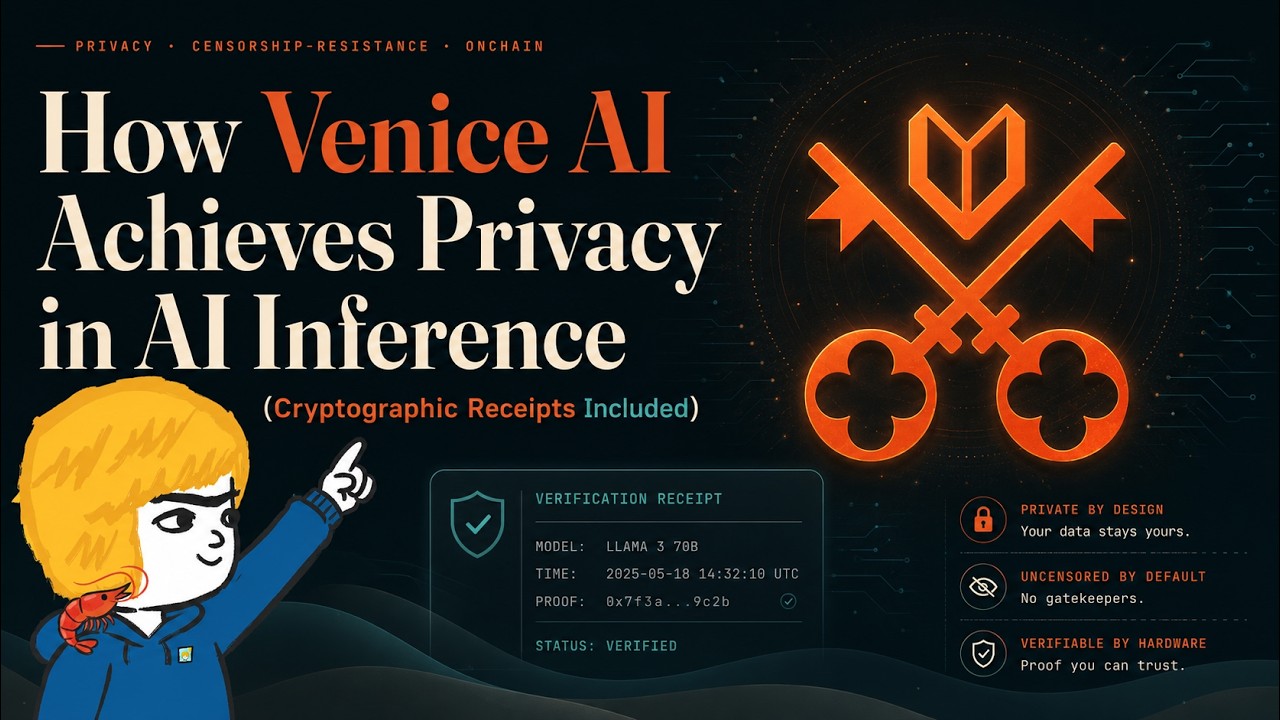
The video explores the critical theme of privacy in AI, focusing on how Venice AI addresses privacy concerns in AI inference. As AI increasingly integrates into our lives, privacy issues become more pressing, especially since most data is handled by a few large companies. Venice AI offers a private and uncensored alternative to mainstream AI, emphasizing that chat histories remain on users’ devices, prompts are not stored, and models are not trained on user data. The platform supports multiple privacy modes, ranging from anonymous usage to advanced hardware-enforced privacy through Trusted Execution Environments (TEEs) and end-to-end encryption (E2EE).
Venice AI provides four privacy levels: anonymous, private, TEE, and E2EE. The anonymous mode hides user identity but not prompt content, suitable for accessing high-quality frontier models with basic privacy. The private mode runs on no-log infrastructure with contractual guarantees but lacks hardware verification. The TEE mode, the most significant focus of the video, uses hardware-sealed enclaves where data is decrypted and processed securely, inaccessible even to the host or operators. This mode includes cryptographic attestation, a proof mechanism that verifies the enclave’s authenticity and that the AI inference occurs in a secure environment. The E2EE mode, still in beta, encrypts prompts on the user’s device, decrypting them only inside the enclave, offering the strongest privacy guarantee.
The video explains how Venice AI leverages hardware and blockchain-adjacent technologies to ensure privacy. The TEE enclaves are hosted by partners like Phala Network and NEAR AI Cloud, which provide decentralized confidential compute environments using Intel TDX and Nvidia confidential GPUs. These enclaves generate cryptographic receipts signed by hardware root keys, proving that the AI inference is running on genuine, secure hardware. While the AI computations themselves run off-chain, the blockchain elements help verify and gate key releases, enhancing trust and transparency. This combination of hardware security and blockchain verification represents a novel approach to privacy in AI.
Venice AI also offers censorship-resistant models, many of which are open-weight and fine-tuned to remove refusal behaviors at the model level. These models provide uncensored responses without disclaimers or moralizing, though illegal content remains restricted. The platform balances privacy and censorship resistance, giving users more control over their AI interactions. The video also touches on the pricing trade-offs, noting that privacy-enhanced models tend to be more expensive than alternatives like OpenRouter, reflecting the added security and attestation features.
Finally, the video includes a live demonstration of Venice AI’s privacy features using Hermes Agent and a Python script to interact with the platform. The demo shows how to verify enclave attestation, generate fresh nonces, and confirm that AI responses are signed by the enclave’s cryptographic keys. This process provides verifiable proof that the AI inference is conducted in a private, hardware-secured environment. The presenter emphasizes the importance of “don’t trust, verify” in privacy and highlights Venice AI as a promising step toward more secure and transparent AI inference, suggesting that privacy will remain a major focus in AI development moving forward.