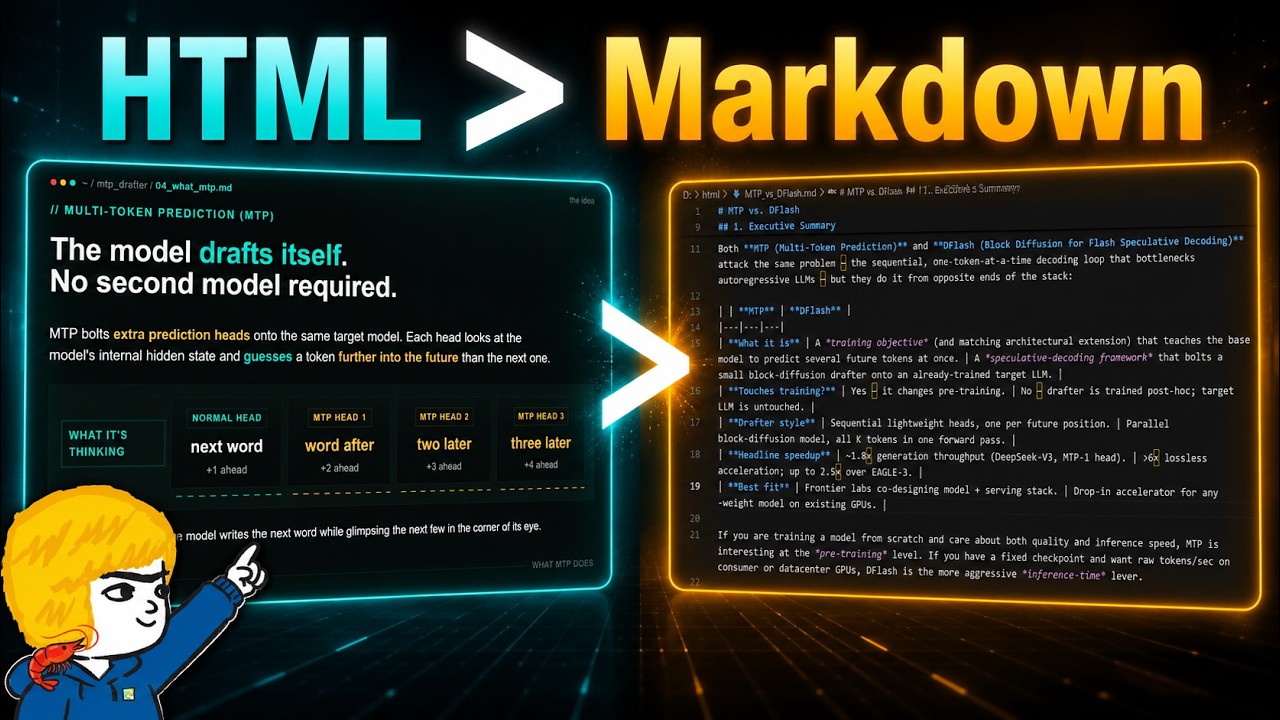
The video discusses a recent article by Theariq from Anthropic, which argues that HTML is a superior format to Markdown for AI agent responses. While Markdown has been the default due to its simplicity, readability, and ease of use, Theariq suggests that as AI models become more capable, Markdown’s limitations become a bottleneck. HTML offers a richer vocabulary and greater flexibility, enabling more complex visualizations, interactive elements, and better organization, which can significantly enhance the readability and usefulness of AI-generated reports.
Markdown is praised for its plain text syntax, compatibility with various tools, and ease of editing, making it suitable for about 80% of agent outputs. However, its simplicity restricts the presentation of dense or complex information, especially in longer documents. Theariq highlights that humans struggle to read lengthy Markdown files, which often lack visual clarity and interactivity. HTML, on the other hand, supports tables, images, videos, collapsible sections, and responsive layouts, making it easier for readers to navigate and understand large amounts of information.
The video also covers common objections to using HTML, such as increased token usage, slower generation times, difficulty in viewing without a browser, and noisy version control diffs. Theariq acknowledges these issues but argues that the benefits outweigh the costs, especially with modern models supporting large context windows and the ease of sharing HTML files via browsers. Additionally, Andrej Karpathy supports this view, emphasizing that visual and interactive formats like HTML better leverage the brain’s capacity for processing visual information, making AI outputs more human-friendly.
To demonstrate the practical differences, the presenter compares AI-generated reports on a technical topic in both Markdown and HTML formats. The Markdown report, while comprehensive, is difficult to read due to poor formatting and limited visual aids. In contrast, the HTML report includes clickable contents, color-coded sections, clear charts, and better-structured information, making it far more accessible and engaging. The presenter further enhances the HTML report by converting it into a slideshow with images and even a short video, showcasing the potential for richer, multimedia AI outputs.
In conclusion, the video advocates for treating output format as a design choice rather than defaulting to Markdown. HTML’s flexibility and interactivity can significantly improve the clarity, usability, and shareability of AI-generated content. While Markdown remains useful for simple tasks, HTML opens the door to more sophisticated presentations that better support human understanding. The video encourages viewers to experiment with HTML outputs today and hints at a future where AI responses might evolve into fully interactive, neural-generated multimedia experiences.