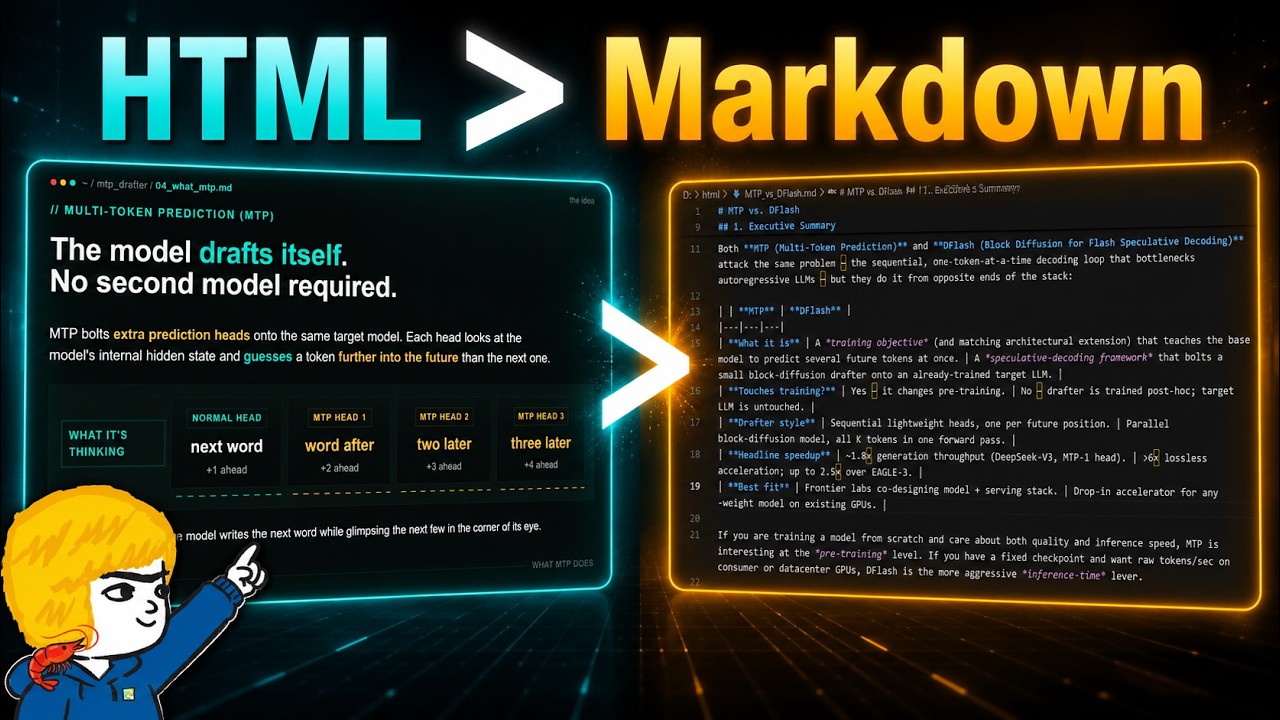
The video discusses a recent article by Theariq from Anthropic that argues HTML is a superior format to Markdown for AI agent responses. While Markdown has been the default due to its simplicity, readability, and ease of use, Theariq suggests that as AI models become more capable, Markdown’s limitations become a bottleneck. HTML offers a richer vocabulary, allowing for more complex visualizations, colors, diagrams, and interactive elements that Markdown cannot support. This makes HTML better suited for longer, more detailed reports and specifications that are easier for humans to read and navigate.
The video outlines five key arguments in favor of HTML over Markdown. First, HTML supports much higher information density with tables, images, videos, and interactive controls, whereas Markdown is limited to basic formatting like bullet points and code blocks. Second, HTML improves visual clarity and readability, especially for longer documents, by enabling features like collapsible sections, sidebars, and responsive layouts. Third, HTML files are easier to share since they open natively in any web browser, unlike Markdown which often requires special viewers or conversion. Fourth, HTML allows two-way interaction with elements like sliders and toggles that can feed user input back to the AI. Finally, HTML integrates better with data ingestion and context grounding, especially when used with agents like Claude Code.
The video also addresses common counterarguments against HTML, such as higher token costs, slower generation times, difficulty in editing, and noisy version control diffs. Theariq acknowledges these issues but argues that the benefits outweigh the costs, especially with modern large context window models and the fact that HTML outputs are usually generated once and then consumed multiple times. Viewing HTML locally or hosting it online is straightforward, and while diffs can be noisy, this is a manageable tradeoff for the improved usability and presentation.
Supporting this perspective, Andrej Karpathy tweeted that structuring AI responses as HTML leads to better, more visual outputs and suggested a progression from raw text to Markdown to HTML as increasingly human-friendly formats. He envisions future steps involving interactive and neural-generated video outputs, emphasizing that visual channels are the highest bandwidth for human information processing. The video creator demonstrates this by comparing Markdown and HTML reports generated by Claude Code on the same topic, showing how HTML’s richer formatting, color coding, and navigation features make the report more accessible and engaging.
Finally, the video explores pushing HTML outputs further by converting them into slideshows with AI-generated images and even short videos, illustrating the potential for more dynamic and interactive presentations. While not yet practical for everyday use, these enhancements point toward a future where AI-generated content is not just text-based but highly visual and interactive, improving comprehension and engagement. The video concludes by encouraging viewers to consider HTML as a design choice for AI outputs to enhance understanding and usability, inviting comments and subscriptions for more AI insights.