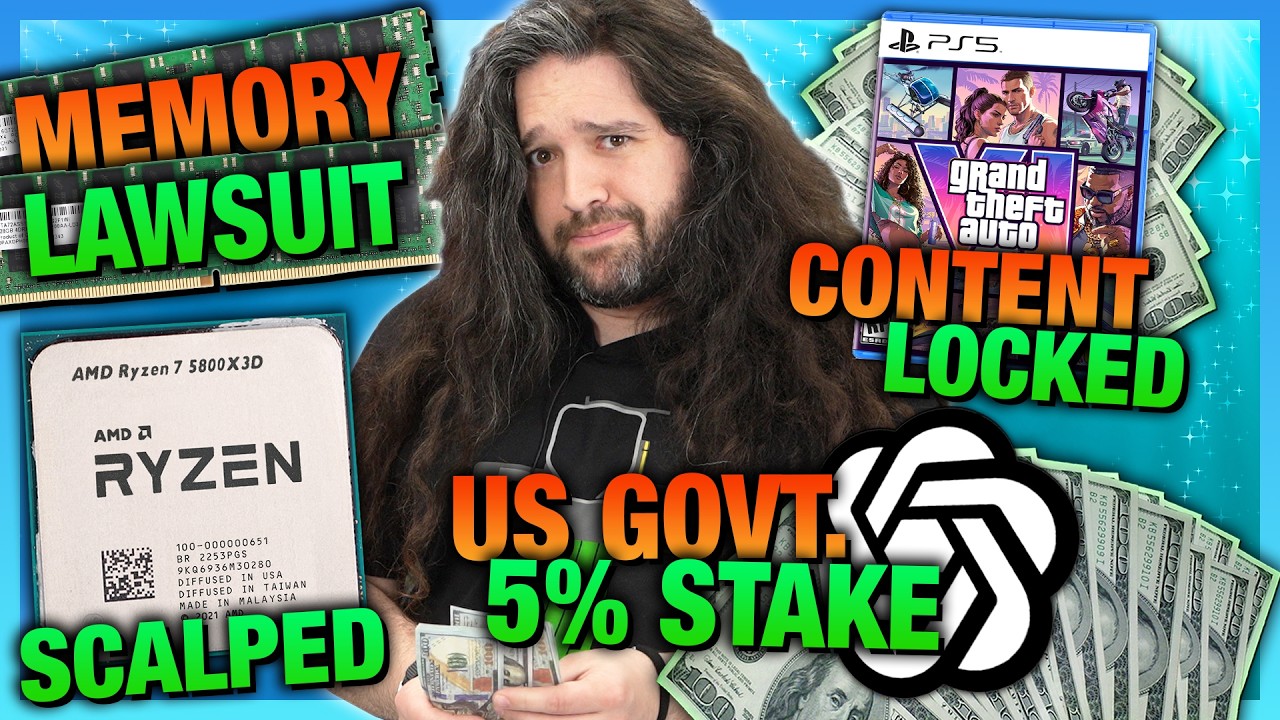
In this week’s Hardware News Recap, several major industry developments were discussed, starting with OpenAI reportedly offering the U.S. government a 5% stake in the company. This move, possibly aimed at easing investor concerns about regulation and maintaining the AI market bubble, follows a pattern where the government takes equity in tech firms. Meanwhile, a significant antitrust lawsuit has been filed against the three largest DRAM manufacturers—Micron, Samsung, and SK Hynix—accusing them of colluding to fix prices and restrict production, which allegedly caused DRAM prices to surge by approximately 700% over four years. This lawsuit echoes past cartel convictions and highlights ongoing concerns about anti-competitive behavior in the memory market.
On the semiconductor front, Samsung and SK Hynix are planning a massive $518 billion fab expansion in South Korea to dominate the AI sector. However, insiders warn that despite this investment, consumer access to silicon will remain limited as production capacity will prioritize high-value data center clients, keeping prices elevated. Lenovo also weighed in, stating that DRAM and NAND prices are unlikely to return to previous lower levels due to sustained AI demand, a sentiment that underscores the ongoing scarcity and high cost of memory components.
AMD re-released its popular 5800X3D CPU with an updated bonding process, but the new batch quickly sold out and scalpers are reselling it at inflated prices. This re-release, priced lower than the original launch, appears to be a strategic move to cater to consumers who cannot afford newer platforms due to high RAM prices, effectively capitalizing on the memory shortage by supporting older AM4 systems. The CPU remains highly regarded for gaming performance, but availability and pricing issues persist.
Legislative developments include the introduction of the Kids Internet and Digital Safety Act (Kids Act), a comprehensive bill aimed at protecting children online. While it ostensibly focuses on shielding minors from harmful content and scams, critics argue that it effectively pushes for increased identity verification and online censorship, potentially weakening privacy protections. The bill’s provisions could pressure platforms to implement age verification measures indirectly, raising concerns about surveillance and user privacy.
Finally, Rockstar Games revealed that GTA 6 will be priced at $80 for the standard edition and $100 for the ultimate edition, which includes exclusive digital content but no physical discs. This digital-only approach aligns with Sony’s announcement that it will cease physical disc production for new games after January 2028, signaling a broader industry shift toward digital distribution. While this trend reflects changing consumer preferences, it also raises concerns about game preservation, accessibility for those without high-speed internet, and the elimination of used game sales, drawing mixed reactions from the gaming community.