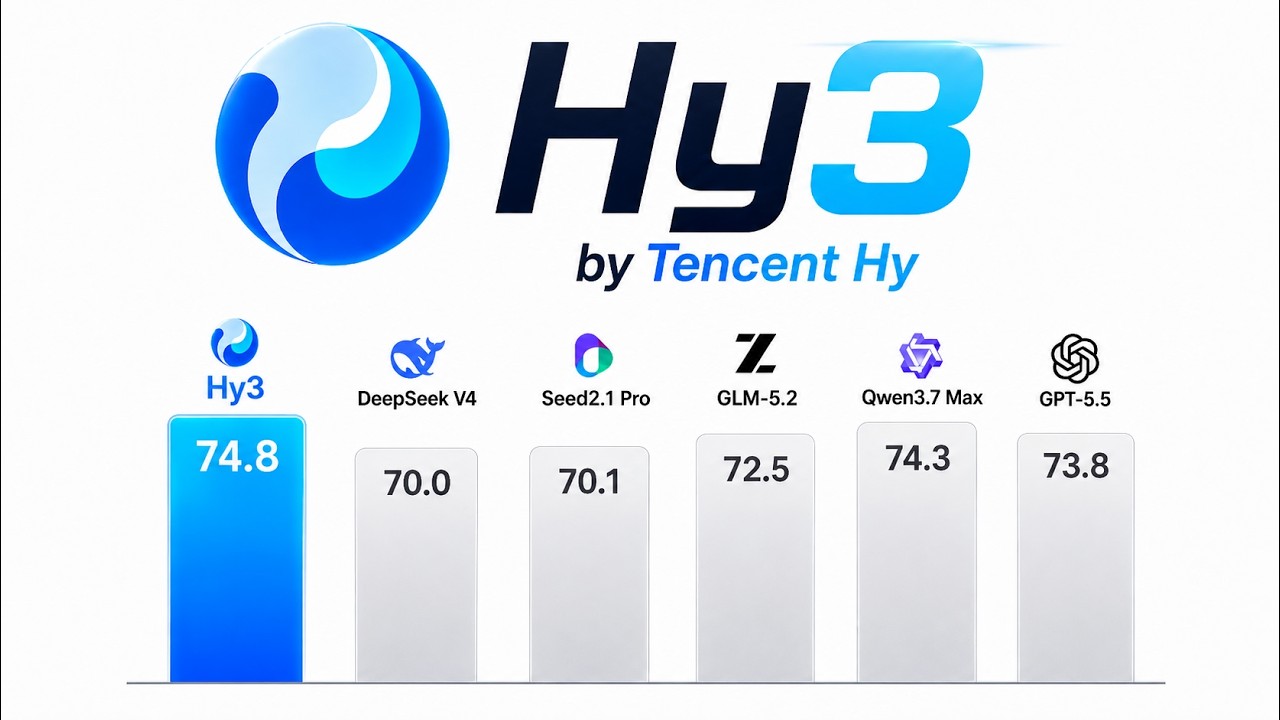
Tencent recently launched the fully complete version of their Hy3 model, a significant development in the open AI ecosystem. Previously in preview, this 295 billion parameter mixture of experts model features 21 billion active parameters and a 3.88 billion parameter speculative decoding model to enhance speed. While its context window of 256K tokens is smaller than some competitors like GLM 2.5, Hy3 is designed to excel in agentic tasks rather than coding, where models like GLM 5.2 currently outperform it. Tencent’s move signals their ambition to become a frontier lab supporting open AI development, leveraging their strong deep learning team and vast ecosystem, including their dominance with WeChat and gaming assets.
Hy3 is particularly suited for companies seeking a powerful, locally deployable model that can be fine-tuned for specific use cases. Although it remains a large model, it is more accessible than some of the largest models requiring expensive hardware, making it a practical option for mid-tier applications. Currently, a free version of Hy3 is available on OpenRouter for two weeks, allowing users to test its capabilities without cost. Early indications suggest that pricing for paid versions will be competitive, especially compared to larger models like GLM 5.2, making Hy3 an attractive alternative for certain enterprise needs.
In practical tests, Hy3 demonstrated strong performance in generating complex outputs such as detailed SVG images, long-form essays, and HTML coding tasks. The model shows a high-quality chain of thought in reasoning tasks, although it lacks explicit controls for toggling long-chain reasoning. Its outputs are generally well-structured and coherent, with improvements over the preview version evident in more accurate and polished results. However, the free version can experience slow response times and rate limiting, which may affect user experience during peak usage.
Hy3 also excels in handling tool calls and multi-step agentic workflows, passing various tests related to tool use and error handling with high accuracy. It maintains focus despite irrelevant or distracting inputs and can retry failed tool calls effectively. Additionally, the model can generate interactive content such as HTML5 games, albeit with longer processing times. These capabilities highlight Hy3’s strength in agentic and interactive applications, positioning it as a versatile tool for developers building complex AI-driven systems.
Overall, Hy3 represents a promising new entrant in the mid-tier large language model space, offering a balance between size, performance, and accessibility. Tencent’s commitment to reducing hallucinations and improving output quality through better training and data cleaning is evident. While it may not surpass the very largest models in raw power, Hy3’s focus on practical utility and local deployment makes it a compelling choice for enterprises and developers. Users are encouraged to try the free version and share their experiences, as the model’s ecosystem and hardware support continue to evolve.