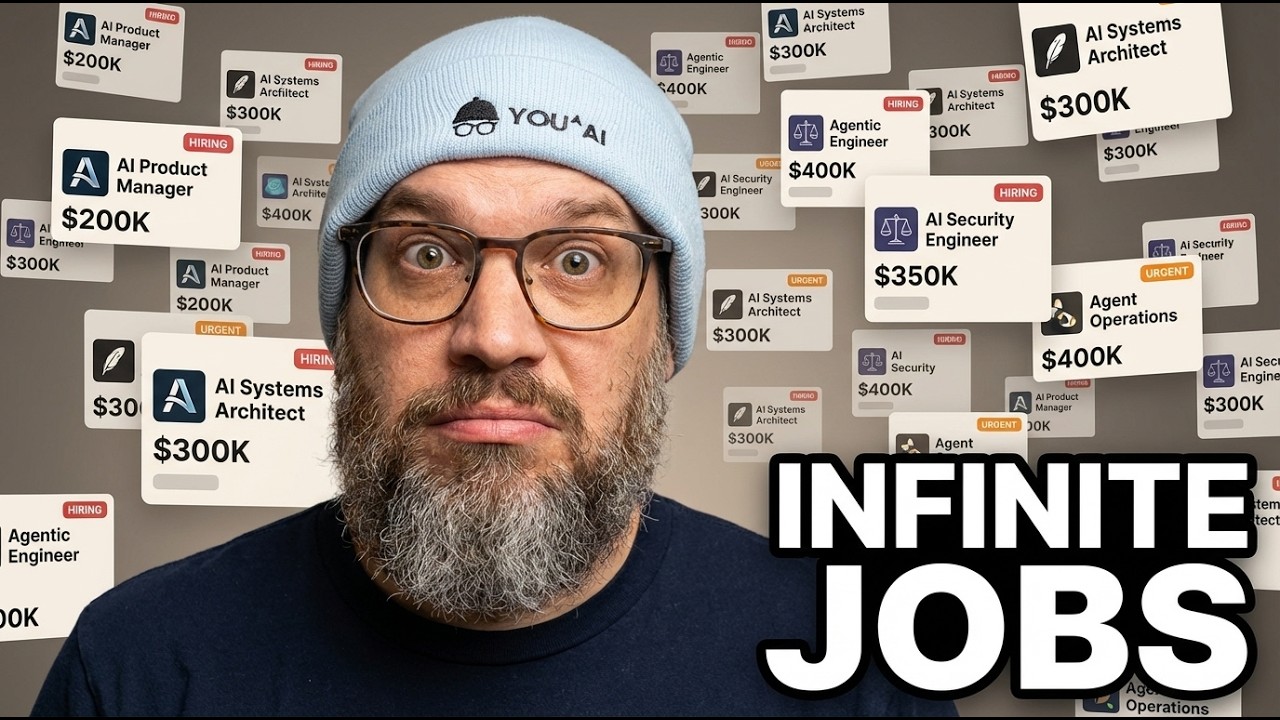
The current AI job market is uniquely expansive and highly competitive, with demand far outstripping supply. Unlike traditional knowledge work roles, which are flat or declining, AI-specific roles—those focused on designing, building, operating, and managing AI systems—are growing rapidly. There are currently over three AI job openings for every qualified candidate, leading to long hiring times and high salaries for those with the right skills. However, many employers struggle to fill these roles due to a mismatch between what candidates claim and the actual skills needed, as well as some companies using interviews as learning tools rather than genuine hiring processes.
From analyzing hundreds of AI job postings, seven core skills consistently emerge as essential for success in AI roles. The first is specification precision, or the ability to clearly and precisely communicate intent to AI agents, which cannot infer meaning like humans do. Closely tied to this is evaluation and quality judgment—the skill of critically assessing AI outputs to detect errors, edge cases, and failures, rather than being misled by AI’s confident but sometimes incorrect responses. These skills are fundamental across engineering, operations, and product management roles and require a mindset of rigorous quality control.
Another critical skill is managing multi-agent systems, which involves decomposing complex tasks into manageable parts and delegating them effectively to different AI agents. This requires clear task definitions and guardrails, as agents lack the flexibility of human teams and need precise instructions to function correctly. Alongside this is failure pattern recognition, the ability to identify and diagnose common AI failure modes such as context degradation, specification drift, tool selection errors, cascading failures, and silent failures—issues that can severely impact system reliability and require deep technical understanding to resolve.
Trust and security design form the fifth key skill, focusing on building reliable guardrails around AI systems to ensure they operate safely and predictably in production. This includes understanding the cost of errors, reversibility of mistakes, frequency of failures, and verifiability of outputs to maintain high standards of functional correctness rather than just semantic plausibility. Context architecture is another advanced skill, involving the design of data systems that supply AI agents with the right information at the right time, enabling scalable and efficient AI operations. This skill is akin to creating a well-organized library system that AI can navigate effectively.
Finally, cost and token economics is a senior-level skill that involves calculating the financial viability of AI tasks by analyzing token usage and model pricing. Professionals must optimize model selection and task design to ensure that AI deployments are cost-effective and deliver a strong return on investment. These seven skills cut across various job titles and functions, reflecting the evolving nature of AI work. They are learnable and in high demand, offering a clear pathway for individuals seeking to thrive in the AI job market. The video also offers resources and guidance for developing these skills, emphasizing that mastering them can open doors to lucrative and fulfilling AI careers.