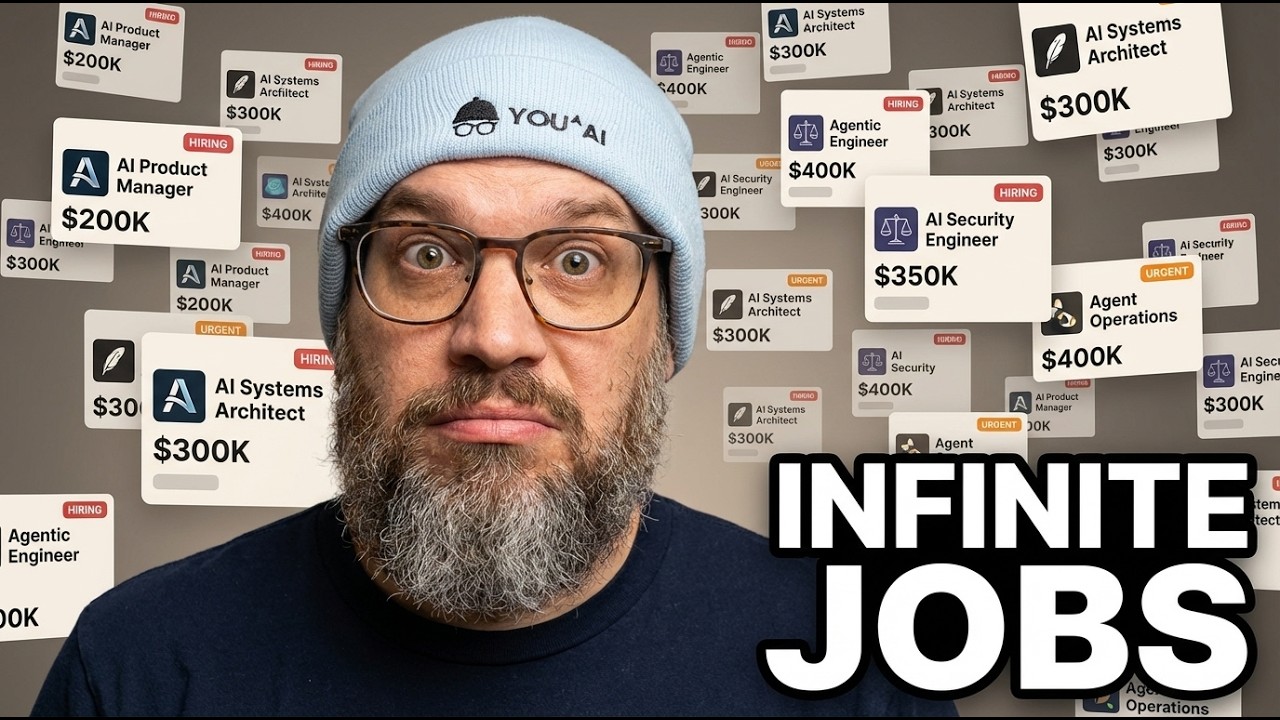
The current AI job market is uniquely expansive and highly competitive, with demand far outstripping the supply of qualified talent. Unlike traditional knowledge work roles, which are flat or declining, AI-specific roles are growing rapidly, with more than three job openings for every qualified candidate. This has created a K-shaped job market where employers struggle to fill AI roles, while many applicants either overstate their skills or face confusion due to vague or misleading job postings. The speaker emphasizes that AI talent is in desperate demand across companies of all sizes, and those with the right skills can command premium opportunities.
The video identifies seven core skills that are consistently sought after in AI job postings, derived from a detailed analysis of hundreds of listings. The first skill is specification precision, or the ability to clearly and precisely communicate intent to AI agents, which unlike humans, require explicit instructions without ambiguity. Closely related is evaluation and quality judgment, the critical skill of assessing AI outputs for correctness and detecting errors, especially since AI can confidently produce fluent but incorrect responses. This skill involves building automated evaluation systems and developing a mindset to critically analyze AI behavior rather than accepting outputs at face value.
Another essential skill is managing multi-agent systems, which involves decomposing complex tasks into manageable parts and delegating them effectively to different AI agents. This requires a clear understanding of task boundaries and the ability to design workflows that agents can reliably execute, which differs significantly from managing human teams due to the rigid and literal nature of AI agents. Complementing this is failure pattern recognition, the ability to diagnose and address common AI failure modes such as context degradation, specification drift, tool selection errors, cascading failures, and silent failures that produce plausible but incorrect results.
The video also highlights the importance of trust and security design in AI systems, focusing on how to implement appropriate guardrails, define human-agent boundaries, and manage the risks associated with AI decision-making. This includes understanding the cost of errors, reversibility of mistakes, frequency of failures, and verifiability of AI outputs to ensure functional correctness rather than just semantic plausibility. Context architecture is another advanced skill, involving the design of systems that supply AI agents with the right information at the right time, akin to building a searchable library of company data that agents can efficiently navigate to perform tasks at scale.
Finally, the seventh skill is cost and token economics, which requires the ability to calculate and optimize the cost-effectiveness of AI tasks based on token usage and model selection. This skill is crucial for ensuring that AI deployments are financially viable and deliver a good return on investment, especially as pricing models and token costs evolve rapidly. The speaker stresses that these skills are not limited to engineers but span operations, product management, and architecture roles, and are foundational to the future of AI work. To support learners and employers, the speaker is creating a detailed guide, a job board, and educational resources to help people develop these in-demand skills and connect with opportunities in the AI job market.