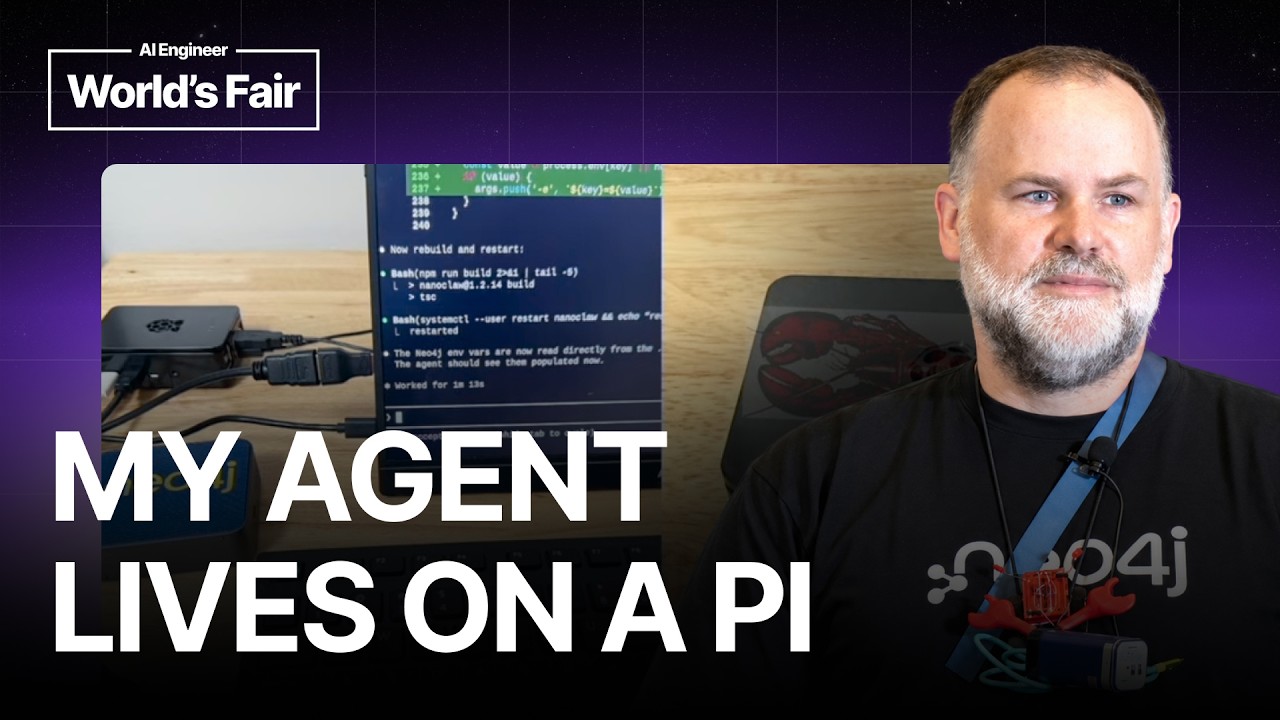
Jeremy Adams from Neo4j presents his personal AI agent project built on a Raspberry Pi, focusing on integrating graph databases with AI agents. He begins by introducing the concept of personal AI agents, mentioning tools like Open Claw and Nano Claw, and highlights his preference for a cheap, open, and hackable solution rather than relying on commercial products. Using a Raspberry Pi 4B, he demonstrates how he set up the hardware and software, including Docker containers running Neo4j and the Nano Claw agent SDK, to create a local AI agent that communicates via WhatsApp.
Adams explains the architecture of his system, where messages from his phone are sent through WhatsApp to the Raspberry Pi agent, which then interacts with cloud-based services for processing. He emphasizes that while the AI’s “brain” operates in the cloud, the local device manages communication and data storage. He also introduces the concept of agent memory, inspired by the POLE+O model (Person, Object, Location, Event, Organization), which he implemented using Neo4j to store and organize memories as graph data. This memory system allows the agent to recall past interactions and contextual information effectively.
The presentation includes a live demonstration of the agent’s capabilities, showing how it can query a movie database stored in Neo4j and respond to natural language requests. Adams also discusses his experiments with offline functionality, such as using a USB microphone to capture voice input, convert it to text, and store relevant data locally when Wi-Fi is unavailable. He highlights the importance of offline mode for real-world scenarios like conferences, where connectivity can be unreliable.
Adams shares his experience using the agent at events, where he recorded information from various exhibition stands and organized it into a local Neo4j database. He created a simple data model to capture booth numbers, names, and notes, which he later enriched and uploaded to the cloud. This approach enabled him to generate new insights by connecting related themes and topics across different exhibitors, demonstrating the power of graph databases in knowledge discovery and organization.
In conclusion, Jeremy Adams invites viewers to explore Neo4j’s Graph Academy for hands-on learning and encourages them to visit the Neo4j stand for further discussions. His project showcases how combining personal AI agents with graph databases can create a powerful, customizable, and portable system for managing memories and knowledge. The Raspberry Pi-based setup exemplifies an accessible and hackable approach to AI agent development, blending local processing with cloud intelligence.
Useful Links