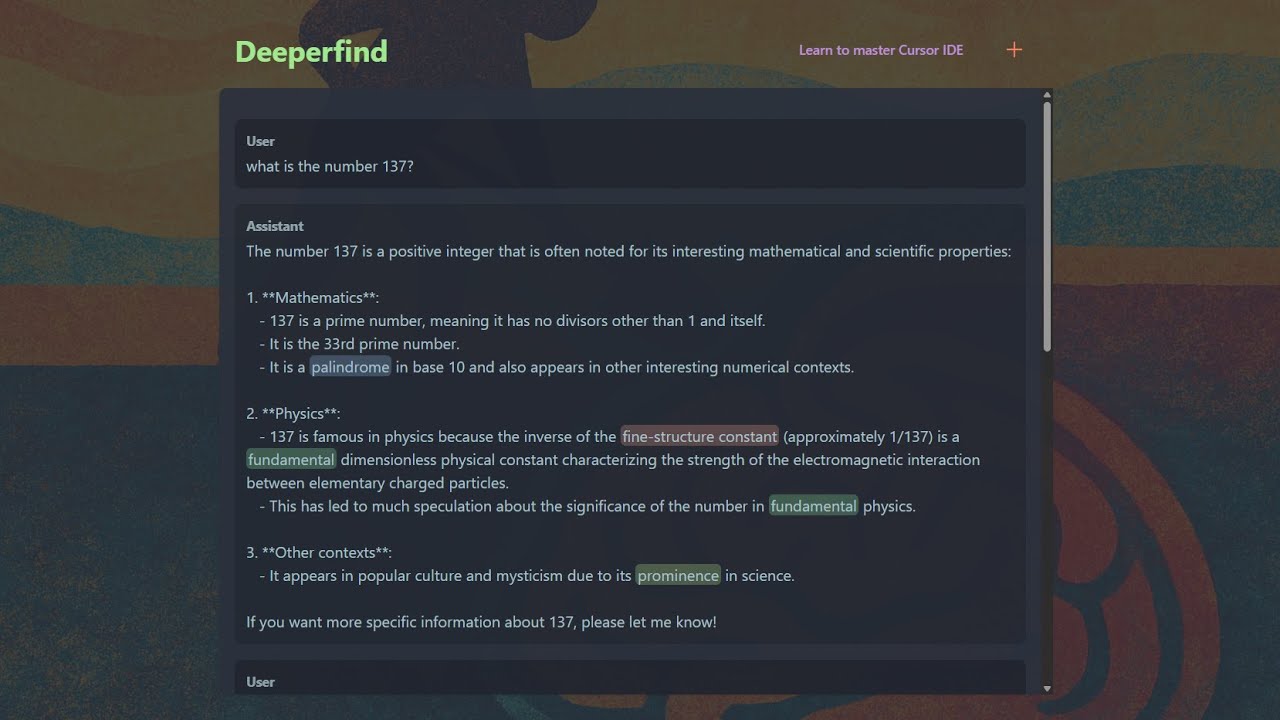
In the video, the creator introduces Deeperine, a research app designed to help users understand specific texts within an assistance response. The app allows users to select words or phrases, which then trigger automatic explanations displayed in popups. These explanations can be revisited later, even after refreshing the page, enabling users to delve deeper into topics like the fine structure constant or Planck’s constant without cluttering the chat interface. The app also marks all instances of explained words throughout the conversation, facilitating continuous learning within the chat environment.
The developer discusses the technical aspects of Deeperine, highlighting that it is built as a fast API web app using a single Python file for the backend, with additional models.py for database management. The frontend is composed of modular JavaScript components, utilizing AlpineJS for efficient state management. The app incorporates moderation features, including OpenAI’s omni moderation API and a profanity filter via Better Profanity, ensuring safe and appropriate interactions. The code is available for download on Patreon, allowing others to experiment with, modify, and deploy the app independently.
Beyond Deeperine, the creator shares insights from building other web applications, such as League of Prompts and Liximix. League of Prompts is a competitive platform where users craft prompts to generate haikus and climb leaderboards, fostering engagement and creativity. The developer emphasizes the value of using simple stacks like pure JavaScript and FastAPI, noting that these tools make development straightforward, quick, and easy to update. They also mention experimenting with Ginga for templating, similar to React or Next.js, to manage complex components and partials effectively.
The creator reflects on their experience with rapid app development, citing how quickly they built various projects—Deeperine in about 8 hours, League of Prompts in a few days, and Liximix in just 5 hours. They highlight the importance of choosing a stack that feels manageable and familiar, with Python and AlpineJS being particularly effective for their workflow. The use of AlpineJS for state management and templating has been instrumental in simplifying development, especially for multi-page or component-heavy applications, making the process more efficient and less overwhelming.
In conclusion, the developer shares their ongoing journey of learning and building, emphasizing the importance of simplicity and familiarity in technology choices. They plan to produce more content explaining their findings and encourage viewers to try out Deeperine. They also invite feedback and engagement, aiming to refine their approach and continue creating innovative web apps. Overall, the video offers insights into practical app development, tool selection, and the importance of iterative learning in building effective, user-friendly applications.