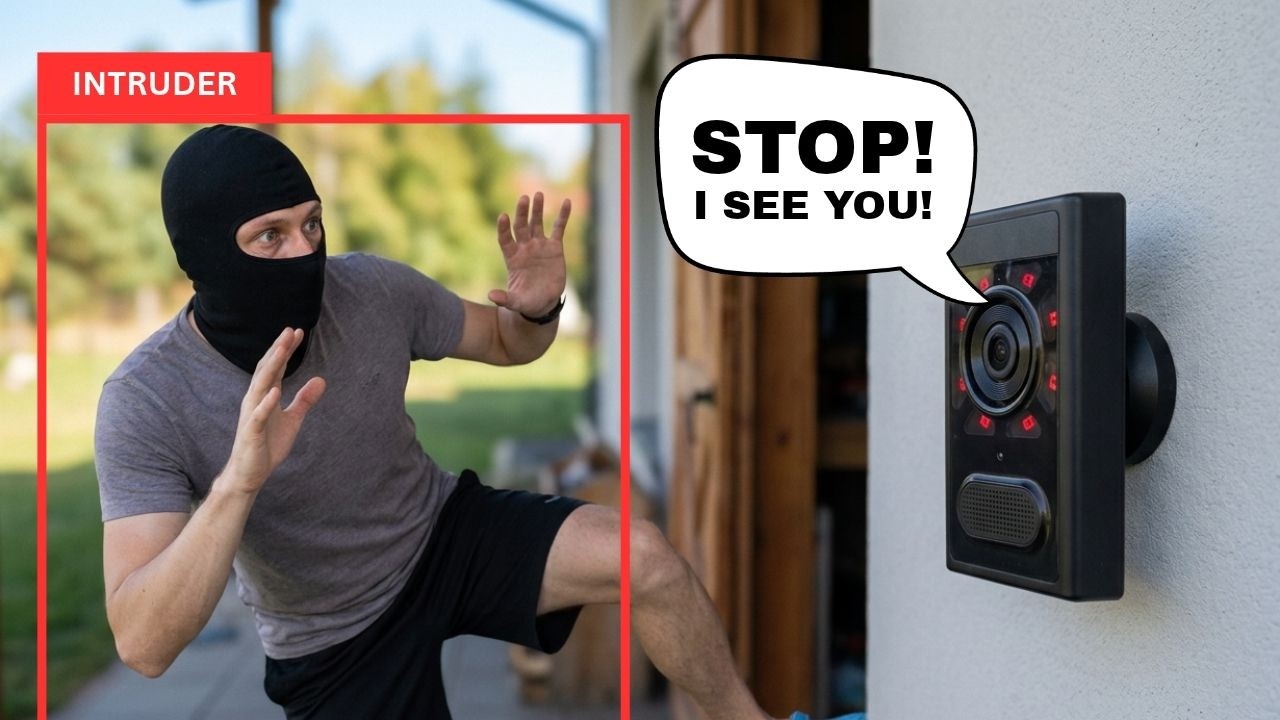
The creator developed an AI-powered security camera system using the Qualcomm Dragon Wing board that analyzes video feeds in real-time to deliver personalized vocal warnings to intruders, enhancing home security with context-aware alerts while maintaining user privacy through local processing. Despite challenges integrating various camera types, the system effectively distinguishes between harmless visitors and threats, providing a proactive and energy-efficient alternative to traditional security cameras.
The video begins with the creator expressing frustration with traditional security cameras that merely record footage for later review, often sending numerous irrelevant notifications that users tend to ignore. To address this, the creator proposes building an AI-powered security camera system that actively screams personalized warnings at intruders based on real-time analysis of the camera feed. The goal is to develop a system compatible with various cameras, energy-efficient, user-friendly, and capable of generating context-aware vocal alerts rather than generic messages.
The hardware foundation for this project is the Qualcomm Dragon Wing evaluation board, featuring a powerful IQ9075 processor capable of handling intensive AI tasks with low power consumption. After setting up the board with Ubuntu and exploring AI models from Qualcomm’s AI Hub, the creator tests multimodal models like Gemma 4, which can process images and video frames effectively. These models run efficiently on the Dragon Wing, consuming about 20 watts while generating detailed text outputs, which form the basis for the personalized vocal warnings.
Developing the software involved overcoming challenges related to integrating various types of cameras, especially battery-powered ones that do not stream continuously but only activate upon motion detection. While real-time streaming protocol (RTSP) cameras were straightforward to integrate, battery-powered cameras posed reliability issues. A clever workaround was to use a Bluetooth speaker to play the AI-generated messages, although this led to some humorous confusion when the speaker unexpectedly switched languages due to interference from another device.
Testing the system showed promising results, with the AI accurately assessing threat levels and generating appropriate vocal warnings through connected speakers. The system could distinguish between harmless visitors like neighbors or delivery personnel and potential intruders, personalizing messages based on detected behavior and appearance. The creator also emphasized the importance of local processing to maintain privacy, as all video analysis and response generation occur on the Dragon Wing device within the home network, without relying on cloud services.
In conclusion, the AI-powered screaming camera system offers a proactive approach to home security by combining real-time video analysis with personalized vocal alerts. The project demonstrates effective integration of AI models, hardware, and software to create a responsive and privacy-conscious security solution. The creator expresses satisfaction with the system’s performance and thanks Qualcomm Technologies for sponsoring the project, encouraging viewers to explore the Dragon Wing platform for similar applications.
Useful Links