Certainly! Here’s a five-paragraph summary of the video transcript:
The speaker recounts their experience at an AI startup, where they worked as a full stack developer, data engineer, and product manager, helping to build a multimodal RAG (Retrieval Augmented Generation) system for record labels. Before leaving, they designed the interview process to hire their replacement, reflecting on what skills and knowledge are truly necessary for the role often labeled as “AI engineer.” The speaker expresses skepticism about the title, noting that most so-called AI engineers are not training models or publishing research, but rather integrating AI into practical software products.
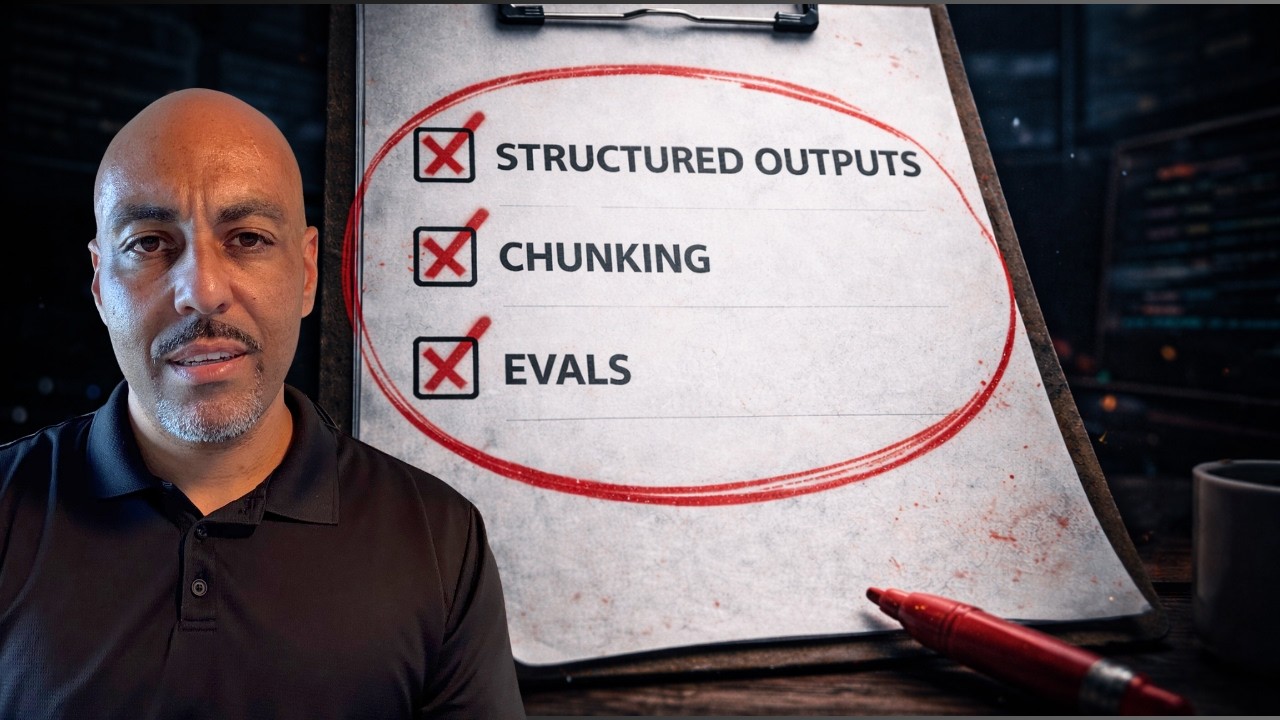
During the interview process, the speaker observed a significant gap between candidates’ theoretical knowledge and real-world, hands-on experience. Many applicants, even those who seemed smart or had impressive credentials, struggled with basic but essential concepts like structured outputs—making LLMs return data in a usable, schema-based format rather than unstructured text. Surprisingly, some candidates defaulted to parsing raw LLM responses with regex or manual JSON conversion, missing more robust and modern approaches.
Another key area where candidates faltered was in evaluating AI system performance and reliability. The best answers involved using evaluation datasets, curated prompts, and automated tools like LLM-as-judge to assess outputs, as well as observability tools (e.g., Langsmith, Helone) to monitor and debug systems. However, many candidates lacked this practical understanding, and some even attempted to cheat by covertly using AI tools during the interview, only to falter when asked follow-up questions that required genuine experience.
The most challenging technical topic for candidates was RAG (Retrieval Augmented Generation), which is central to many current AI applications. Many interviewees gave superficial answers about chunking documents but failed to consider important details like overlapping chunks for context, metadata management, or strategies for handling evolving data. Notably, none mentioned reranking—an essential technique for improving the relevance of retrieved documents before passing them to the language model.
The speaker concludes that there is a wide gap between AI hype and the skills needed to build robust, production-ready AI products. While prompt engineering and tool usage are popular topics online, true value comes from understanding data pipelines, evaluation, observability, and practical system design. The rarity of these skills means that developers who master them are highly sought after, and the speaker encourages others to focus on these areas to stand out in the field of AI engineering.