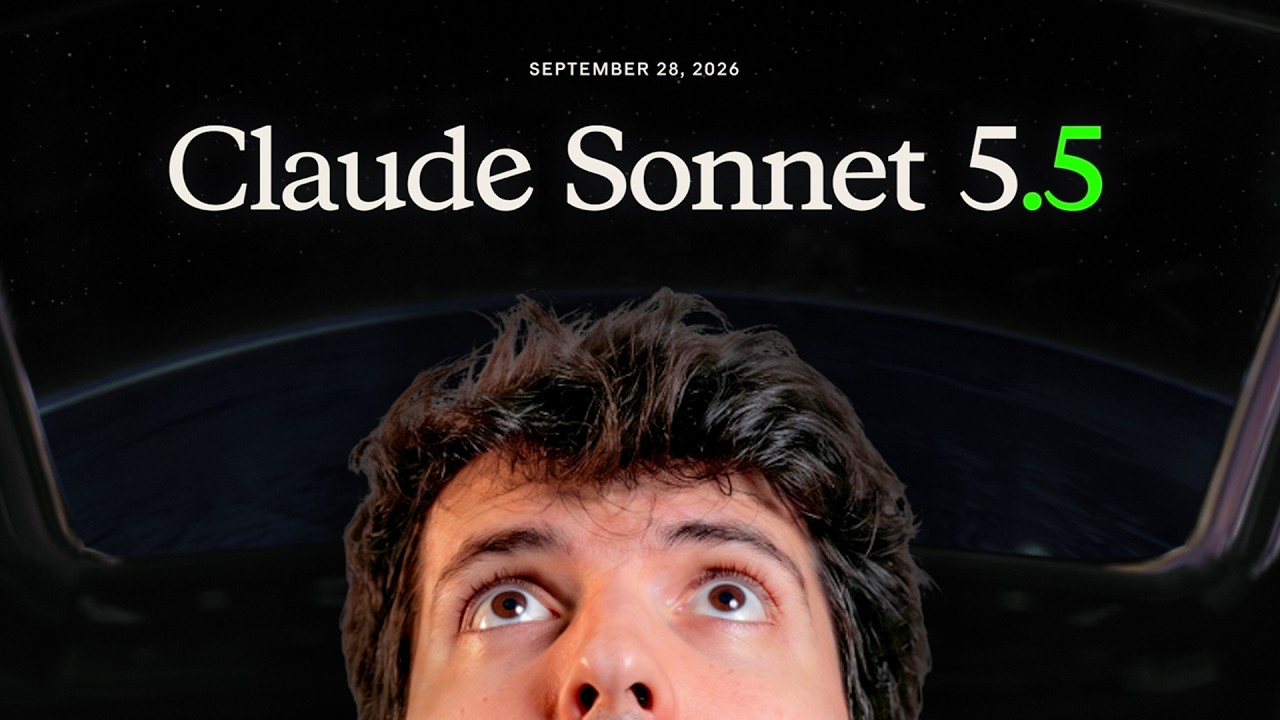
The video discusses Anthropic’s recent progress in AI models, focusing on the newly released Claude Sonnet 5.5. The presenter initially did not expect to be impressed by Sonnet 5.5, especially given the strong performance and value of Anthropic’s Opus 5.5 and Fable 5.1 models. However, Sonnet 5.5 surprised him with its capabilities, particularly as a cost-effective and strategically positioned model aimed at competing with OpenAI’s offerings. Despite benchmarks showing Sonnet 5.5 as more expensive and less intelligent than Opus 5.5 on some metrics, the model shines in specific use cases, especially for well-scoped everyday tasks and as a complementary tool within Anthropic’s model ecosystem.
Sonnet 5.5 is faster and up to 30% cheaper than its predecessor, Sonnet 5, and excels in tasks like bug fixing, document creation, and long-horizon work such as image understanding and playing games from screenshots. The model demonstrates significant improvements in reasoning capabilities, scoring notably higher on Terminal Bench 4 compared to earlier versions. However, the presenter cautions against using the “max” reasoning mode due to its excessive token consumption and diminishing returns, recommending medium or high settings instead. While Sonnet 5.5 is faster in raw token processing speed, its high token usage often results in longer overall task completion times compared to Opus 5.5.
A critical point raised is the model’s pricing structure, particularly the cost of cached token reads, which remains relatively high for Sonnet 5.5 compared to other Anthropic models. This pricing nuance means that despite lower input and output token costs, the overall expense for real-world agentic tasks may not be significantly cheaper than using Opus 5.5. The presenter emphasizes that Sonnet 5.5 is not the best choice for direct use by most users but is highly valuable as a sub-agent model that other models like Opus or Fable can call upon for specific analytical or research tasks within large codebases, offering a good balance of speed, cost, and effectiveness in these scenarios.
The video also reviews Sonnet 5.5’s design capabilities, noting that while it produces unique and somewhat creative outputs, it falls short compared to Opus 5.5 and especially Fable 5.1 in front-end design tasks. Despite this, Sonnet 5.5’s ability to collaborate and produce clearer, more structured outputs marks a significant improvement over previous Sonnet versions. The presenter shares personal experiences using Sonnet 5.5 in complex codebase analysis and cleanup tasks, highlighting its logical decision-making and efficiency in handling large-scale code audits, which further supports its role as a specialized tool rather than a general-purpose model.
In conclusion, the presenter views Sonnet 5.5 as a valuable addition to Anthropic’s model lineup, particularly as a cost-effective and efficient sub-agent for deep analytical tasks within codebases. While it may not replace Opus or Fable for everyday coding or design work, its strategic use can enhance overall workflow efficiency and reduce costs. The video ends with a reflection on the competitive landscape, noting that OpenAI currently lags behind Anthropic in several key areas, including model intelligence, efficiency, and pricing, and expresses anticipation for OpenAI’s upcoming responses and innovations.
Useful Links