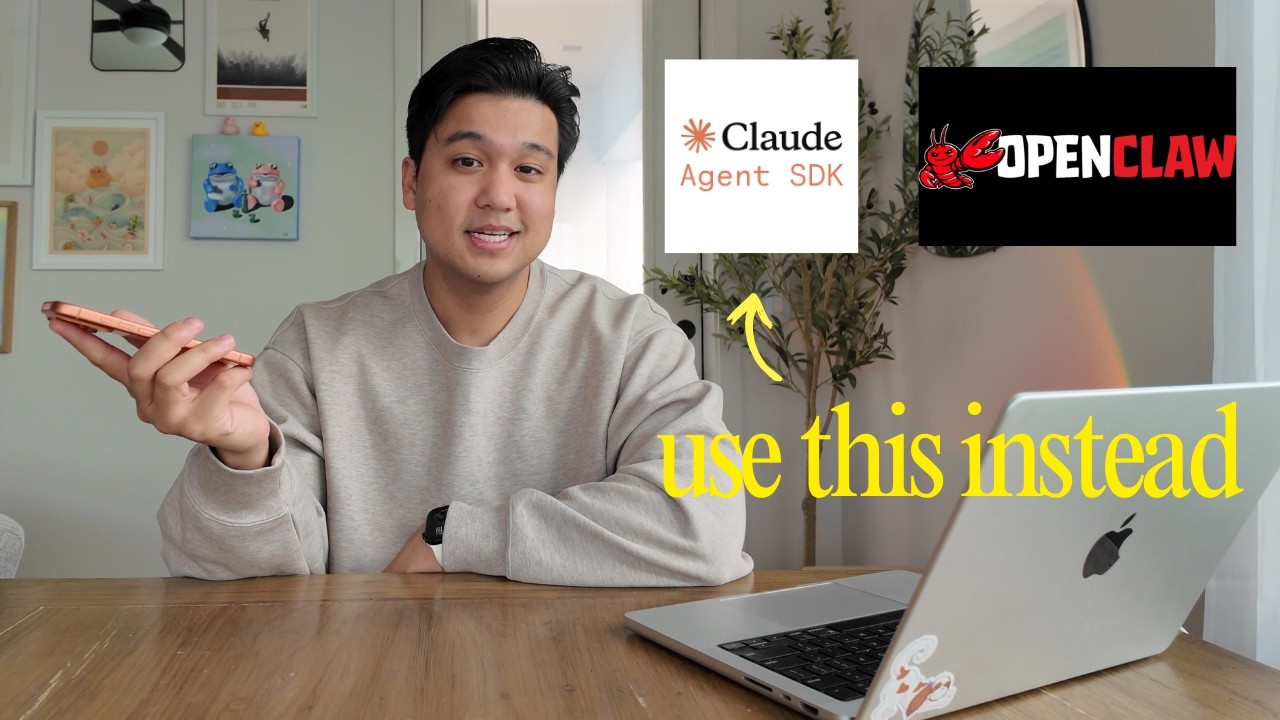
In this video, Chris shares his experience building a custom AI agent using Anthropic’s Agent SDK over the course of a week. His agent, named Luna L1, integrates with various tools such as iMessage, Slack, Gmail, Notion, ChartMogul, and App Store Connect, allowing it to perform tasks like surfacing urgent messages, answering business questions, and running scheduled workflows. Unlike standard chatbots, Luna L1 is highly thorough and personalized, offering more accurate and relevant responses, albeit with longer response times. Chris demonstrates the agent’s capabilities and explains how it’s more powerful than existing solutions like ChatGPT due to its deep integrations and custom memory system.
Chris then delves into the fundamentals of AI agents and the differences between popular frameworks. He explains that an agent typically consists of a large language model (LLM), a set of tools the LLM can control, and a loop that allows the agent to iteratively use these tools to complete tasks. While frameworks like Vercel’s AI SDK simplify some of the boilerplate code, Anthropic’s Agent SDK stands out by managing conversation context automatically, supporting context compaction, and providing access to robust built-in tools such as bash, file editing, and web search. The SDK also allows developers to leverage their Claude Code subscription for significant cost savings during experimentation.
A key architectural highlight is Chris’s approach to memory management. He categorizes memory into session memory (current conversation), persistent memory (important facts and preferences), and archival memory (large reference materials). By instructing the agent to proactively save critical information and corrections, Chris ensures Luna L1 remains highly personalized and context-aware. He uses Convex as the backend database, praising its real-time capabilities, ease of integration, and built-in features like cron jobs for automation.
Chris also discusses the implementation of tools and skills within the Agent SDK. Tools are defined using the Model Context Protocol (MCP), allowing the agent to interact with external services through well-structured schemas and handler functions. Skills, on the other hand, are organized as folders with metadata and markdown instructions, enabling the agent to load relevant capabilities on demand through a process called progressive disclosure. This system keeps the agent efficient by only loading necessary skills into context when required.
Despite the impressive results, Chris highlights significant limitations that prevent him from releasing Luna L1 to the public. The primary concern is cost—complex queries can be expensive, making consumer pricing impractical compared to mainstream AI services. Additionally, some integrations, like iMessage, rely on local machine access and cannot be replicated on a server, and handling sensitive authentication for third-party services poses security risks. Chris concludes that while custom agents are currently best suited for business (B2B) applications where higher costs are justified, he remains optimistic about future improvements in accessibility and deployment. He invites viewers to comment if they want a deeper dive into advanced features or deployment strategies.