The video is a comprehensive recap of the Supercomputing 2025 conference held in St. Louis, Missouri, a major annual event focused on high-performance computing (HPC), supercomputers, and related academic and industry research. The presenter describes the conference as a vibrant mix of industry and academia, with about 16,000 attendees and a show floor expanded by 30% to accommodate the growing number of exhibitors. The event features a wide range of booths from universities and companies, as well as numerous presentations and networking opportunities, including job fairs and student volunteer programs. The presenter emphasizes the value of attending for anyone interested in HPC, especially students.
On the show floor, the presenter highlights several notable technologies and companies. Broadcom showcased its next-generation TH6 DevO switch chip, a 102.4 Tbps optical switch with advanced cooling and connectivity features. Cadence demonstrated a five-chiplet UCIe design, showing high-speed interconnects over varying distances, which could have implications for future chip architectures. ASM, a sponsor, was mentioned for its atomic-level engineering in chip manufacturing. Kaleotech introduced a mathematical processing unit using “posits” instead of traditional floating-point numbers, aiming for greater accuracy and efficiency in numerical computations.
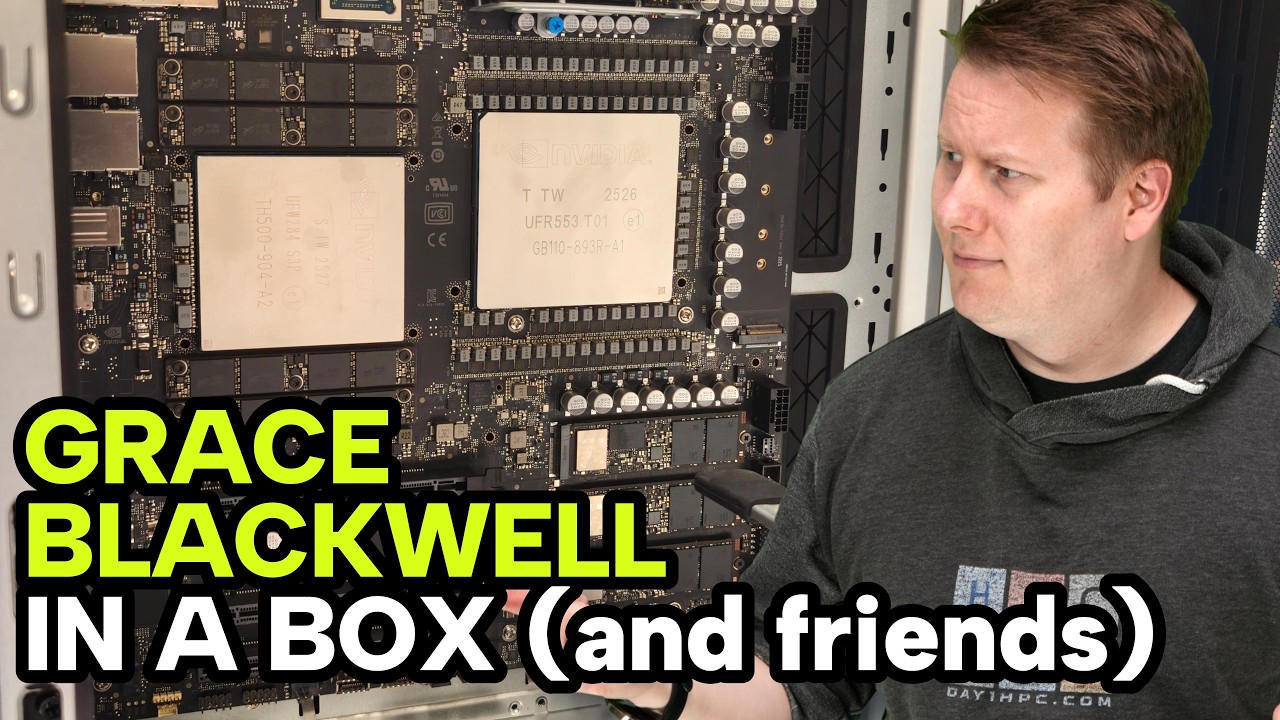
Other interesting exhibits included Sienna’s optical link running at 448 Gbps, Cisco’s custom switch silicon, and Cognifiber’s approach to computing with light directly in fiber optic cables, potentially revolutionizing matrix multiplication for AI workloads. The video also covers Nvidia’s DGX Station and Grace Blackwell superchips, with various OEM implementations from ASUS, MSI, and Supermicro, all designed for powerful AI and HPC tasks. HyperXL, a Korean AI inference accelerator company, presented its new chip architecture, while Lightmatter demonstrated its photonic computing solutions.
The presenter also touches on broader industry trends and updates. Dr. Heather West from IDC gave a talk on the state of quantum computing, highlighting the progress and challenges in the field, as well as the recent acquisition of Skywater by IonQ. The latest Top 500 supercomputer rankings were discussed, noting AMD’s dominance, the absence of new Nvidia Blackwell systems in the US, and China’s lack of submissions due to geopolitical reasons. The presenter questions whether the Top 500 list still accurately reflects the true state of global supercomputing.
Finally, the video wraps up with a look at additional hardware and companies, such as NEC’s upcoming vector engine developed with OpenChip, Nvidia’s NVLink switch silicon, BlueField 4 DPU, and SK Hynix’s HBM4 memory modules. The presenter also mentions Xena’s CXL memory expander and accelerator card, and shares anecdotes about the conference atmosphere, including celebrity appearances and networking opportunities. The overall message is that Supercomputing is a uniquely collaborative and exciting event, highly recommended for anyone in the field, especially students, and that it offers a rare chance to see cutting-edge silicon and meet key players in HPC.