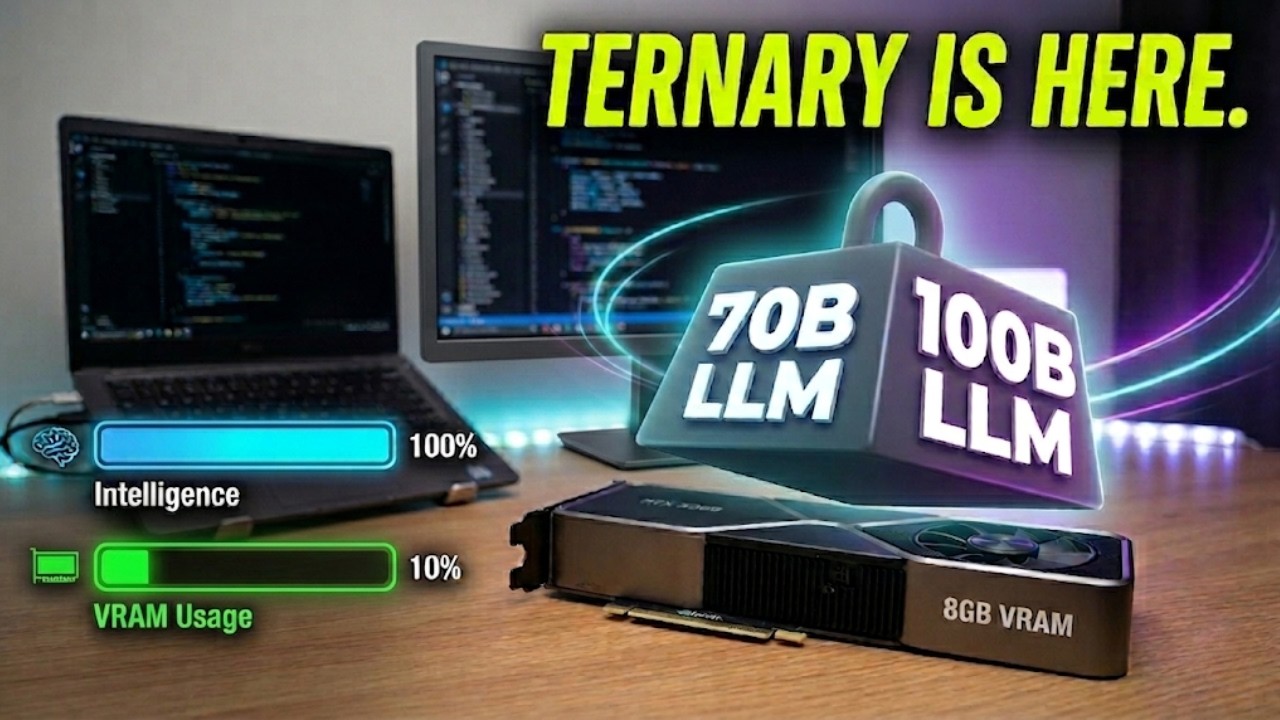
In this video, Timothy Carbat, founder of Anything LLM, discusses the exciting advancements in local AI models, focusing on the newly introduced ternary models by Prism ML. He begins by revisiting the concept of one-bit models, which drastically reduce the memory requirements of large language models (LLMs) by representing weights with just one bit, enabling models like an 8-billion parameter (8B) model to run efficiently on devices with limited resources such as phones or low-end laptops. While one-bit models offer significant memory savings and decent intelligence, they come with some accuracy trade-offs compared to traditional 16-bit models.
Timothy explains the technical background of model quantization, where models are compressed from 16-bit floating point precision to lower bit representations to save memory and computational power. Traditional two-bit quantization often results in poor model performance, whereas one-bit models, though more efficient, still have some accuracy loss. The ternary model, which uses three possible values (-1, 0, 1) instead of two, strikes a balance by maintaining accuracy close to the original 16-bit models while still offering substantial reductions in memory usage—about seven to eight times less than the full precision models.
He highlights the performance benchmarks comparing the ternary Bonsai 8B model to other models like the Quen 38B, showing that ternary models achieve near state-of-the-art accuracy with a much smaller file size (under 2 GB) and lower energy consumption. Timothy emphasizes that while benchmarks are useful indicators, the true test of a model’s quality is hands-on experimentation, which is easy and free with local models. He also notes the significant energy efficiency gains of ternary and one-bit models, making them attractive for running on various hardware, including CPUs and GPUs.
The video includes a practical demonstration of how to download and run the ternary Bonsai 8B model using a custom version of Llama CPP, compatible with different operating systems and hardware configurations. Timothy walks through the setup process, including downloading the model and the specialized Llama CPP fork from Prism ML, running the model locally, and integrating it with the Anything LLM tool for enhanced functionality like web scraping and document summarization. This hands-on approach showcases the accessibility and usability of these cutting-edge models for everyday users.
Finally, Timothy discusses the future potential of ternary and bitnet models, particularly the challenge of scaling beyond 8B parameters. While Prism ML has so far focused on 8B models due to computational costs, the prospect of running much larger models (e.g., 27B) locally with minimal resource requirements is tantalizing. Such advancements could revolutionize local AI by enabling powerful, cloud-like AI experiences directly on personal devices, combining efficiency, privacy, and performance. Timothy concludes by expressing optimism about the ongoing evolution of local AI and the exciting possibilities that ternary models bring to the field.