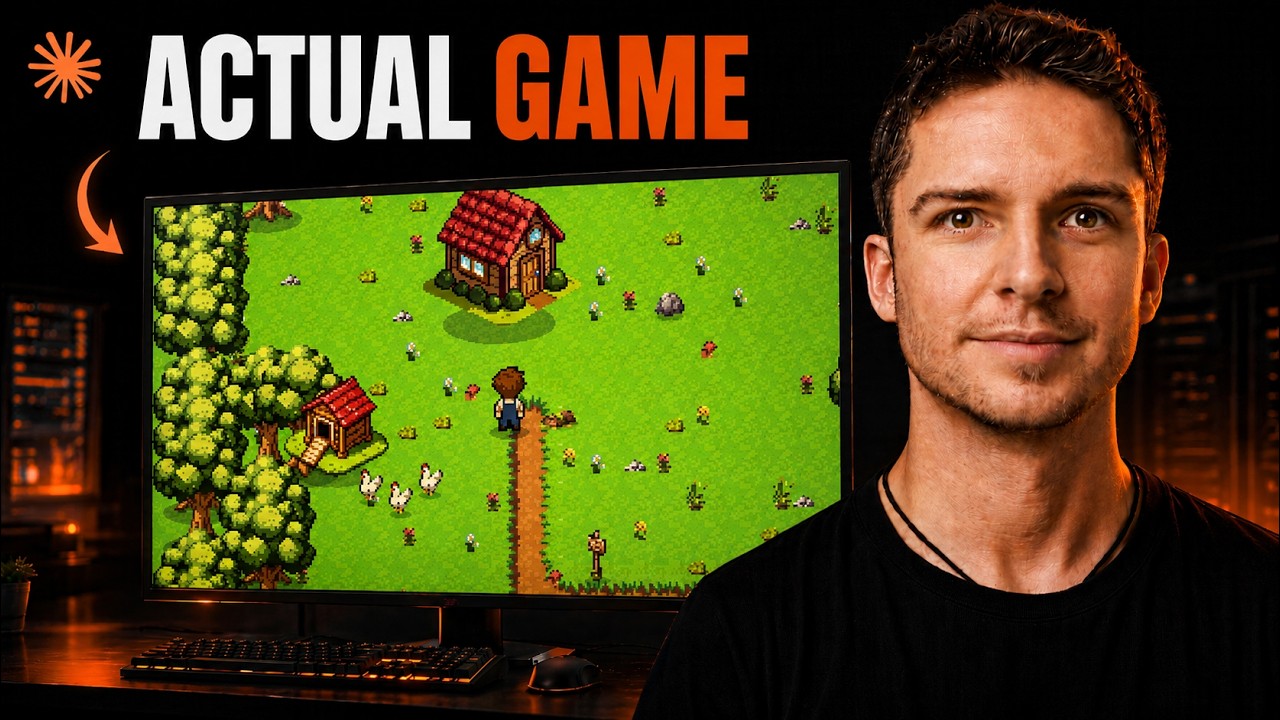
In this video, the creator demonstrates an impressive experiment where they tasked the AI model Claude Fable with building a pixel art RPG inspired by Stardew Valley, called “Claude Valley.” Despite not being a game developer, the creator provided a clear specification and leveraged tools like Pixel Lab for sprite generation, integrating them through MCP access. The AI was given freedom to pivot and improve the plan, and after just three prompts, it produced a working prototype of the game, complete with farming, fishing, mining, and NPC interactions, all running in a browser environment as recommended by the AI.
The development process involved detailed planning, including defining the game’s core mechanics such as walking, planting, day-night cycles, inventory, shops, and dialogue systems. The AI also handled art asset creation by communicating with Pixel Lab, which generated pixel art sprites and animations in parallel batches to speed up production. The creator monitored resource usage and costs, noting that although the process consumed a significant number of tokens, caching mechanisms greatly reduced expenses, resulting in a total cost of around $316 for the full build.
Throughout the build, the AI demonstrated problem-solving capabilities by troubleshooting issues like failed tile sets and optimizing the workflow to avoid context window bloat using sub-agents. It even added unprompted features such as sound effects, shadows, animals, and interactive elements like entering houses and dynamic NPC dialogue, showcasing a level of creativity and autonomy beyond the initial instructions. The creator reflected on the AI’s recommendation to build the game as a browser-based application, inviting game developers to explain this choice.
The video also touches on the broader implications of AI in creative fields, emphasizing that while AI can handle heavy lifting tasks, human creativity and artistic skills remain invaluable. The creator, a musician with 25 years of experience, expresses reluctance to use AI for music creation, highlighting the importance of human expression in art. They suggest using AI to augment tasks that are difficult or time-consuming while preserving the uniquely human elements that give creative works their soul and resonance.
In conclusion, the experiment showcases the remarkable potential of AI to autonomously develop complex projects like games with minimal human input, albeit at a high cost and limited availability. The creator encourages viewers to consider AI as a powerful tool for overcoming challenging tasks but advises balancing its use with personal creativity. They also provide resources for learning more about AI tools and invite engagement from the community, underscoring the evolving landscape of AI-assisted creation and its impact on various industries.