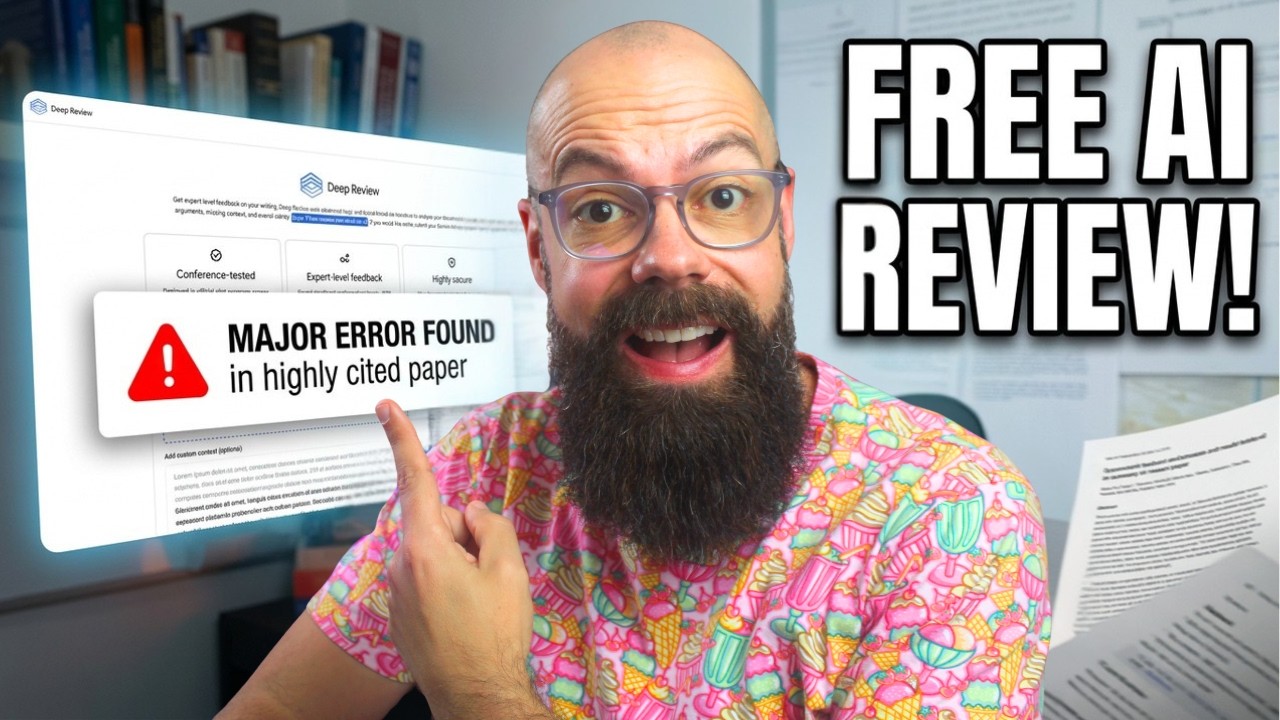
The video explores Google’s newly released AI tool, Deep Review, which offers expert-level feedback on academic papers. The presenter highlights its user-friendly interface, allowing users to upload documents easily and receive two free reviews per week, with the option to access more by providing a Gemini API key. Deep Review is praised for its security measures, including encrypted storage and data deletion after one year, addressing common concerns about data privacy in academic settings. The tool has been conference-tested and shown to identify significant mathematical errors in over 30% of theoretical papers, prompting many researchers to rerun experiments based on its feedback.
The presenter tests Deep Review by uploading one of his own previously published papers from 2015. The AI quickly identifies numerous issues, ranging from inconsistencies in data tables to repetitive phrasing and minor typographical errors. Despite some feedback being debatable, many of the critiques are accurate and valuable, demonstrating the tool’s potential to improve the quality of academic writing before submission. The presenter admits feeling embarrassed by some of the errors found but emphasizes that such detailed feedback would be beneficial for researchers, especially PhD students, to refine their work.
Next, the presenter uploads the most cited paper in history, published in 1951, to see how Deep Review handles a highly influential and well-regarded document. Despite the paper being scanned and requiring optical character recognition, the AI still manages to analyze it effectively. While the paper is mostly praised for its comprehensive study, Deep Review flags some weaknesses, including minor suggestions and a few major and even one critical issue related to the microanalysis protocol. The presenter expresses uncertainty about the validity of these flagged errors but encourages viewers knowledgeable in the field to weigh in.
Throughout the video, the presenter underscores the practical benefits of Deep Review, noting that it not only checks textual content but also examines figures and equations, which is crucial for scientific papers. The ability to add custom context when submitting a paper allows users to tailor the feedback to specific areas of concern. The presenter recommends using Deep Review as a standard part of the academic writing process, either before submission or when preparing drafts for supervisors, given its free access and the depth of its analysis.
In conclusion, Deep Review is presented as a powerful, secure, and accessible AI tool that can significantly enhance academic writing by identifying errors and suggesting improvements. The presenter encourages researchers to take advantage of the free reviews offered weekly and highlights the tool’s potential to prevent errors that might otherwise slip through peer review. Despite some limitations and occasional disagreements with the AI’s feedback, Deep Review is portrayed as a valuable resource for maintaining high standards in academic publishing.
Useful Links