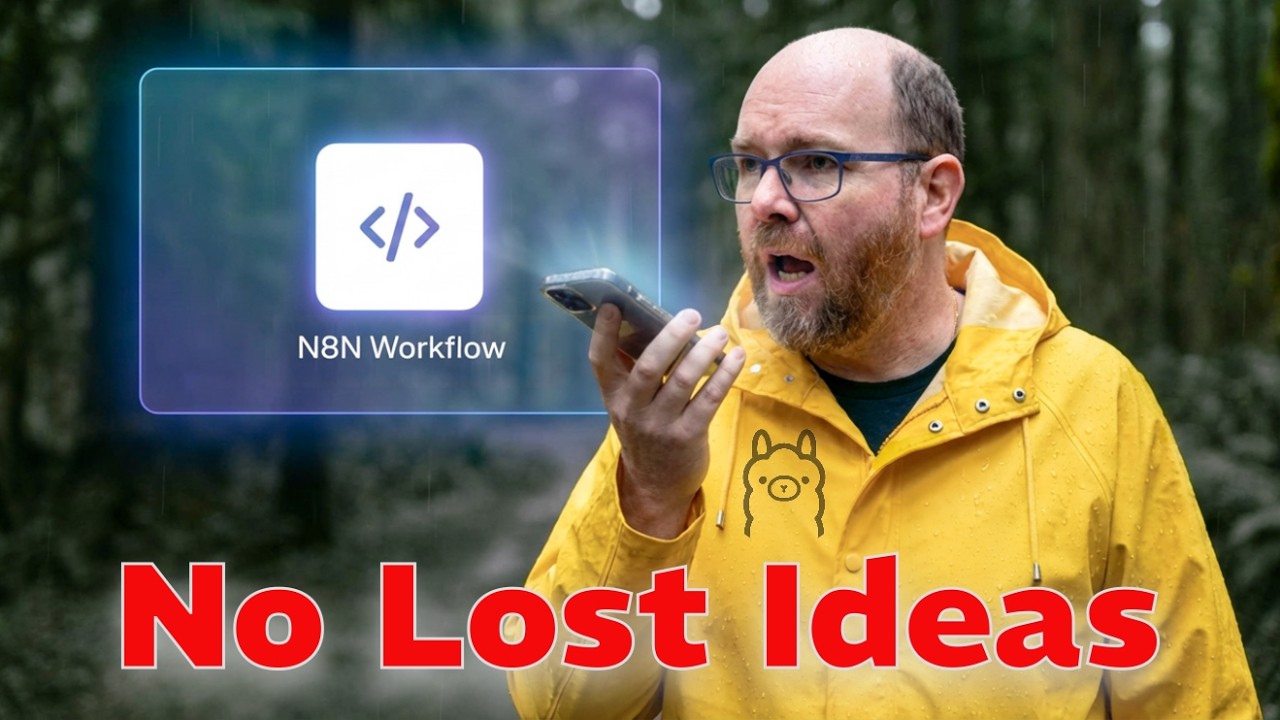
The video addresses the common problem of losing good ideas while on the go, particularly during activities like walking the dog. The creator describes the frustration of forgetting ideas before they can be captured or losing them in scattered notes. To solve this, the video demonstrates building a hands-free, reliable system for capturing voice notes with a single trigger, automatically routing them to the right place using automation and AI. The goal is to ensure every idea is securely recorded, classified, and acted upon, with minimal friction and maximum trustworthiness.
The core of the system is built using N8N, an automation platform. The workflow starts with a secure webhook that only accepts authorized requests, ensuring privacy and preventing spam. When a voice note is captured on the phone (using a shortcut triggered by a triple tap on the iPhone), it is sent as a JSON payload to the webhook with the necessary authorization. The system immediately logs the raw input in a journal (using N8N’s data tables) before any processing, ensuring that every note is auditable and recoverable if something goes wrong.
To prevent duplicate entries, the workflow checks if the same text has already been recorded, regardless of timestamp, and ignores repeats. This idempotency is crucial for reliability, especially when network issues or accidental double triggers occur. The journal records the original text, its classified intent, the extracted output, and the status at each step, providing a clear audit trail and making troubleshooting straightforward.
AI is used in two focused ways: first, to classify the intent of each note (e.g., video idea, to-do, calendar item), and second, to extract structured information from the freeform speech. The creator uses Olama Cloud for classification and a lightweight GPT model for extraction, emphasizing that the AI’s role is to label and structure the data, not to perform the automation itself. The workflow then branches based on the classified intent; in this example, video ideas are formatted and sent to Obsidian via Dropbox, with the process tracked and status updated in the journal.
The video concludes by highlighting the benefits of this approach: fast, hands-free capture; secure and durable storage; minimal reliance on AI for only the necessary steps; and a robust, maintainable automation pattern. The creator encourages viewers to adapt the pattern to their own needs, add more branches for different types of notes, and experiment with triggers and AI services. The system is designed to be trustworthy, easy to extend, and resilient to common pitfalls like duplicates and lost data.