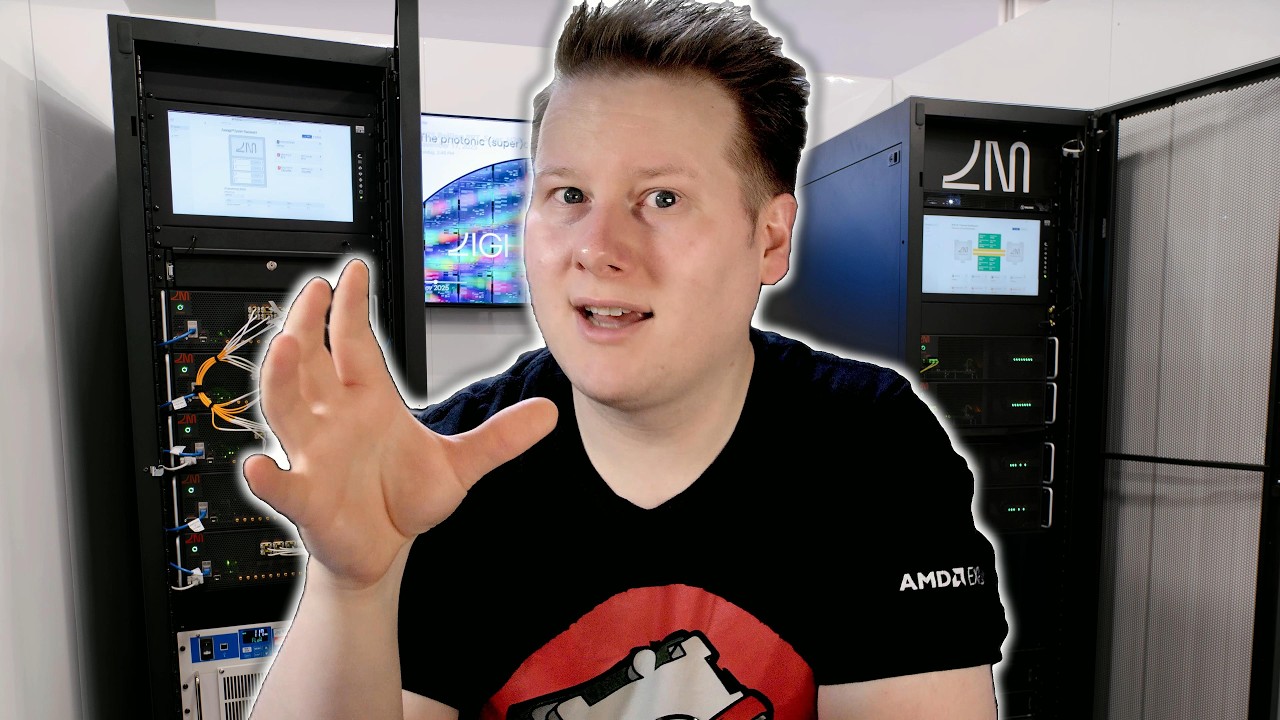
The video discusses the current state of optical chip-to-chip networking, focusing on co-packaged optics (CPO) technology and the main players in the market. The presenter highlights that while Broadcom and Nvidia have their own solutions, there are three notable startups: IR Labs, Celestial, and Lightmatter. Celestial was recently acquired by Marvell, leaving IR Labs and Lightmatter as the primary independent startups. The context for the video began at the Hot Chips conference, where the presenter noticed that, despite Lightmatter’s extensive marketing and technical discussions, they had yet to provide a public demo of their technology.
At the Hot Chips conference, the presenter publicly questioned Lightmatter about the absence of a public demo, a concern shared by many in the industry. Lightmatter responded by promising a public demonstration at the Supercomputing 2025 (SC25) conference and offered a private office demo, which the presenter was unable to attend due to scheduling conflicts. This set the stage for the much-anticipated public demo at SC25, which became the focal point of the video.
During SC25, Lightmatter showcased two live demos at their booth. The first demo, accessible to the public, featured two systems connected via two optical links running through 200 meters of cable, demonstrating a 50 Gbps optical link with a very low error rate and efficient power usage. The setup involved their optical interposer technology, which enables high-bandwidth, low-energy data transfer between chips or within a chip package. While the demo was impressive, the hardware was kept behind shelving, and visitors were not allowed to physically inspect the components.
In a private showroom, Lightmatter presented a more intricate demo with two chips connected in an all-to-all fashion, simulating the kind of connectivity required in large data centers. This demo also maintained high data rates and low error rates, with the system kept at a constant temperature using water chillers to ensure thermal stability. The presenter noted that, unlike previous demos from competitors like IR Labs, Lightmatter did not perform any public thermal stress tests (such as using a hair dryer) to further prove stability, citing concerns about static electricity and the booth environment.
The video concludes by reflecting on the challenges and future of optical interconnects in the industry. With Celestial now part of Marvell, the field is narrowing, and only a handful of large customers worldwide are likely to adopt these expensive, cutting-edge solutions. The presenter raises questions about Lightmatter’s major customers and the scalability of their technology, noting that widespread adoption is expected around 2027–2029 as manufacturing ramps up. The potential for optical interconnects to revolutionize data center architecture—by decoupling memory and compute resources—is significant, but practical deployment will depend on overcoming manufacturing, reliability, and integration hurdles.