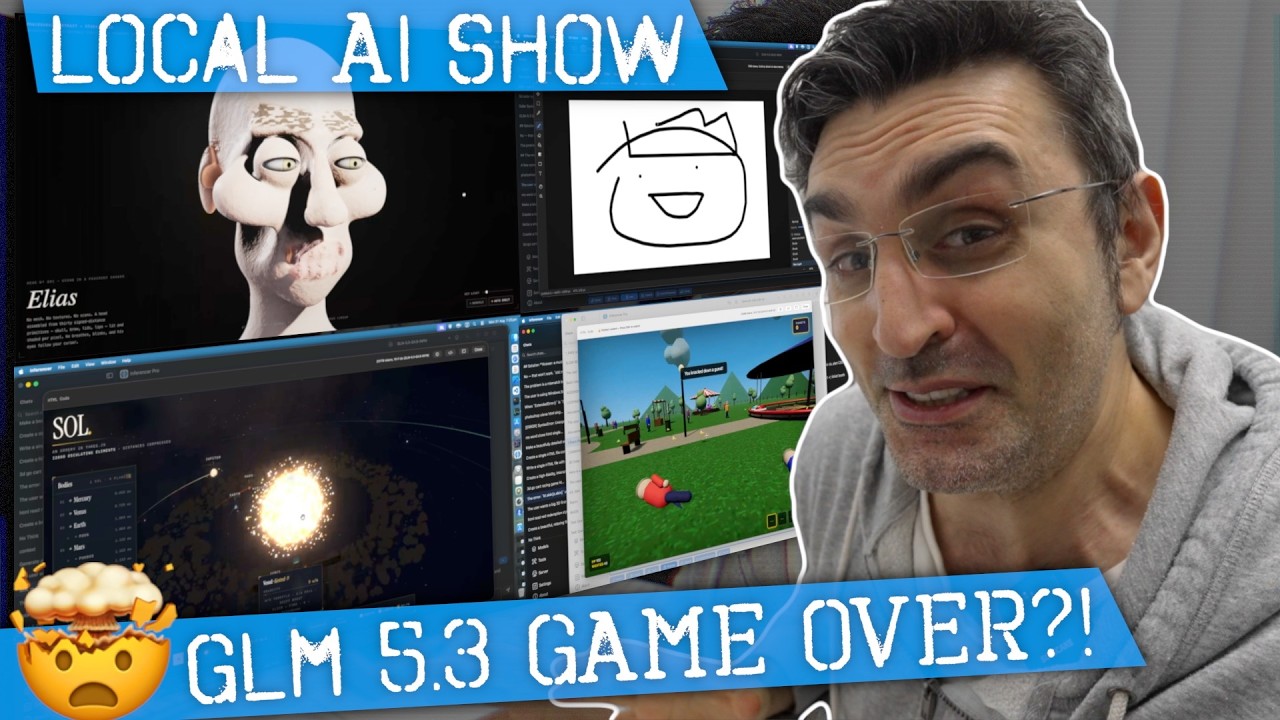
In this video, the creator explores running the GLM 5.3 large language model locally over 48 hours, highlighting its impressive capabilities and improvements over the previous GLM 5.2 version. GLM 5.3, a 700 billion parameter model, shows significant benchmark gains, outperforming much larger models like Kimmy K3 with 2.8 trillion parameters. Despite its size and slow speed, the model is accessible for local use, though it comes with a custom license mainly restricting commercial use for companies earning over $10 billion. The presenter emphasizes the model’s frontier status in local AI development and its potential for broader adoption in the near future.
The video demonstrates running GLM 5.3 in different quantization modes, primarily the standard Q4 (4-bit) and an INF edition that offers higher fidelity. The Q4 version produces decent outputs but suffers from bugs and runtime errors, such as issues when interacting with generated elements like planets or spaceships. In contrast, the INF edition delivers smoother, more interactive generations, including a detailed 3D solar system where clicking on planets zooms in properly. The presenter notes that while low thinking mode generates fewer tokens and simpler outputs, switching to high thinking mode significantly improves quality and token count, though it requires much longer runtimes.
Several creative prompts are tested, including generating a solar system with a controllable spaceship, a photorealistic human face, and an amusement park simulation. The face generation is described as eerie and zombie-like, reflecting the AI’s unique interpretation of humanity. The amusement park demo shows interactive elements but also some bugs, such as reversed controls and limited character interactions. The presenter compares these results with GLM 5.2, noting that while 5.2 still performs well, especially in non-thinking mode, 5.3 offers more advanced and complex generation capabilities, particularly when using high thinking mode.
The video also explores GLM 5.3’s coding abilities through programming questions in various languages like WinRT, Swift, C++, and math problems. The model’s accuracy depends heavily on the quantization used; the INF edition with high thinking mode provides more correct and detailed answers, while the Q4 quantization sometimes fails or gives incomplete responses. The presenter advises users to carefully choose quantization settings to balance performance and accuracy, recommending smaller models at higher quantization over aggressive quantization for better results.
Overall, the video showcases GLM 5.3 as a powerful and promising local AI model that rivals larger commercial models, with impressive generation quality and interactivity. Despite some bugs and slow processing times, the ability to run such a frontier model locally is seen as liberating and exciting for AI enthusiasts. The presenter hints at future experiments with max thinking mode and distributed setups to further enhance performance and fidelity. The video closes on a playful note, highlighting the model’s creative outputs like blowing up the sun and its quirky view of humans as zombies, underscoring the evolving frontier of local AI technology.