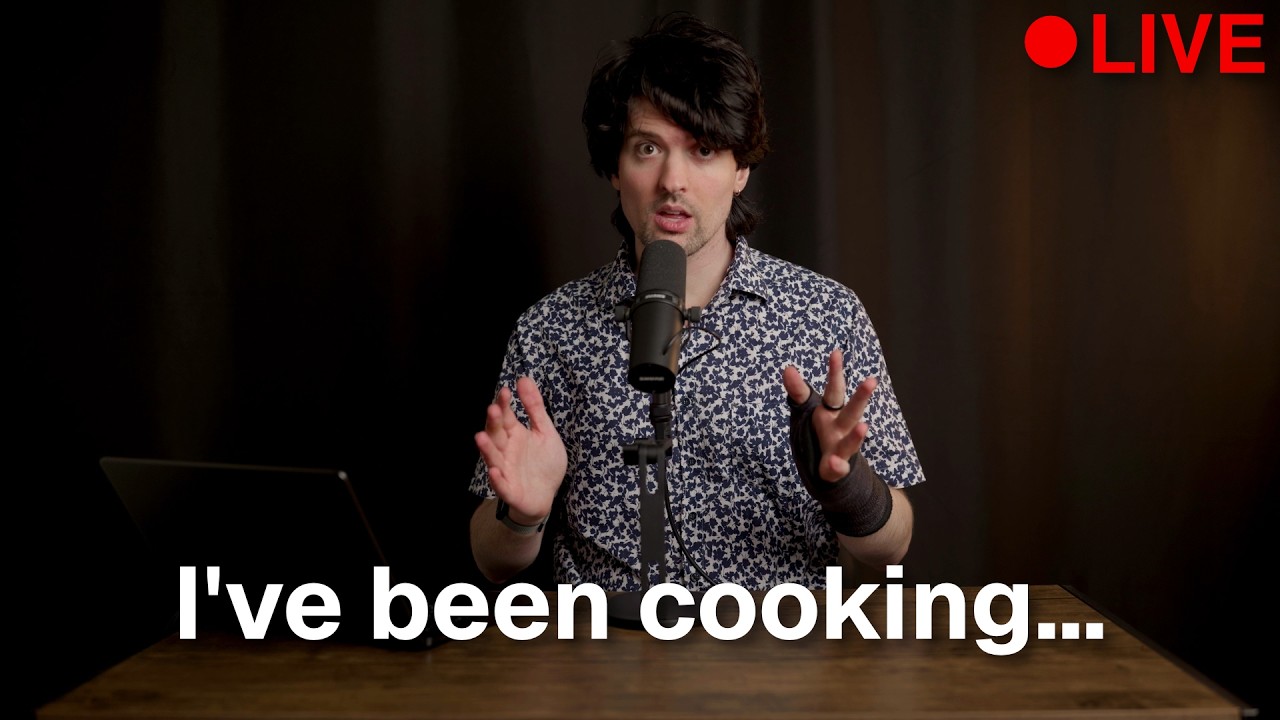
The video begins with the creator discussing the challenges faced while going live due to identity verification issues with a new phone and technical difficulties with streaming platforms like YouTube and Twitch. Despite these setbacks, the creator expresses excitement about recent developments, including updates on Anthropic’s SDK and the Duo device, and shares personal experiences with the Samsung ZFold 8 phone. The stream also touches on various tech topics, community interactions, and the creator’s ongoing work with T3 code, an open-source agentic development environment (ADE) designed to integrate multiple AI harnesses and tools seamlessly.
A significant portion of the video is dedicated to explaining the concept of AI harnesses versus interfaces. The creator clarifies that a harness is a system that provides language models (LLMs) with tools and syntax to perform actions beyond generating text, likening it to a kitchen equipped with utensils for a chef. Interfaces, on the other hand, are the user-facing applications that interact with these harnesses. T3 code is described as an interface that connects humans to various harnesses, enabling multi-harness management and advanced features like spawning sub-agents and accessing external data through MCPs (multi-channel protocols). This distinction aims to clear up common confusion in the AI developer community.
The creator then delves into the evolution of developer focus over time, highlighting how engineers tend to care deeply about layers of technology that are becoming obsolete due to advancing abstractions and AI capabilities. Using analogies from skateboarding and programming, the video emphasizes the importance of adaptability and the willingness to move beyond entrenched preferences, such as specific programming languages or tools. The creator stresses that harnesses, once a hot topic, are becoming less critical as AI models and tools mature and integrate more tightly, making the choice of harness less relevant to end users.
A major highlight is the creator’s experiment with using AI agents to improve the UI design of T3 code through a process called hill climbing. By leveraging multiple AI models as reviewers (the “council”), the system iteratively refines the UI until it achieves high scores across various design criteria. This process, which cost around $250-$400 in API usage, resulted in a significantly improved and more consistent user interface that rivals or surpasses competing AI development environments. The creator shares insights into the technical setup, challenges faced, and the surprising effectiveness of this AI-driven design optimization approach.
Towards the end, the creator reflects on the broader implications of these advancements, emphasizing the shift from manual, human-driven development to AI-assisted workflows that can evaluate and improve themselves. They discuss ongoing work to optimize T3 code’s MCP descriptions and tool implementations, reducing token usage and improving efficiency. The video concludes with a candid discussion about the challenges of maintaining complex AI systems, the importance of continuous innovation to stay ahead, and a call to the community to embrace these new paradigms while acknowledging the creator’s personal journey and commitment to pushing the boundaries of AI development tools.