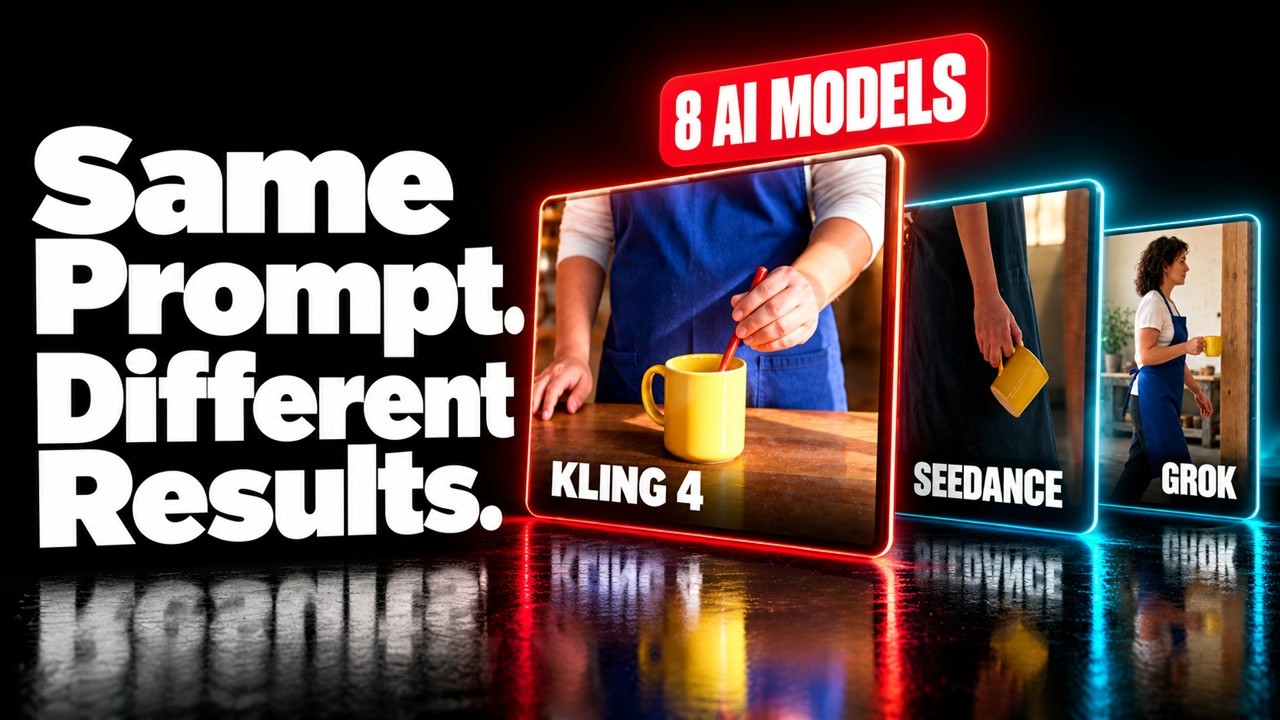
In this video, the creator tests eight different AI video models by giving them the same detailed prompt: a continuous 10-second live-action shot of a potter in a sunlit studio carrying a yellow mug, walking behind a wooden post, placing the mug on a table, and then using their left hand to put a red spoon into the mug. The evaluation focuses on three main criteria—action order, prop continuity, and composition—rather than just image polish. Each model generated a single take using the Higsfield platform, with no retries, allowing for a direct comparison of how well each followed the prompt’s instructions.
Among the eight models, Cling 4.0, Seed Dance 2.5, and Seed Dance 2.0 successfully executed the requested sequence, maintaining the correct action order and prop continuity. Cling 4.0 was the creator’s top pick because it preserved the specified colors—blue apron, yellow mug, and red spoon—most accurately, despite cropping out the potter’s head. Seed Dance 2.5 offered a cinematic, warm lighting but darkened the apron to a nearly black navy, while Seed Dance 2.0 showed a wider framing initially but rendered the apron in a desaturated teal, highlighting trade-offs between framing, lighting, and color fidelity.
Other models faltered in subtle ways that affected usability. Grock Imagine 1.5 provided the best framing by showing the potter’s face but failed the continuity test by having the potter walk in front of the wooden post, thus never hiding the mug and avoiding the challenge of maintaining prop consistency. Additionally, Grock and several other models like Flux 3 and Gemini Omni Flash 1.1 reused the same hand to carry the mug and insert the spoon, contrary to the prompt’s instructions to use the left hand for the spoon, revealing a common shortcut that breaks the intended choreography.
Miniax H3 got the hand usage correct but failed on timing, as the potter’s right hand still held the mug’s handle while the left hand inserted the spoon, violating the prompt’s requirement to fully release the handle first. Juan 3.0 stood out for its cinematic lighting and tactile ceramic surfaces and followed the action sequence well, but it introduced an extra red spoon on the workbench and showed a heavily marked apron instead of the clean blue one requested. These deviations illustrate how visual polish can mask continuity errors or unmet instructions, emphasizing the importance of checking specific editorial needs beyond surface quality.
Ultimately, the video concludes that Cling 4.0 is the best fit for this particular continuous pottery shot due to its faithful adherence to the action sequence and color accuracy, despite its tight cropping. However, if a wider framing showing the potter’s face is essential, Grock Imagine 1.5 is a viable alternative, provided the editor can accept its continuity compromises. The creator encourages viewers to test these models themselves on Higsfield and highlights that choosing the right AI video model depends on the specific requirements of the scene rather than just image aesthetics.
Useful Links